

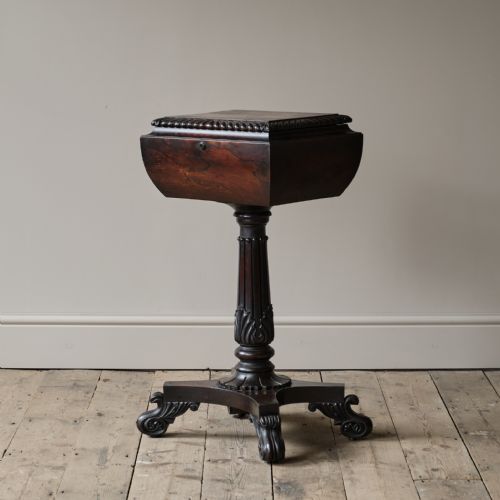


Wooden Tea Caddy Stand
These wooden tea caddy stand pieces, often known as teapoys, are sophisticated household containers designed to hold valuable tea leaves safely in period drawing rooms.
Wooden Tea Caddy Stand
A wooden tea caddy stand is typically encountered as a decorative box on a pedestal or four carved feet, designed to store dry tea when the beverage was a costly luxury. You will mostly find these pieces dating from the Georgian, Regency, and Victorian eras, taking the form of sarcophagus-shaped boxes, chests, and occasional tables.
The objects listed here span several decades of the nineteenth century, including specific design iterations such as tea stoves, jardiniere hybrids, and classical teapoys. Mahogany, rosewood, and walnut form the primary corpus of these pieces, reflecting the favoured timber choices of nineteenth-century cabinet makers.
Makers and workshops of the period produced these stands in various regional interpretations, including Scottish examples alongside English designs stamped or attributed to Gillows. The internal fittings originally designed for tea canisters frequently adapt well to modern household uses.
Materials and construction
Cabinet makers utilised dense hardwoods such as mahogany, flame mahogany, rosewood, and burr walnut, often selecting figured veneers to create striking lid and panel surfaces. Solid mahogany served structural components like legs and feet, while brass inlay provided crisp linear decoration on Regency examples.
Joinery techniques combined precision box construction for the storage compartment with robust turning for central pillars and pedestal bases. Steel elements occasionally reinforced internal mechanisms, and carved details on feet or pedestals required skilled hand chiselling.
Wooden Tea Caddy Stand Retail Price Guide 2026
Typical asking prices for wooden tea caddy stand among the pieces listed under this phrase on Sellingantiques today, from the lower quarter to the upper quarter. They describe what is for sale here now, not the wider market.
Some nineteenth-century hosts kept the tea locked up tight because servants had a habit of pilfering the expensive leaves.
Judging quality in tea caddy stands
Quality rests upon the selection of timber veneers and the crispness of carved details on the feet and pillar, where finer workshops achieved sharper relief. The integrity of the internal compartments and the survival of original brass mounts or inlay distinguish superior examples from standard production pieces.
Attribution to documented makers such as Gillows elevates certain pieces through superior construction standards and refined proportions. The coherence of the design between the upper box and the supporting stand dictates the overall visual success of the piece.
Gillows
The Wooden Tea Caddy Stand Glossary
- Teapoy
- A small stand or table equipped with a lidded box for storing tea leaves. The term derives from the Hindi word for three feet, though many later examples stand on pedestals or four feet.
- Sarcophagus
- A box shape featuring a convex or gabled lid and sloping sides, resembling a classical stone coffin. This silhouette was particularly popular for Regency tea containers.
- Flame mahogany
- Timber cut from the fork of the mahogany tree where the branch meets the trunk, producing a distinctive flickering flame pattern. Cabinet makers used these veneers on primary display surfaces.
- Jardiniere
- A decorative container for holding plants or flowers. Certain nineteenth-century variants share forms with tea caddies, sometimes serving dual or converted functions.
- Brass inlay
- Technique involving the precise insertion of thin brass strips into routed channels within the wood surface. This decoration defines many Regency pieces.
Wooden Tea Caddy Stand: Frequently Asked Questions
What is a wooden tea caddy stand used for?
These pieces served as secure, lockable containers for storing expensive black and green teas in the nineteenth-century drawing room. Servants typically brought the stand into the room so the lady of the house could measure the leaves herself.
Today, collectors use them as decorative accent pieces, jewellery boxes, or occasional tables in living spaces. Their internal compartments make them practical for organising small personal items.
How do I tell a Regency tea stand from a Victorian one?
Regency examples often feature architectural brass inlay, sarcophagus shapes, and rosewood or mahogany timbers influenced by classical design. They date roughly from the early decades of the nineteenth century.
Victorian pieces tend to utilise oak, walnut, or heavy mahogany with more robust carvings and different proportions. The turnings on the pedestals and the style of the feet usually reflect the heavier aesthetic of the later nineteenth century.
Are the tea canisters usually inside?
Most surviving stands have lost their original internal caddies, mixing bowls, or glass basins over the intervening centuries. Surviving internal fittings represent a notable bonus for collectors.
When fitted interiors do survive, they typically consist of small lidded wooden boxes or metal containers designed to keep different tea varieties separate.
How should I care for a rosewood tea stand?
Keep the wood away from direct sunlight and heat sources to prevent the fine veneers from drying out and lifting. Regular dusting with a soft, dry cloth maintains the polished surface without chemical buildup.
Apply a microcrystalline wax sparingly if the timber appears dry, buffing gently with a clean cloth. Avoid placing wet items on the top surface to protect the historical finish.