


Wooden Revolving Bookcase
A wooden revolving bookcase brings neat, accessible book storage to a corner, pairing smooth turning action with period timber.
Wooden Revolving Bookcase
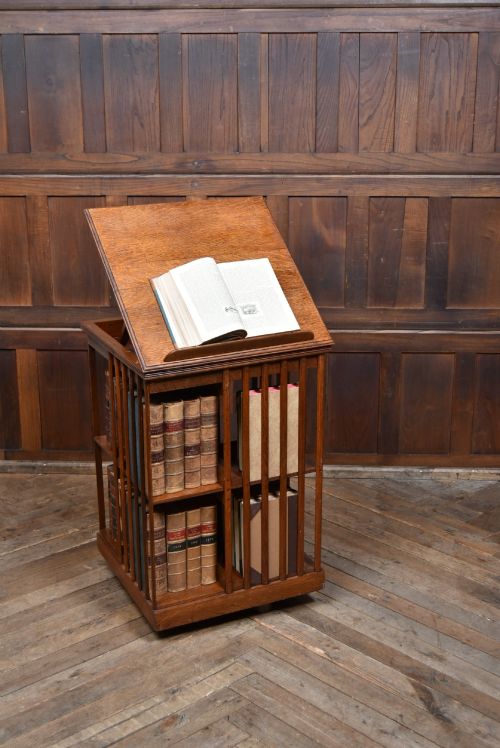
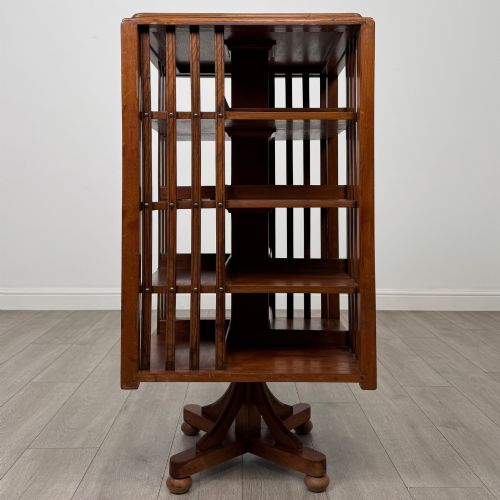
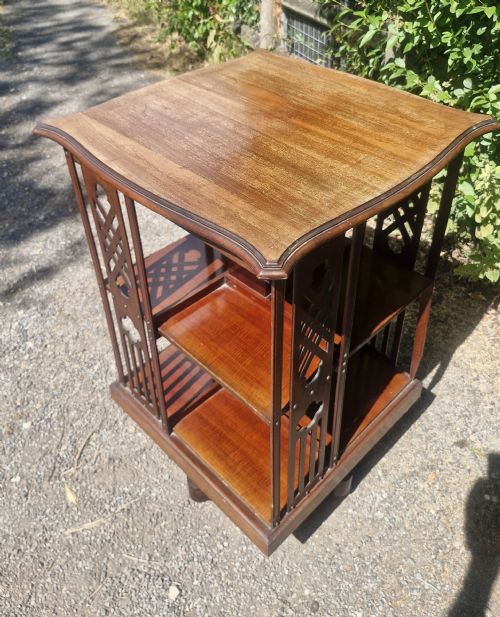
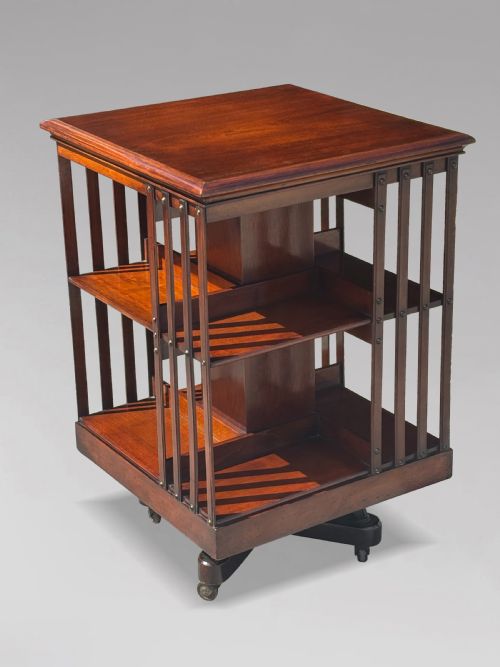
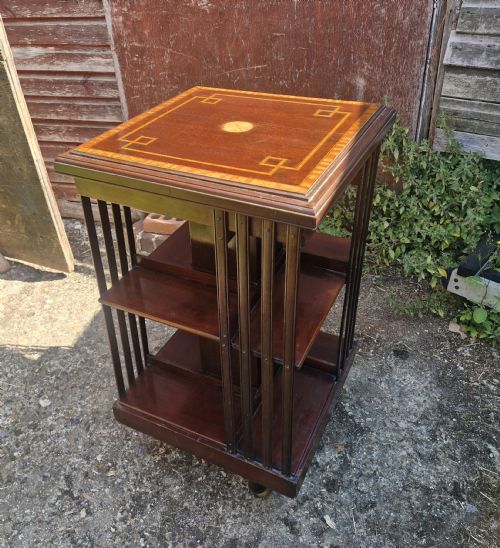
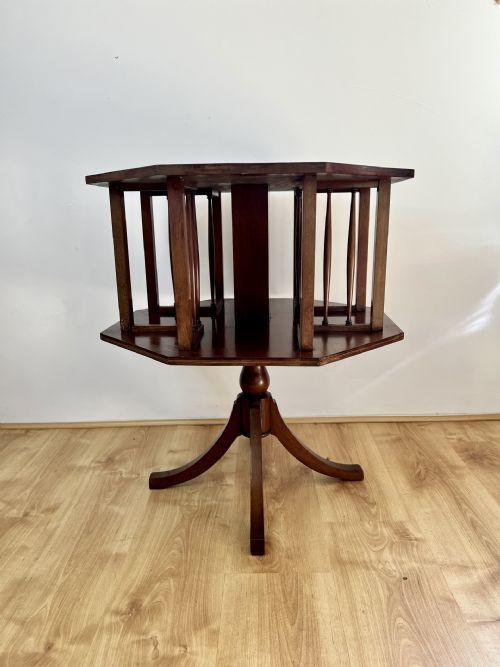
A wooden revolving bookcase is a rotating shelf unit designed to hold volumes upright while allowing access from any angle. The pieces found here span the 19th Century, Victorian, Edwardian, and 1930 periods, taking the form of bookcases, book stands, and open square shelves.
You are most likely to meet Edwardian and Victorian examples on this page, particularly in mahogany or oak. Formats range from petite French models and circular oak tiers to larger inlaid designs and Anglo-Indian variants.
These items serve as functional furniture for studies and sitting rooms, offering compact storage where floor space is limited. Their revolving mechanism allows a collection of books to sit within arm's reach beside a desk or armchair.
How they were made
Cabinet makers utilised solid timbers and veneers such as mahogany, oak, walnut, and satinwood to construct the bodies and tiers. Inlays were applied to surfaces to introduce contrasting border lines or decorative motifs.
Internal rotation relies on hidden mechanisms incorporating cast iron, brass, and metal components. These allow the heavy wooden tiers to turn smoothly on a fixed central base without wobbling.
Listings feature woods such as mahogany, oak, walnut, and satinwood paired with metal and brass hardware.
What varies in quality
The standard of timber selection and complexity of surface decoration separate standard examples from finer ones. Simple oak or mahogany tiers sit at one end, while pieces featuring satinwood inlay or unusual woods such as walnut occupy another.
The engineering of the revolving mechanism dictates the smoothness and stability of the turn. Heavier, larger frames require robust internal hardware to maintain balance across all loaded shelves.
Maple and Co
The Wooden Revolving Bookcase Glossary
- Edwardian
- Dating from the reign of King Edward VII, typically spanning the early years of the twentieth century. Furniture from this era often lighter in proportion than Victorian pieces.
- Victorian
- Spanning the reign of Queen Victoria during the nineteenth century, encompassing diverse stylistic revivals. Pieces from this period frequently employ dense mahogany and robust construction.
- Inlay
- A technique where pieces of contrasting wood like satinwood are inserted into the primary timber surface to form patterns. This decorative method is common on Edwardian desks and bookcases.
- Satinwood
- A durable, lustrous yellowish timber native to India and Sri Lanka, valued for its fine grain. It is often utilised for banding and detailed inlay work.
Wooden Revolving Bookcase: Frequently Asked Questions
How do revolving bookcases work?
A concealed internal pivot mechanism of metal or brass lets the upper tiers spin independently from the base. This allows users to access different shelves without moving the main structure.
The weight of the books helps steady the rotation, keeping the motion balanced when turned from side to side.
Are these bookcases sturdy enough for heavy books?
Most antique versions are constructed from dense hardwoods like mahogany or oak, giving them natural structural strength. Their wide base helps prevent tipping when the shelves are loaded.
Larger variants distribute weight across reinforced internal framing designed to handle heavy volumes without straining the rotating pivot.
Where should I place a revolving bookcase?
They suit corners or open floor spaces beside seating areas where access from multiple angles is practical. Their compact footprint makes them useful in studies or libraries with limited wall space.
Because all four sides hold books, placing them away from walls lets you utilise every tier fully.
How do I identify an Edwardian revolving bookcase?
Edwardian examples often feature lighter timber tones, refined proportions, and delicate satinwood inlay work. They date from the early twentieth century and frequently utilise mahogany or walnut.
Construction details tend to be sleeker than heavier Victorian models, reflecting the changing interior tastes of the period.