


Vintage Rotating Shelf
A vintage rotating shelf gives you instant access to a growing library from a single comfortable seat.
Vintage Rotating Shelf
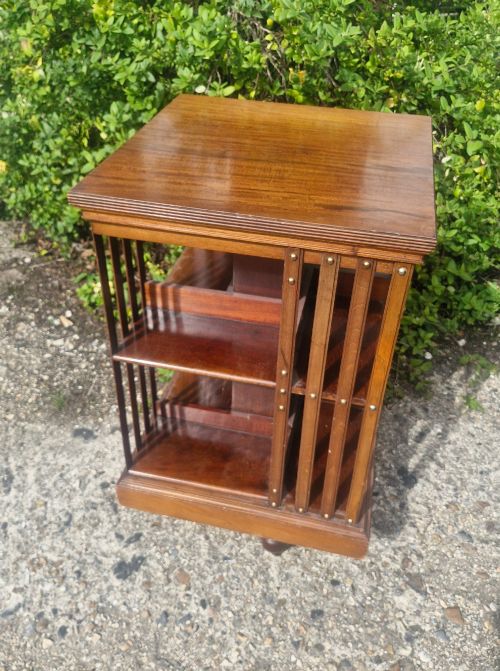
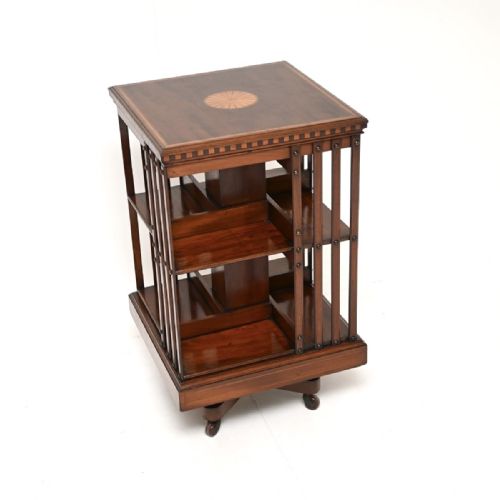
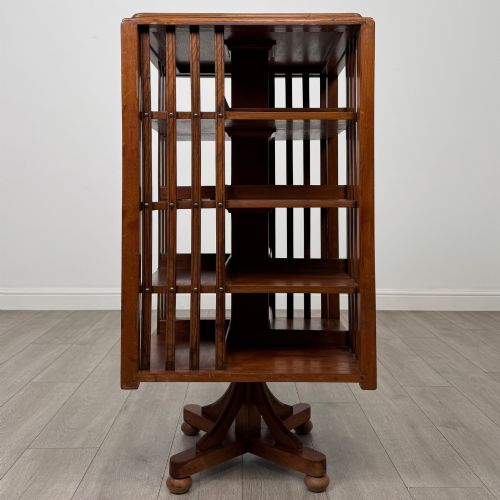
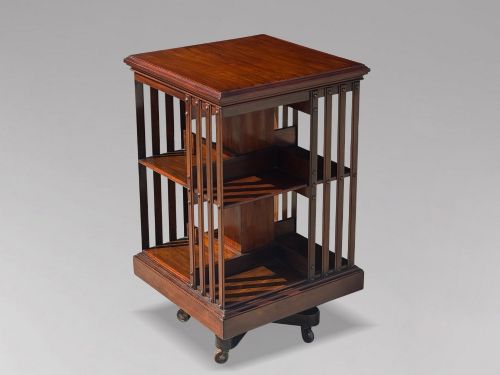
A vintage rotating shelf primarily takes the form of a revolving bookcase designed to sit on a floor or table and turn smoothly on a hidden mechanism. These pieces span the Victorian, Edwardian, and early twentieth-century periods, bringing practical book storage into domestic studies and living rooms.
You will most frequently meet mahogany examples from the Edwardian and late Victorian eras, often featuring crossbanding or satinwood inlay alongside slatted or open sides. Oak versions also appear, alongside occasional petite French provincial interpretations and circular multi-tier designs.
Each piece balances solid timber construction with functional engineering, allowing several shelves of books to spin within a compact footprint. Buyers seek them out for their combination of traditional cabinet-making and everyday utility in a modern home.
How they were made
Cabinet-makers relied heavily on rich timbers such as mahogany and oak, frequently selecting figured grain for top surfaces and incorporating satinwood stringing for subtle contrast. Brass components often reinforced the revolving mechanisms and castors, ensuring the tiers turned smoothly under a heavy load of books.
Construction techniques combined sturdy joinery with slatted or panelled uprights to support the weight of multiple shelves without warping. Iron and cast metal internal hardware provided the central pivot upon which the entire superstructure balanced and rotated.
A good revolving bookcase lets you spin an entire library with one finger while hunting for a misplaced novel.
What varies in quality
Quality rests heavily on the choice of timber and the crispness of any inlay work, where finely figured mahogany and neat satinwood banding elevate a piece beyond standard production. The engineering of the internal revolving mechanism dictates how silently and evenly the shelves turn.
Proportions also separate standard examples from finer ones, with superior items displaying balanced tiers, sound joints, and well-turned spindles that retain their structural integrity over decades of use.
The Vintage Rotating Shelf Glossary
- Revolving bookcase
- A freestanding set of shelves built upon a concealed turntable base that allows the entire unit to spin 360 degrees. This design maximises book storage in tight corners.
- Inlay
- A decorative technique where contrasting woods like satinwood are inserted into recesses in the primary timber. It creates crisp linear patterns across tabletops and friezes.
- Crossbanding
- A border of veneer laid with the grain running perpendicular to the main surface. This frames the top panel of a revolving bookcase with a neat contrasting edge.
- Edwardian
- The architectural and decorative style spanning the reign of King Edward VII up to the First World War. Pieces from this period often display lighter proportions and refined classical details.
Vintage Rotating Shelf: Frequently Asked Questions
Where should I place a revolving bookcase?
These pieces sit comfortably beside a favourite armchair or desk where books need to remain within arm's reach. Their ability to turn means you can access an entire library from a single stationary position.
Ensure there is enough clearance on all sides for the tiers to spin freely without striking walls or surrounding furniture.
How do I care for the rotating mechanism?
The internal pivot benefits from occasional light cleaning and appropriate lubrication if the rotation begins to feel stiff. Keeping dust out of the central bearing prevents the mechanism from binding over time.
Avoid overloading individual tiers beyond their balanced capacity to protect the central vertical axis from undue strain.
How do I date a mahogany revolving piece?
Late Victorian and Edwardian examples often display specific stylistic markers, such as satinwood inlay, slatted sides, or particular turning styles on the corner posts. Comparing the timber selection and joinery helps place the piece within its historical decade.
Heavier cast iron mechanisms frequently point towards nineteenth-century production, while lighter frames align with early twentieth-century manufacturing.
Can these shelves hold heavy volumes?
Traditional wooden revolving bookcases were built to support standard rows of bound literature and reference books. The internal framework distributes weight across a central pivot designed for domestic library use.
Distributing heavier books evenly across opposite sides maintains smooth rotation and prevents the unit from listing to one side.