
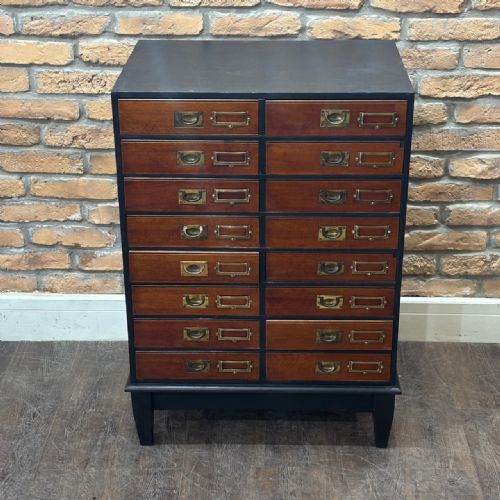
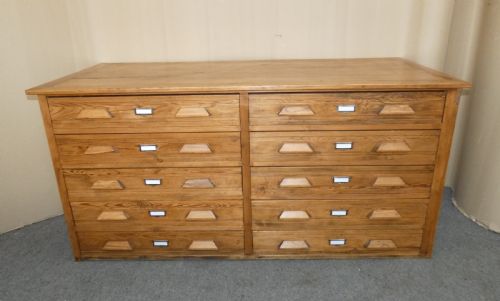
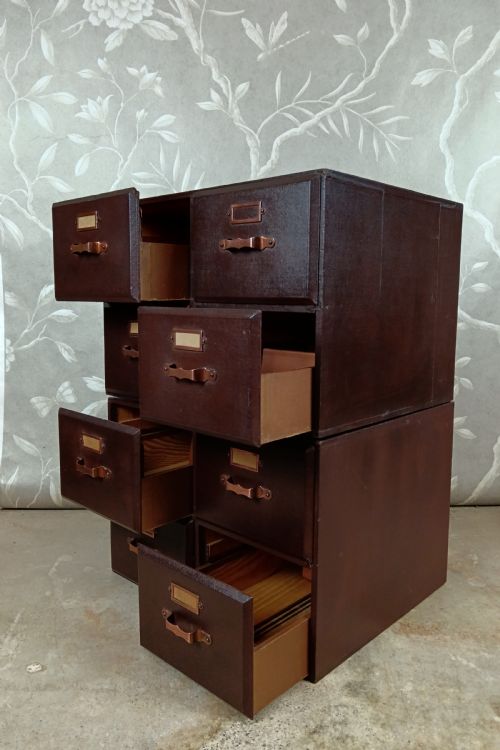


Wooden Index Card Cabinet
A wooden index card cabinet organises small papers with durable charm, bringing authentic period utility straight to your desk.
Wooden Index Card Cabinet
A wooden index card cabinet serves as a compact storage unit designed for systematic organisation of records, notes, and cards. You are most likely to encounter Edwardian examples alongside pieces from the 1920s and early twentieth century office traditions.
Forms on this page range from desktop filing drawers and banks of drawers to dedicated library card filing sets and patent letter files. Oak and mahogany are the dominant timbers, accompanied by occasional pine, beech, walnut, and painted wood.
The aesthetic bridges domestic furniture and commercial utility, drawing on Edwardian, Victorian utility, and industrial commercial styles. These pieces range from multi-drawer filing units to large sixty-six drawer office cabinets.
Construction and materials
Workshop construction relies on sturdy hardwoods like oak and mahogany, often paired with secondary woods such as pine and beech for internal framing. Cabinet makers joined drawer boxes with tight joints to withstand daily commercial retrieval.
Listings span from the nineteenth century through the 1960s, featuring oak, mahogany, pine, walnut, and beech alongside brass and metal hardware.
Judging quality and character
Quality rests in the precision of the drawer joinery and the integrity of the original brass pulls and label holders. Superior examples retain their patented filing mechanisms and smooth running drawers without excessive timber shrinkage.
The choice of timber creates a distinct hierarchy, with richly figured mahogany and quarter-sawn oak sitting above simpler pine or painted utility builds. Original hardware and maker markings elevate an ordinary office box into a notable archive piece.
Amberg·Shannon
The Wooden Index Card Cabinet Glossary
- Index card cabinet
- A small-format multi-drawer chest built specifically to house standard reference cards or letters. These units were staples of early twentieth century office organisation.
- Patent letter file
- A specialised filing container incorporating a mechanical pressing or indexing device to secure documents. Amberg's patent units represent a specific version of this mechanism.
- Bank of drawers
- An assemblage of numerous small drawers arranged in a grid for sorting vast quantities of flat items. They are frequently found in commercial, library, and workshop settings.
- Edwardian
- The architectural and decorative style spanning the reign of King Edward VII up to the First World War. Pieces from this period often display refined proportions and neat brass furniture.
Wooden Index Card Cabinet: Frequently Asked Questions
What fits inside these drawers?
These cabinets were built to hold standard index cards, small reference notes, and folded correspondence letters. The shallow multi-drawer layout keeps loose paper flat and sorted.
Larger configurations accommodate cataloguing slips or A4-sized sheets depending on the specific filing format the unit was manufactured to serve.
How do I date a cabinet?
Dating relies on observing timber choices, handle styles, and construction techniques relative to known periods. Edwardian and 1920s pieces often feature distinct brass label holders and solid oak or mahogany construction.
Patent inscriptions or maker stamps on the drawer fronts or internal mechanisms provide the most precise chronological markers.
Where were they used?
Cabinet makers supplied these units to professional offices, libraries, counting houses, and commercial businesses. They kept vast quantities of customer records and reference data readily accessible.
Later utility variations served in industrial workshops and artist studios for sorting small components or tools.
How do I care for the wood?
Maintain the timber by keeping the cabinet away from direct heat sources and sudden humidity shifts. Regular dusting preserves the dry-scraped or polished surfaces without risking moisture damage.
Apply a microcrystalline wax sparingly if the wood appears dry, rubbing gently with the grain to protect the antique finish.