
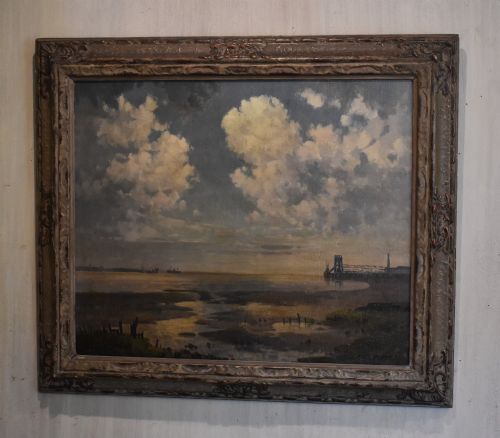


Wooden Framed Coastal Painting
A wooden framed coastal painting captures the pull of the sea through brush and canvas, bringing light and harbour air straight into a room.
Wooden Framed Coastal Painting
A wooden framed coastal painting brings together maritime scenes, harbours and shorelines set within wooden boundaries. When searching for a wooden framed coastal painting, buyers encounter works spanning from the early nineteenth century through to the mid twentieth century.
The selection on this page ranges across Victorian marine art, British impressionism, post-impressionism and English folk art. Common formats include oil on canvas and watercolour paintings, alongside dimensional shadow box shell dioramas.
Origins stretch from British and Welsh coastal views to French ports and Dutch waterways. Alongside traditional paintings, the selection occasionally holds unexpected forms such as art nouveau settees linked by name to literary coastal themes.
Materials and methods
Makers applied oil paint or watercolour onto canvas and paper substrates to capture shifting light over water. Canvases are frequently stretched over wooden supports and enclosed within wood frames, sometimes retaining gilt finishes.
Folk art pieces incorporate gathered natural elements such as shells arranged within glazed shadow boxes. Frames vary from simple wooden mouldings to elaborate period surrounds that complement the marine subject matter.
Regional styles represented include British Impressionism, Victorian Marine Art and English Folk Art.
Markers of distinction
Quality rests in the handling of light and atmosphere by the artist, distinguishing spirited impressionist brushwork from rigid or formulaic illustration. The cohesion between the painting and its original wooden frame also elevates a piece.
Works carrying documented provenance or attribution to established regional painters hold greater weight for collectors. The preservation of the canvas, paint surface and framing materials determines the overall integrity of the piece.
Clive Browne·Edward Matthew Elliott·Raymond Picque·William Lee Hankey·Gustave De Bréanski·Robert Macaulay Stevenson·Ernst Louizor·Charles McAuley
The Wooden Framed Coastal Painting Glossary
- Oil on canvas
- Pigments bound in a drying oil applied to a woven fabric stretched across a wooden frame. This method allows for rich texture and deep colour blending.
- Shadow box
- A deep, glass-fronted wooden box used to display three-dimensional arrangements such as shell dioramas. It protects delicate natural specimens from dust and damage.
- Impressionism
- An art style focused on accurate depiction of light in its changing qualities, often painted outdoors. Artists use visible brush strokes to capture the immediate visual impression.
- Marine art
- Depictions of ships, seascapes and coastal scenes. This genre encompasses historical naval battles, working harbour views and quiet shorelines.
Wooden Framed Coastal Painting: Frequently Asked Questions
How do I date an old coastal painting?
Dating relies on stylistic clues, the type of canvas or stretcher used, and the construction of the wooden frame. Hand-mixed pigments and framing techniques often point to specific decades or centuries.
Signatures, exhibition labels, and written inscriptions on the reverse provide further historical context to help narrow down the period of creation.
Where should I hang a coastal painting?
These works suit spaces that benefit from natural light, such as living rooms, hallways, or studies. Pairing them with neutral walls allows the marine colours and wooden frames to stand out.
Avoid placing paintings in areas subject to direct sunlight or high humidity, which can damage canvas and wood over time.
What is the difference between oils and watercolours?
Oils use slow-drying paint suspended in oil, allowing for thick impasto marks and deep, luminous colour depth. Watercolours use water-soluble pigments on paper, resulting in a lighter, more transparent finish.
Watercolour paintings require protective glass framing to prevent moisture damage, whereas oil on canvas can remain unglazed.
Are all these paintings British?
While many pieces depict British and Welsh shores, the selection includes continental European scenes from France and the Netherlands, as well as Haitian impressionist works.
Makers and subjects span various geographical locations, reflecting diverse regional approaches to capturing maritime life.