


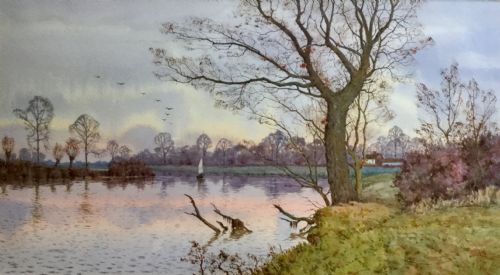
Winter Landscape Watercolour Painting
These winter landscape watercolour painting works capture the chill of snow and frost through fluid pigment on paper, prized by collectors for their atmospheric depth.
Winter Landscape Watercolour Painting
A winter landscape watercolour painting depicts snowy fields, frost-bound villages, and freezing skies through transparent washes of pigment on paper. These works capture the stillness and quiet tones of the colder months across various British and European schools.
The pieces on this page span from the late nineteenth century through to the mid-twentieth century, encompassing periods such as the Edwardian era, the nineteen-twenties, and the nineteen-fifties. Common forms include framed original artworks, fine art paintings, and intimate pastoral studies.
Makers and artists working in styles like British Impressionism, French Impressionism, and Scottish Impressionist traditions frequently turned to snow scenes to explore pale light and muted colour. Buyers encounter framed watercolours complemented by gouache, ink, wood, and gilt mounts.
Materials and construction
These works are executed primarily in watercolour pigment and gouache on paper support, often framed behind glass within wooden or gilt surrounds. Artists applied fluid washes of water-soluble pigment to create pale skies and snow-covered terrain.
Mid-century and earlier twentieth-century pieces sometimes incorporate pastel or ink alongside watercolour to build texture in winter trees, farmsteads, and snowdrifts. Framing typically relies on timber mouldings and protective glass to preserve the delicate paper beneath.
Listings feature works created across eight different decades, stretching from the eighteen-nineties to the nineteen-sixties.
Assessing quality and execution
The distinction between ordinary and exceptional works rests on the artist's handling of light and negative space to convey freezing conditions. Superior pieces use the bare white of the paper effectively to represent snow without relying on heavy opaque paint.
Compositional strength and atmospheric resonance separate masterworks from simple topographical records. Stronger examples display confident brushwork and tonal balance that evoke the true stillness of a winter day.
Gaston Cornil·Fred Lawson·Ernest Uden·William Tatton Winter·A. Winter Shaw·George Graham·Emily M. Paterson·Eveline Lance·Matthew Hale·Angus Rands·Arthur Anderson Fraser·Mahler·Maurice Long
The Winter Landscape Watercolour Painting Glossary
- Watercolour
- A paint consisting of a solution of colour in water, applied in translucent washes to paper. It allows light to reflect from the paper surface through the pigment layers.
- Gouache
- An opaque water-based paint that includes a white pigment filler, creating heavier, solid strokes. Artists use it alongside watercolour to add highlights of snow and dense cloud cover.
- Impressionism
- An art movement focusing on transient effects of light and atmosphere rather than precise detail. British and French practitioners applied this approach to winter scenes.
- Gilt
- A thin layer of gold leaf or gold-coloured paint applied to wood. It forms the decorative finish on many traditional picture frames.
- Pastel
- A dry drawing medium composed of powdered pigment and a binder. It appears in some mixed-media winter landscape works on paper.
Winter Landscape Watercolour Painting: Frequently Asked Questions
How do I care for a winter landscape watercolour painting?
Keep watercolours away from direct sunlight to prevent the pigments and paper from fading over time. Ensure the framing remains sealed to protect the paper from humidity and dust.
Display the artwork on interior walls where temperature and light levels stay relatively constant. Professional framing with UV-filtering glass offers the best protection for vintage paper.
What periods do these winter paintings come from?
The listings span from the late nineteenth century through the Edwardian period and the nineteen-twenties, extending into mid-century modern eras. Earlier works often reflect traditional pastoral styles.
Later pieces from the nineteen-fifties and sixties introduce bolder brushwork and modernist interpretations of snow-covered terrain. Each era brings distinct framing materials and aesthetic priorities.
What is the difference between watercolour and gouache in these works?
Watercolour relies on translucent washes where the white of the paper provides highlights. This technique creates luminous skies and transparent shadows across snow.
Gouache contains added white pigment that makes the paint opaque, allowing artists to lay solid, bright strokes of white over darker washes. Many works combine both mediums to capture winter light.