
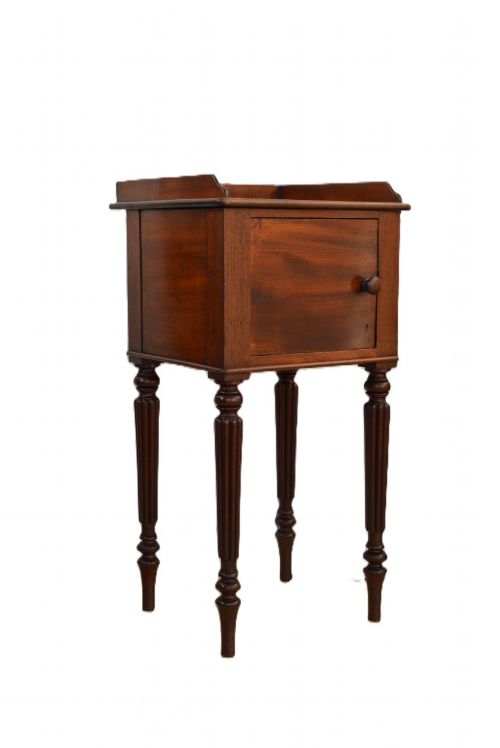


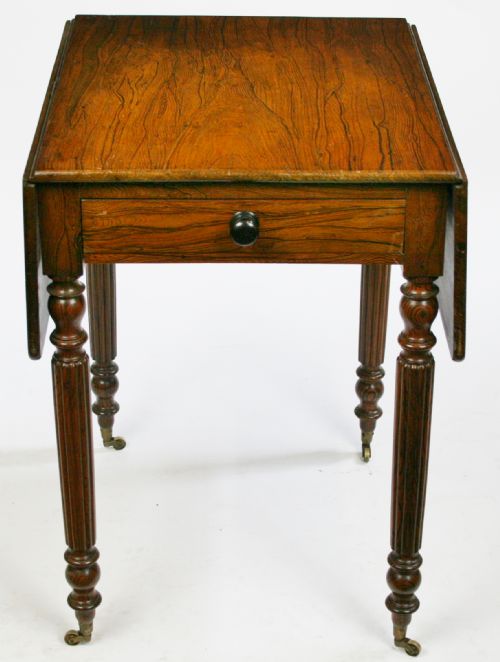
William IV Nightstand
These william iv nightstand pieces bring architectural form and rich timber to the bedside, offering a sturdy surface and enclosed storage.
William IV Nightstand
A william iv nightstand generally takes the form of a bedside cabinet, pedestal cupboard, or cylindrical stand, serving the bedroom with a closed door and a flat top. The selections here span the nineteenth century, including pieces built in the Regency and Victorian eras alongside the titular style.
Most examples rely on mahogany, sometimes featuring flame mahogany veneer, wood, pine, or a painted faux marble finish. Buyers frequently encounter single cupboards and occasional matching pairs designed to sit beside a bed or in a fireside position.
How they were made
Cabinetmakers constructed these pieces primarily from solid mahogany and pine carcasses, applying figured flame mahogany veneers to door panels and drawer fronts to catch the light. Details such as reeded legs and classical architectural mouldings required precise hand-turning and joinery.
Surfaces often received a polished finish to highlight the natural grain of the wood, while alternative executions employed paintwork to imitate marble cylinders or simulated rosewood.
Some cylinders disguise their utility entirely, masquerading as solid marble pillars until a tiny door swings open by the bed.
What varies in quality
Quality rests upon the choice of timber and the dexterity of the veneer work, where book-matched flame mahogany displays dramatic figuring across a single door panel. Construction methods also set pieces apart, distinguishing straightforward utility items from refined architectural forms with reeded legs and balanced proportions.
The integrity of the secondary woods like pine inside the carcass and the crispness of the turned or carved details dictate the overall standard of the piece.
Gillows
The William IV Nightstand Glossary
- Flame mahogany
- A veneer cut from the fork of the mahogany tree, producing a distinctive fire-like pattern across the wood. Cabinetmakers prized this figure for principal display surfaces.
- Pedestal cupboard
- A freestanding enclosed cabinet supported by a single plinth or pedestal base. This form provided concealed bedside storage in nineteenth-century bedrooms.
- Reeded legs
- Cylindrical supports carved with parallel convex mouldings running vertically. They reflect classical influences popular during the Regency and William IV periods.
- Pembroke table
- A small table featuring drop leaves supported by hinged brackets on two opposite sides. Some examples served dual purposes as work or bedside tables.
- Faux marble
- A decorative paint technique applied to wood or other substrates to imitate the veining and coloration of natural stone. It appeared on cylinder stands to achieve a classical aesthetic without the heavy weight of stone.
William IV Nightstand: Frequently Asked Questions
What is a william iv nightstand?
A william iv nightstand is a nineteenth-century bedside cabinet, pedestal cupboard, or small table designed to hold chamber lighting and conceal personal items behind a single door.
These pieces reflect the heavy architectural lines and rich mahogany timbers characteristic of the era, offering both a functional top surface and enclosed interior space.
How do I style a nightstand?
You can place a single cabinet beside a low bed or use a matched pair to frame the sleeping quarters symmetrically.
Their dark wood tones and classical proportions anchor traditional bedrooms, while their enclosed cupboards keep modern bedside clutter out of sight.
Are these cabinets made of solid wood?
Many examples combine solid timbers such as mahogany and pine with decorative veneers applied to the primary exterior surfaces.
Cabinets often feature secondary woods in the interior framework and drawer linings, constructed to withstand daily domestic use.
How do I tell William IV pieces apart?
William IV pieces typically display robust classical architectural forms, heavier proportions, and rich figured mahogany or flame mahogany veneers.
They sit chronologically between Regency restraint and Victorian elaboration, often featuring specific details like reeded legs or cylindrical bodies.