


William IV Davenport Desk
A William IV davenport desk is a compact writing cabinet housing clever storage, prized by collectors for its ingenious small-scale design.
William IV Davenport Desk
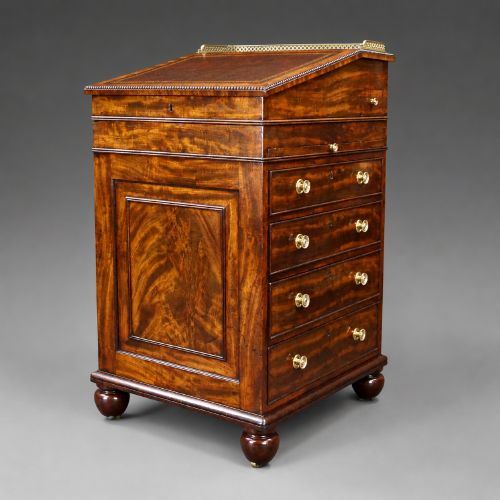
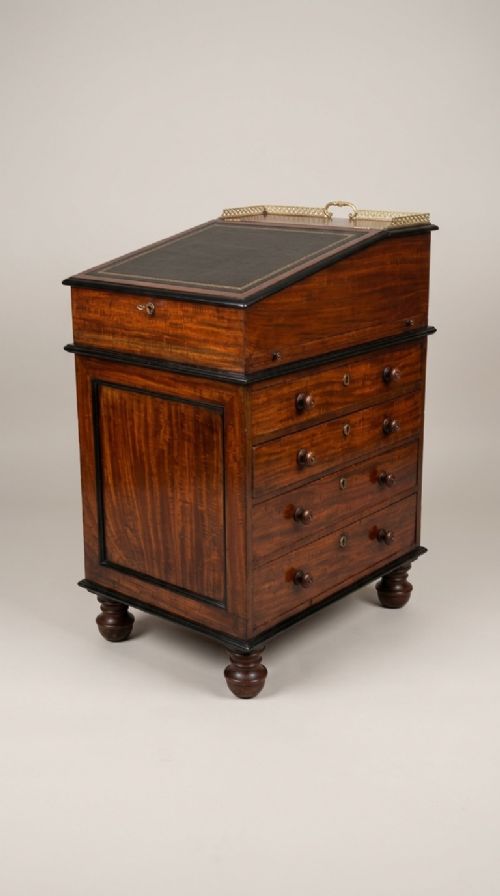
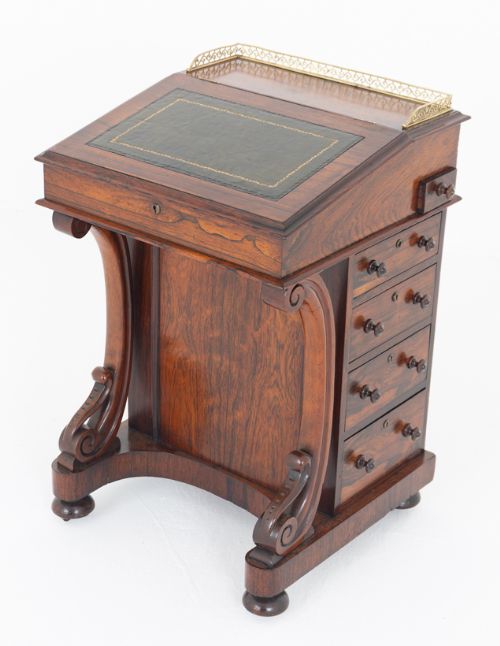
When you search for a William IV davenport desk, you encounter compact writing furniture dating principally from the early nineteenth century. These pieces combine a sloping writing surface with drawers housed beneath a pedestal cabinet, designed specifically for domestic correspondence.
The versions you are most likely to meet on this page belong to the William IV and Regency styles, alongside pieces attributed broadly to the nineteenth century. Most examples appear in dense timbers such as mahogany or rosewood, frequently incorporating sliding tops or stationery compartments.
Materials and construction
Cabinetmakers constructed these desks using solid and veneered timbers, predominantly selecting figured mahogany and richly grained rosewood. Flame mahogany and burr walnut also appear, yielding dramatic surface patterns across the sloping lids and drawer fronts.
Hardware details typically involve turned wooden knobs and brass mounts, whilst writing surfaces are lined with fitted leather panels. Ebonised wood details occasionally accent the primary timber structure.
Captain Davenport allegedly commissioned the very first compact writing desk so he could draft letters while bobbing about at sea.
Judging quality in a davenport
Quality rests upon the selection of timber veneers and the crispness of the cabinetmaker's joinery. Superior examples exhibit matched grain patterns across drawer fronts and smooth operation in sliding tops or secret compartments.
The integrity of the internal fittings and the retention of original brass hardware distinguish finer pieces. Untouched surfaces displaying authentic patination elevate an individual desk above standard examples.
Gillows·James Winter & Son·Burrey & White
The William IV Davenport Desk Glossary
- Davenport desk
- A compact pedestal writing desk featuring a sloped, hinged writing surface above a set of drawers. The form emerged in the late eighteenth century and remained popular through the Victorian era.
- Flame mahogany
- A veneer cut from the fork of a mahogany tree to produce a distinctive flame-like pattern. Cabinetmakers reserved this decorative timber for prominent surfaces such as desk lids.
- Sliding top
- A mechanism allowing the upper writing section to slide forward independently of the lower pedestal. This adjustment provided a more comfortable knee clearance for the writer.
- Ebonised wood
- Timber treated with a dark finish to imitate expensive ebony. Makers utilised this technique for contrasting stringing or decorative accents.
William IV Davenport Desk: Frequently Asked Questions
What is a davenport desk used for?
These compact pieces served as personal writing cabinets for correspondence, letter storage and the organisation of daily records.
The sloping lid provided a firm surface for writing while the internal compartments and side drawers kept stationery neatly contained.
How do I identify a William IV period desk?
William IV desks typically exhibit robust classical proportions with substantial timbers like rosewood or mahogany. Look for characteristic details such as scrolled supports, turned feet and rich natural wood grain.
The construction methods and secondary timbers often align with furniture produced during the 1830s.
Where were davenport desks placed in a home?
Due to their compact footprint, these desks worked well in drawing rooms, boudoirs or private studies where space was limited.
Many examples featured drawers opening to the side rather than the front, allowing the desk to sit comfortably away from a wall.
Are writing tables different from davenport desks?
Writing tables generally offer an open frame with legs beneath a flat or slightly sloped top, lacking the heavy pedestal cabinet of a davenport.
Davenports prioritise integrated storage and vertical presence, enclosing drawers directly beneath the writing slope.