
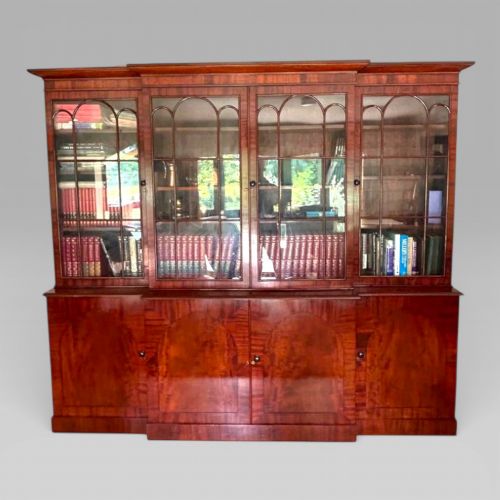
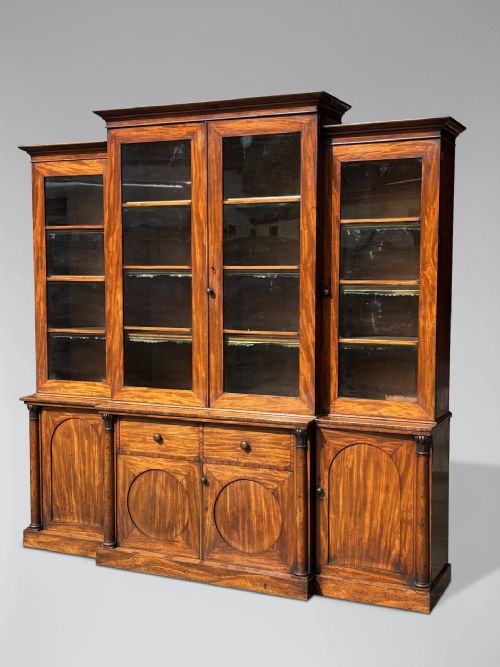


William IV Breakfront Cabinet
These william iv breakfront cabinet examples are substantial architectural storage pieces designed to anchor a principal room.
William IV Breakfront Cabinet
A william iv breakfront cabinet typically presents as a large library bookcase, sideboard or side cabinet featuring a central section that projects forward from the flanking wings. These pieces span the 19th Century, incorporating Regency influences alongside specific William IV and early Victorian styles.
The selections encountered here range from diminutive low bookcases and open shelving formats to massive multi-door library bookcases and fitted secretary variants. Oak, satinwood, goncalo alves and rosewood frequently form the carcases, alongside extensive use of mahogany and flame mahogany veneer.
Sideboards and chiffoniers also appear within this group, offering lower storage profiles with glass or wooden doors. Makers and designers such as Holland and Sons and Gillows inform the traditional proportions and architectural pediments seen across these formats.
Construction and Materials
Cabinet makers utilised solid timbers alongside finely matched veneers, applying flame mahogany and rosewood across primary surfaces while relying on oak for internal carcase framing and drawer linings. Brass inlay work and delicate glazing bars frequently accent the doors of bookcase and cabinet formats.
Carved wooden details define the period style, showing bold scrolling consoles, classical pilasters and heavy plinth bases. Joinery relied on traditional hand-cut dovetails and pegged joints to stabilise the substantial multi-section breakfront forms.
Several bookcases preserve the ghostly impressions of long-lost folios through distinct dust shadows trapped behind glass doors.
Evaluating Quality
Quality rests upon the selection and continuity of timber veneers, where superior examples display symmetrical flame figures across wide expanses of door and drawer fronts. The crispness of carved elements and the integration of brass inlay dictate the overall finish.
Interior construction reveals the maker's hand through secondary woods, drawer linings and original locking mechanisms. Proportions remain balanced even in diminutive pieces, separating standard cabinet work from superior workshop production.
Holland and Sons·Richard Bridgens
The William IV Breakfront Cabinet Glossary
- Breakfront
- An architectural furniture form where the central section projects forward from the flanking wings.
- Secretaire
- A cabinet or bookcase incorporating a fitted writing drawer with a drop-down front.
- Chiffonier
- A low sideboard or cabinet, frequently featuring enclosed shelving and a raised superstructure.
- Goncalo Alves
- A dense exotic hardwood with striking contrasting grain patterns, utilised in high-status 19th-century cabinet making.
- Glazing bars
- The narrow wooden strips that divide individual panes of glass within a cabinet door.
William IV Breakfront Cabinet: Frequently Asked Questions
What is a breakfront cabinet?
A breakfront cabinet is a large storage piece where the central section projects forward from the flanking wings, creating visual depth across the facade.
This architectural arrangement was favored by cabinet makers to break up long runs of timber in libraries and formal reception rooms.
How do I identify a William IV piece?
William IV pieces sit between the Regency and early Victorian periods, generally defined by heavy proportions, bold scrollwork and substantial plinths.
Woods such as rosewood, mahogany and oak dominate, often paired with carved wooden details rather than delicate neoclassical inlays.
Where were these cabinets used?
These cabinets served primarily in formal libraries, dining rooms and grand hallways for the storage of books, porcelain and household silver.
Lower sideboard versions functioned as serving tables while providing enclosed cupboard space beneath.
Are secretary bookcases practical?
Secretary bookcases combine a working desk surface with extensive upper shelving, offering a dual function within a single footprint.
The pull-down writing flap conceals small pigeonholes and drawers for correspondence while keeping the main room tidy.