


White Marble Bronze Garniture
White marble bronze garniture sets bring heavy neoclassical presence to a mantelpiece, pairing pale stone with cast metal mounts.
White Marble Bronze Garniture
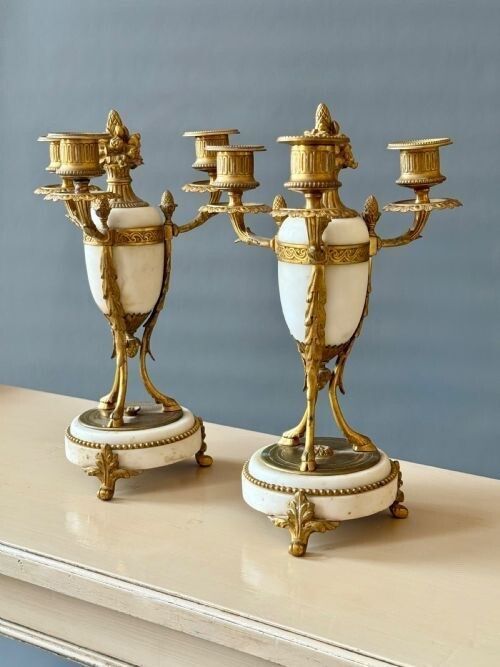
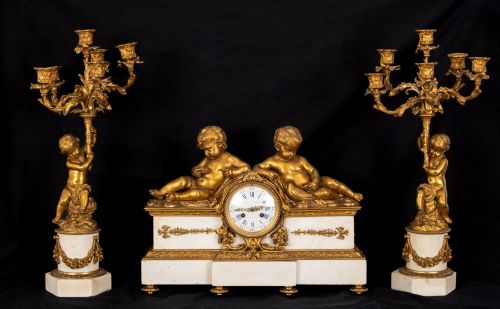
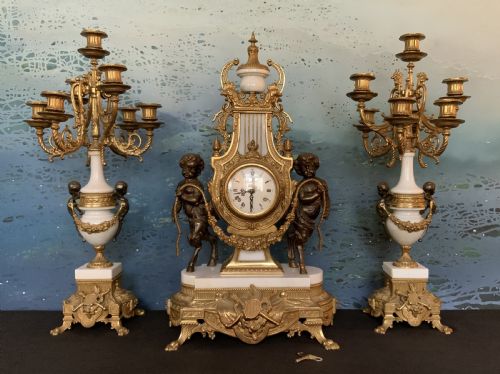
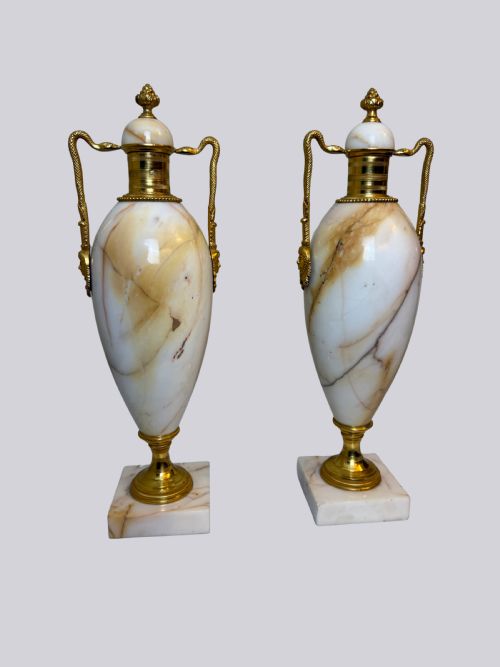
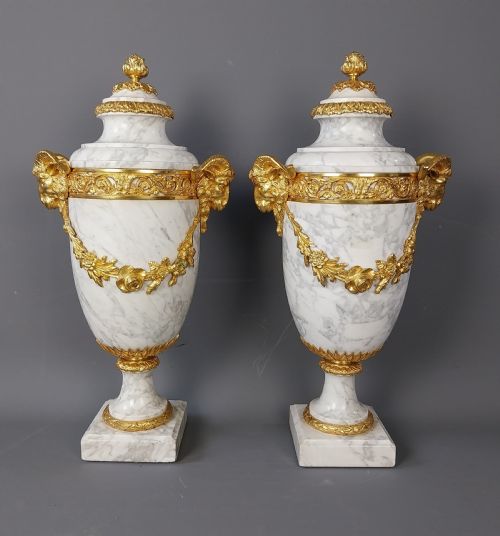
A white marble bronze garniture comprises a central mantel clock accompanied by matching side pieces such as candelabras, urns, or cassolettes. These matched sets originate predominantly from nineteenth-century France, executed in the Louis XVI style or its later revivals.
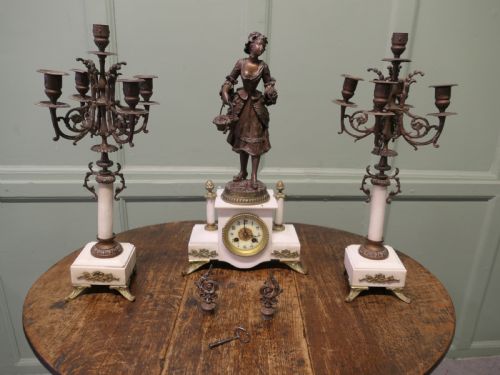
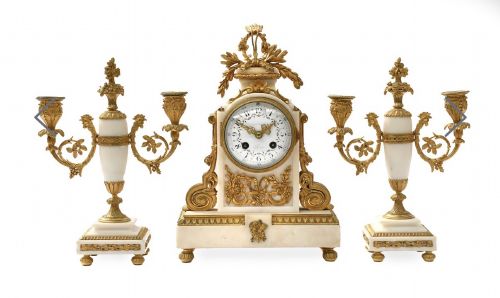
The most common configuration on this page is a three-piece set consisting of a clock flanked by twin candelabras or urns. They utilise classical architectural forms, often incorporating cherubs, gilt mounts, and polished stone columns.
Craft and materials
Makers shaped white marble and white onyx by hand, turning or carving the stone to form urn bodies, clock cases, and pedestals. Metal components were cast in bronze or brass before receiving mercury gilding or ormolu finishes.
Fine chasing defines the cast metal mounts, adding crisp foliage, ribbons, and figural details that contrast against the smooth, pale stone. Enamel dials and brass eight-day movements complete the timepieces.
Materials recur in combinations of white marble, white onyx, gilt bronze, brass, and enamel.
Quality differences
The weight and selection of the marble set the baseline, with denser, unblemished stone indicating superior material. Finer examples display deeply chiselled ormolu mounts rather than shallow, cast-flat replacements.
Integration separates standard assemblies from exceptional ones. The best sets share a cohesive design language across clock and sidepieces, executed by known makers with precision movement engineering.
H Luppens Paris·AD Mougin Paris·Ferdinand Berthoud
The White Marble Bronze Garniture Glossary
- Garniture
- A set of ornamental objects designed to match and display together on a mantelpiece or sideboard, typically comprising a central clock and two side pieces.
- Ormolu
- Gilded bronze, where a layer of finely ground gold mercury amalgam is applied to cast bronze and heated. This technique creates a durable, warm metallic finish seen on nineteenth-century mounts.
- Cassolette
- A decorative vase or urn featuring a reversible lid that transforms the piece from a solid-topped vessel into a candleholder. They frequently appear within matched mantel sets.
- Louis XVI Style
- A neoclassical design vocabulary characterised by straight lines, symmetry, classical motifs, and restraint. It heavily influenced nineteenth-century French makers.
- Candelabra
- A branched candlestick holder designed to hold multiple tapers, often matched in style and metalwork to a central clock.
White Marble Bronze Garniture: Frequently Asked Questions
What pieces make up a garniture?
A standard garniture consists of a central mantel clock paired with two matching side pieces, which are usually candelabras, urns, or cassolettes. These items are designed to sit together symmetrically.
They share identical materials, styles, and decorative motifs to create a unified display across a fireplace mantel.
How do I date these sets?
Dating relies on stylistic clues, movement stamps, and material characteristics. Nineteenth-century French pieces often incorporate Louis XVI revival motifs alongside cast brass movements.
Maker signatures on the clock face or movement backplate provide precise attribution when present.
Where should I place a garniture?
These large sets require a stable surface with sufficient depth, such as a wide mantelpiece, a heavy sideboard, or a dedicated console table. The central clock anchors the arrangement.
The matching candelabras or urns flank the clock to maintain symmetry and balance across the display area.
How do I care for marble and ormolu?
White marble requires dusting with a dry microfibre cloth and immediate cleaning of any spills to prevent staining the porous stone. Avoid harsh chemical cleaners.
Ormolu mounts should be kept dry and free from polishes that can strip the historic gilt surface.