
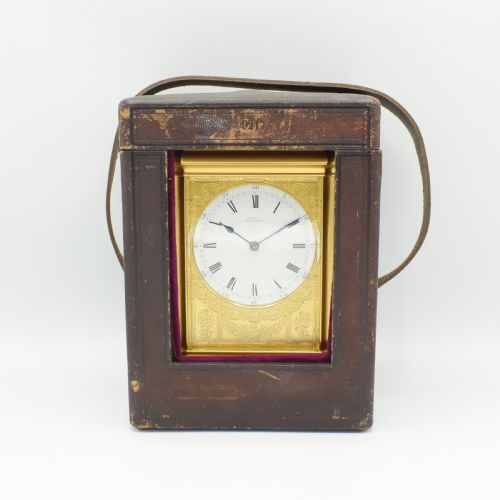
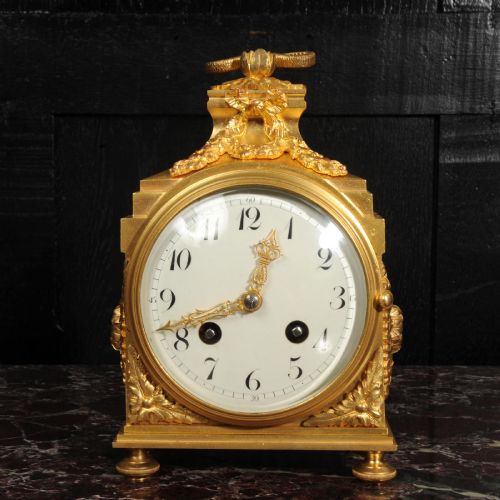
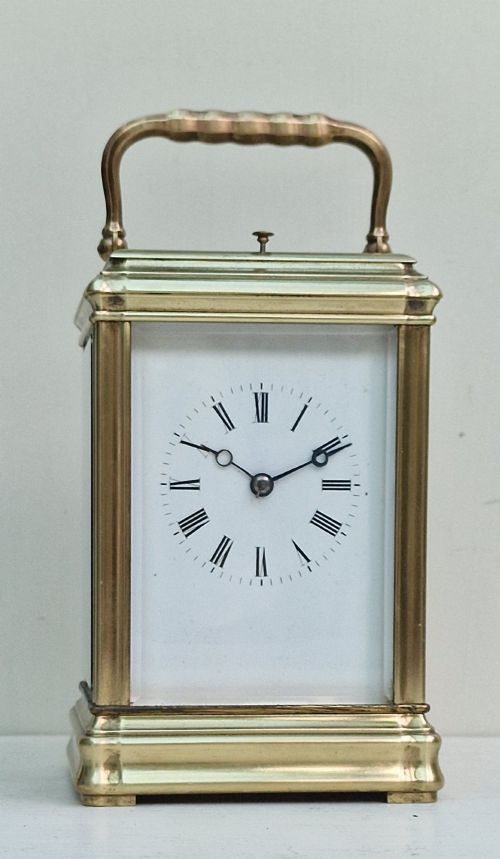


White Enamel Carriage Clock
White enamel carriage clock pieces are sturdy travelling timekeepers featuring crisp dials and brass cases, offering traditional mechanical charm for any mantel.
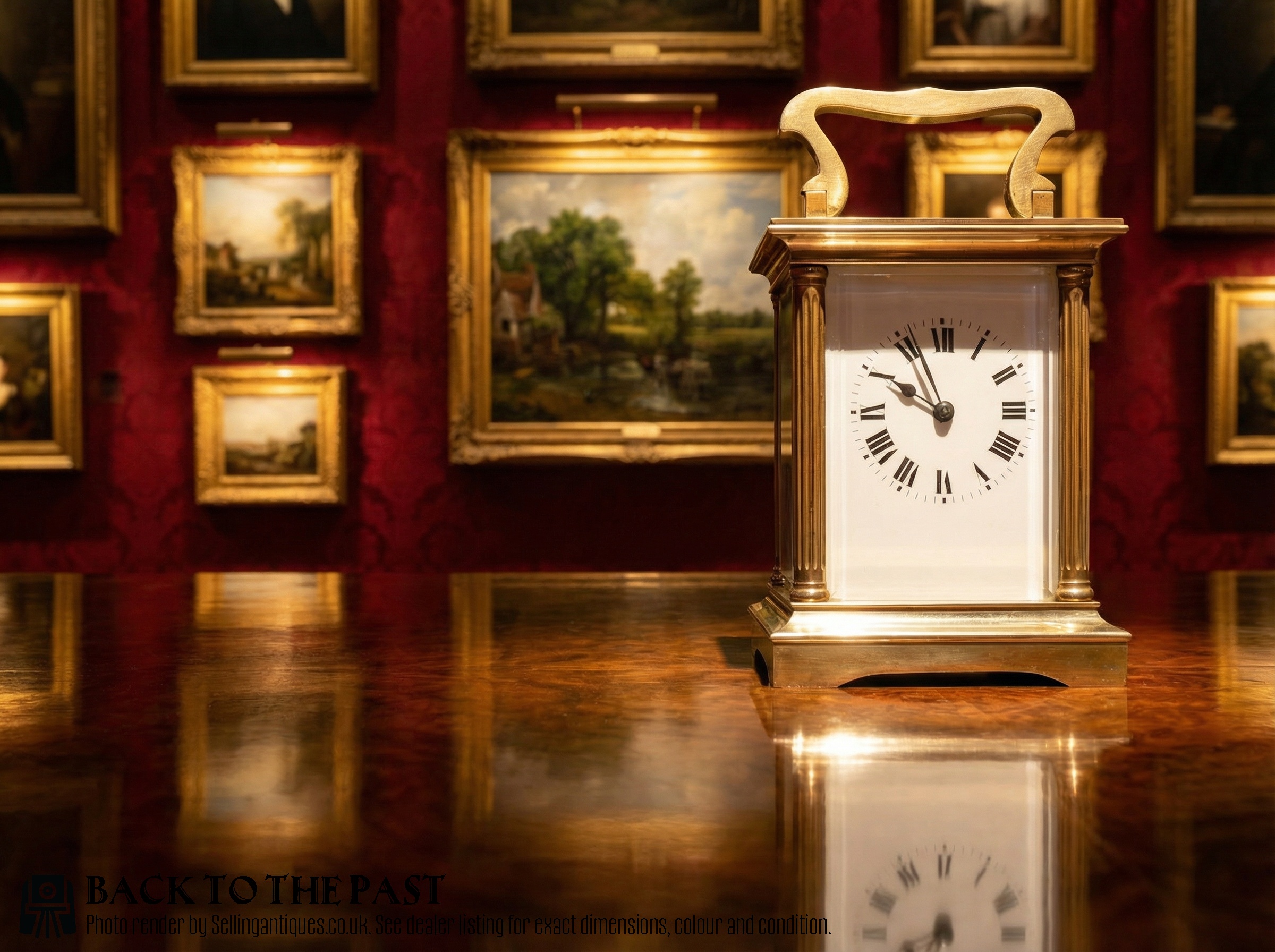
White Enamel Carriage Clock
A white enamel carriage clock combines portable mechanical timekeeping with a legible white dial, originating predominantly from French workshops and British retailers during the nineteenth and early twentieth centuries. These timepieces take forms such as standard gorge cases, miniature brass bodies, and giant engraved housings spanning periods from the Victorian era through the Edwardian years.
Most examples encountered on this page originate from French makers operating in the nineteenth century, often featuring brass or gilt bronze frames alongside bevelled glass panels. Buyers find variations ranging from simple timepieces to complex striking, repeating, and alarm mechanisms housed within brass or silver frames.
Distinctions in craftsmanship and execution
Quality separates through the refinement of the movement, the weight and casting precision of the brass or gilt bronze case, and the clarity of the white enamel dial. Superior examples exhibit intricate hand engraving, platform escapements with exceptional adjustment, and complex striking or repeating mechanisms.
Lesser items offer simpler time-only movements within plain brass frames and standard stamped components. The presence of original gilding, matching leather travel cases, and documented maker signatures elevate an example above standard commercial production.
Selected nineteenth-century models incorporate race horse interest within their records.
Pickford of London·Delépine-Barrois·Gontard & Bolviller Paris·Paul Garnier·Charles Frodsham & Holingue Frères·Henry Matthews·Henry Jacot
The White Enamel Carriage Clock Glossary
- Carriage clock
- A portable spring-driven timepiece originally designed for travelling during the nineteenth century. These clocks typically feature a rectangular brass case with glass panels and a handle on top.
- Enamel dial
- A fused glass surface applied to a metal backing to create a smooth, white display for clock numerals. This material resists fading and provides a crisp background for painted markers.
- Platform escapement
- The miniature regulating assembly mounted visibly on top of the movement gear train. It replaces the pendulum to allow portable timekeeping.
- Repeating mechanism
- A complication that chimes the hours and quarters upon pressing a button on the case. This allows the user to check the time in the dark.
- Gorge case
- A distinct rectangular brass case style featuring stepped mouldings around the top and base. It represents a classic French housing for better quality movements.
White Enamel Carriage Clock: Frequently Asked Questions
How do I wind a carriage clock?
Winding requires inserting a key into the arbours located on the backplate of the movement. Turn the key gently until resistance indicates the mainspring is fully tensioned.
Avoid over-winding, as this can strain the internal springs. Ensure you use the correct key size to prevent damage to the winding squares.
Why does my clock run fast or slow?
Mechanical clocks are influenced by temperature changes and mechanical wear over time. Regulation is achieved by adjusting the small regulator lever located on the platform escapement.
Move the indicator slightly towards the fast or slow marker as needed. Allow the movement to settle for twenty-four hours after making any adjustment.
How do repeating mechanisms work?
Depressing the plunger on top of the case activates gongs that sound the last hour and quarters. This mechanical function operates independently of the main timekeeping train.
Such complications require careful handling during operation. They were originally designed for checking the time at night without lighting a candle.
How do I clean the brass case?
Dust the exterior regularly with a soft, dry microfibre cloth to prevent accumulation. Avoid chemical polishes that can strip original gilding or damage engraved details.
If the glass panels require cleaning, use a mild glass cleaner applied to a cloth rather than sprayed directly. This protects the adjacent metalwork and enamel dial.