


White Carved Bench
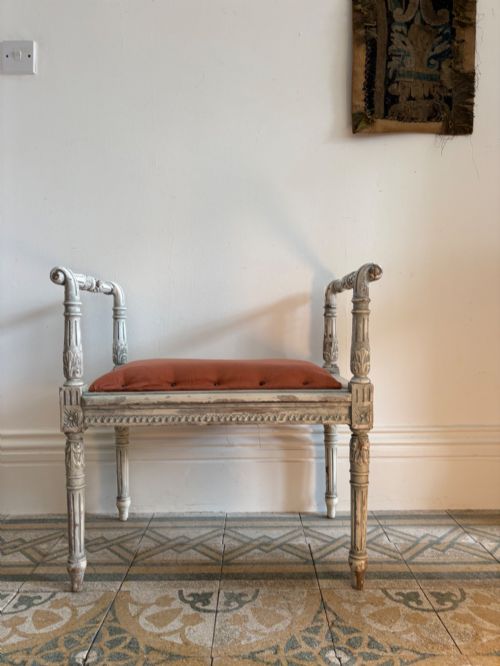
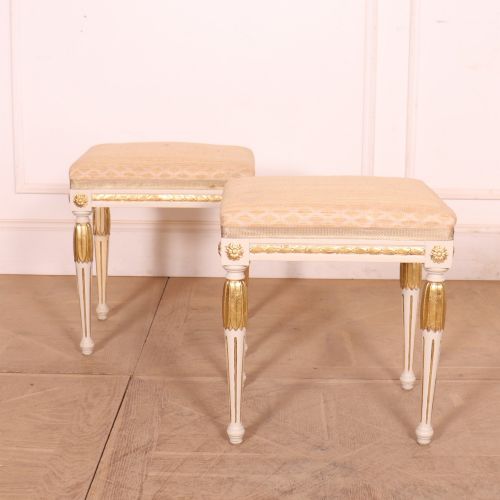
White carved bench options bring pale Nordic elegance and French provincial seating straight to your hallway or bedroom.
White Carved Bench
A white carved bench covers a broad range of antique seating, from Swedish Gustavian settees to French painted caned sofas. Buyers searching for a white carved bench often encounter painted wooden frames alongside upholstered stools and window seats.
The selections span the eighteenth, nineteenth, and early twentieth centuries, drawing heavily on Gustavian Neoclassical, Louis XV, and Edwardian styles. Simpler Asian folk art carvings and garden seats also appear among these pale painted forms.
How they were made
Craftsmen built these frames primarily from solid wood and pine, applying layered paint finishes to create the characteristic white surface. Gold leaf highlights occasionally accent the carved wooden details on formal pieces.
Seating surfaces utilise woven cane, traditional fabric upholstery, and silk seats, supported by carved wooden frames. Joinery methods reflect the specific period of manufacture, from eighteenth-century settle construction to later nineteenth-century framing.
Listings span from the 18th century through the 1920s, incorporating painted wood, pine, silk, cane, and gold leaf.
What varies in quality
The depth and crispness of the carved wooden decoration set finer examples apart from simpler utilitarian seating. Crisp execution in the floral motifs and classical details indicates skilled workshop production.
The integrity of the original painted surface and the condition of integrated cane or silk elements dictate the overall standard. Pieces retaining early paint layers carry greater decorative character than later repainted surfaces.
The White Carved Bench Glossary
- Gustavian
- The Swedish interpretation of Neoclassical style, known for restrained carved detail and pale painted finishes. It flourished from the late eighteenth century onwards.
- Caned
- Woven rattan or cane panels utilised for seat bases and backrests. This technique provides lightweight resilience to wooden frames.
- Settee
- A small upholstered or wooden bench with a back and arms designed for multiple occupants. These forms bridge the gap between chairs and full-size sofas.
- Settle
- A traditional wooden bench featuring a high back and solid arms to block drafts. Early examples often incorporate storage beneath the seat.
- Neoclassical
- A style reviving classical Greek and Roman motifs, featuring symmetrical carved ornaments and restrained proportions.
White Carved Bench: Frequently Asked Questions
Where should I place a white carved bench?
These pieces suit entrance halls, foot-of-the-bed placements, and bright window spaces where their pale finishes reflect light. Their slim profiles allow them to fit easily into narrower circulation areas.
Consider the seat height and depth relative to your surrounding furniture before choosing a specific stool or settee format.
How do I care for painted wooden frames?
Dust regularly with a soft, dry cloth to prevent dirt accumulation on the carved surfaces. Avoid abrasive cleaners that might disturb historic paint layers.
Keep wooden furniture away from direct heat sources and dramatic humidity shifts to protect the underlying timber.
What is the difference between a settee and a sofa?
A settee traditionally refers to a lighter, often partially upholstered wooden seat designed for two or more people. Sofas generally offer deeper, more fully upholstered seating constructed for extended lounging.
Historical terminology often overlaps, with makers using both terms interchangeably for eighteenth and nineteenth-century seating.
How do I identify Gustavian style?
Gustavian pieces display restrained neoclassical carvings, fluted legs, and pale monochrome paintwork. The aesthetic prioritises symmetry and simplicity over heavy ornamentation.
Swedish workshops adapted French Louis XVI designs to create this distinctively bright regional style.