



Walnut Side Table Set
A walnut side table set is a nested group of occasional surfaces, prized for rich figuring and practical space-saving design.
Walnut Side Table Set
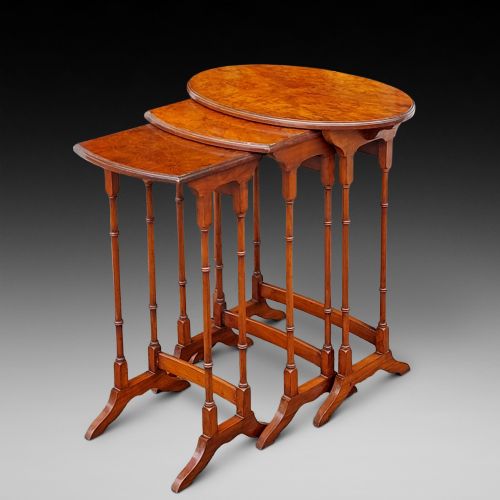
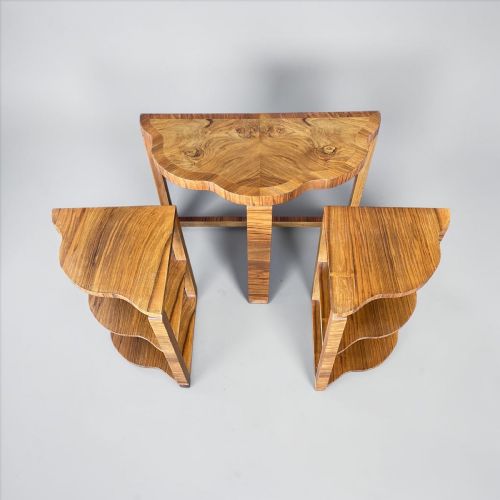
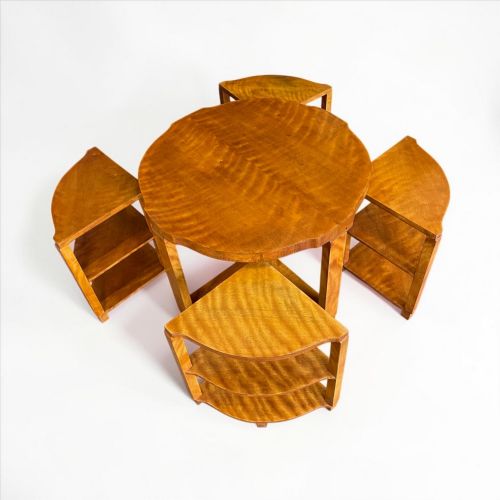
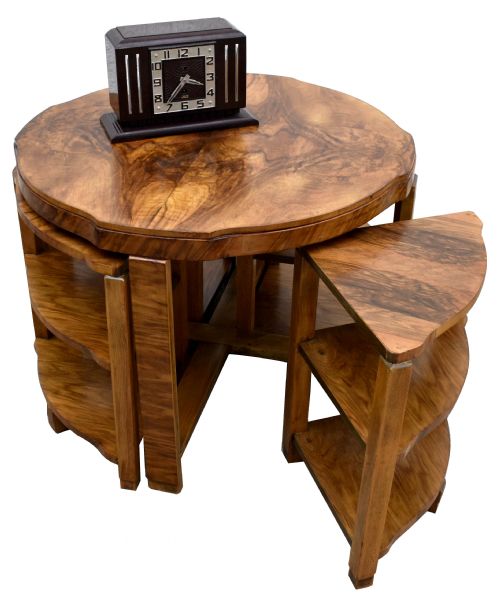
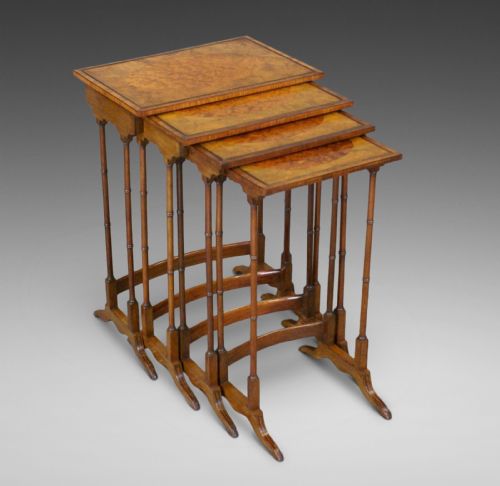
A walnut side table set most frequently appears here as a nest of tables, ranging from Edwardian trios to elaborate Art Deco sets of five. These multi-tiered assemblies slide neatly beneath one another when not in use, making them highly efficient for smaller reception rooms. The form spans from early twentieth century production to nineteenth century examples, with the Art Deco period heavily represented.
Makers such as Harry and Lou Epstein and Heal's produced notable examples during the interwar years, employing distinctive veneering techniques. Alongside these, Edwardian quartetto sets and Queen Anne style interpretations offer traditional silhouettes with curved legs. Buyers encounter both rectangular tops and curved oval formats, demonstrating the versatility of the form across different stylistic movements.
How they were made
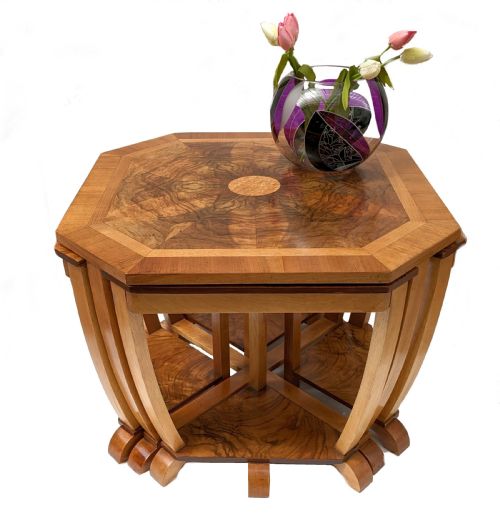
Cabinet makers utilised walnut timber and burr walnut veneer over secondary woods such as oak, applying figured grains to the primary surfaces for visual impact. Some pieces incorporate satinwood veneer or floral marquetry inlay, adding contrasting tones to the tabletops. Construction relies on precise woodworking joints to ensure smaller tables glide smoothly into their larger counterparts.
Finishing techniques involved polishing the wood to highlight the natural patterns within the grain, particularly on burr and figured surfaces. Parquetry work appears on select continental examples, demonstrating intricate geometric arrangement of wood segments. The structural framework typically balances durability with the slender proportions required for nested furniture.
Five tables hiding inside one another proved the ultimate party trick for 1930s hosts short on gin space.
What varies in quality
Quality in a walnut side table set rests upon the selection and matching of the veneer across the nested surfaces. Superior sets display continuous grain patterns that flow harmoniously from the largest tabletop down to the smallest. Finer examples also exhibit meticulous craftsmanship in the joinery, ensuring stability and smooth operation when nesting.
The prominence and symmetry of burr walnut figuring further distinguish higher-tier pieces from simpler plain timber versions. Attribution to known workshops or manufacturers like Harry and Lou Epstein or Heal's adds a layer of distinction. Conversely, heavily worn surfaces or mismatched timber selections place a set lower in the commercial scale.
Harry and Lou Epstein·Heal's
The Walnut Side Table Set Glossary
- Burr walnut
- A prized wood figuring obtained from the growth warts of walnut trees, displaying swirling, knotty patterns. It is sliced into thin veneers for decorative tabletops.
- Quartetto
- A matched set of four small tables designed to nest together. The term originates from nineteenth century furniture terminology.
- Quintetto
- A matched set of five small tables designed to nest together. This configuration is particularly common in Art Deco designs.
- Marquetry
- Decorative woodwork in which pieces of veneer are fitted into a ground to form floral or geometric designs. It creates pictorial surfaces on select table tops.
- Veneer
- A thin slice of figured wood applied over a sturdier secondary timber base. This technique allows cabinet makers to display expensive grains economically.
Walnut Side Table Set: Frequently Asked Questions
What is a quintetto nest of tables?
A quintetto nest consists of five graduating tables designed to slide neatly beneath one another.
This format is frequently encountered in Art Deco walnut sets from the interwar period.
How were nesting tables used historically?
They served as flexible occasional furniture for serving tea, holding lamps, or placing drinks in reception rooms.
Their modular design allowed households to expand surface area quickly without crowding the floor space.
How do I identify an Edwardian walnut set?
Edwardian examples often feature traditional styling such as quartetto sets of four tables with slender turned legs.
They generally pre-date the bolder geometric veneering typical of later Art Deco productions.
Are burr walnut surfaces durable?
Burr walnut veneer provides a stable decorative surface when applied to solid secondary woods and properly maintained.
Routine polishing protects the grain patterns and the underlying timber from moisture and wear.
What styles are common in these sets?
Art Deco and Edwardian designs dominate the selection, alongside occasional Queen Anne style and French Provincial interpretations.
Each style dictates the leg shape, edge profile, and overall silhouette of the nested tables.