


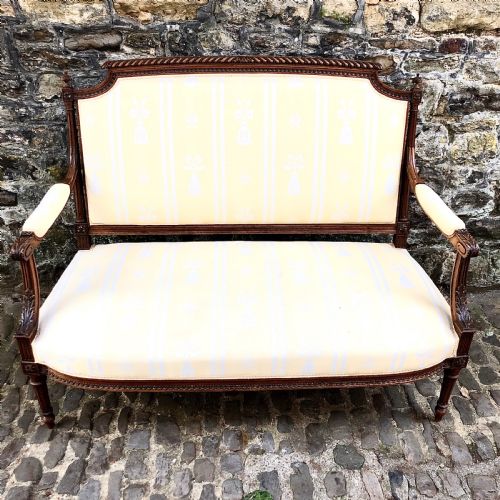


Walnut Padded Settee
These walnut padded settee pieces combine rich timber frames with soft upholstery for a seat that anchors a room.
Walnut Padded Settee
A walnut padded settee is a two or three seater seating form framed in timber and upholstered in fabric or velvet. Buyers searching for a walnut padded settee encounter styles spanning the Victorian era, the nineteenth century, and revival designs like French Rococo and Queen Anne.
The selection here includes carved open arm sofas, small end of bed two-seater sofas, and hall seats originating across various decades from eighteen-sixty to nineteen-thirty. These pieces serve as functional living room seating or decorative bedroom furniture.
Victorian and Biedermeier examples sit alongside Louis style and Queen Anne style walnut framed settees. Each piece demonstrates the enduring appeal of timber frames paired with padded upholstery.
Materials and construction
Makers shaped these frames primarily from solid walnut, occasionally utilising mahogany alongside the main timber. Structural elements frequently feature carved details on the open arms and exposed wooden rails.
Upholstery materials include standard fabric, plush velvet, and dedicated upholstery fabric secured with brass hardware. The combination of carved wooden frames and padded seating defines the construction method across all periods.
Walnut Padded Settee Retail Price Guide 2026
Typical asking prices for walnut padded settee among the pieces listed under this phrase on Sellingantiques today, from the lower quarter to the upper quarter. They describe what is for sale here now, not the wider market.
One compact walnut settee is specifically designated for the end of the bed, proving that Victorian bedrooms took lounging very seriously.
Assessing quality and craftsmanship
Quality in a walnut padded settee rests on the depth and crispness of the carved woodwork on the frame. Finer examples display intricate hand-carved details along the crest rail and open arms that elevate the piece beyond plain construction.
The choice of covering material and the execution of the upholstery work also separate standard examples from superior pieces. Dense velvet and robust upholstery fabrics indicate a higher grade of original finish.
The Walnut Padded Settee Glossary
- Walnut
- A dense, dark hardwood prized for its rich grain and durable qualities in furniture framing. It takes a fine polish and allows for sharp carved details.
- Upholstery
- The padded and covered components of a seat that provide comfort. This includes the internal stuffing and the outer fabric or velvet layers.
- Open arm
- A chair or settee arm design left unpadded and exposed to show the carved wooden structure. It is a common feature on revival and Victorian sofas.
- Biedermeier
- A Central European style of furniture from the nineteenth century focusing on utilitarian comfort and clean lines. Pieces from this movement often feature restrained ornamentation.
Walnut Padded Settee: Frequently Asked Questions
What periods do these settees come from?
The pieces span the nineteenth century through the early twentieth century, including items dated from eighteen-sixty to nineteen-thirty. Revival styles such as Queen Anne and Louis XV appear alongside Victorian and Biedermeier examples.
Each period brings distinct stylistic flourishes to the carved walnut frames and the silhouette of the upholstery.
How are these settees used in a home?
These pieces function primarily as seating in living rooms, studies, or large hallways. Smaller two-seater formats also find placement at the end of a bed.
The combination of a wooden frame and padded upholstery provides both decorative presence and practical comfort.
What fabrics cover these wooden frames?
Upholstery options recorded in the listings include general fabric, velvet, and specialised upholstery fabric. These materials are secured to the walnut frames to create padded seating surfaces.
The choice of textile often reflects the specific era and style of the settee.