


Walnut Oyster Veneered Furniture
Walnut oyster veneered furniture brings together cross-cut branch sections and rich timbers to create remarkable patterned surfaces for the home.
Walnut Oyster Veneered Furniture
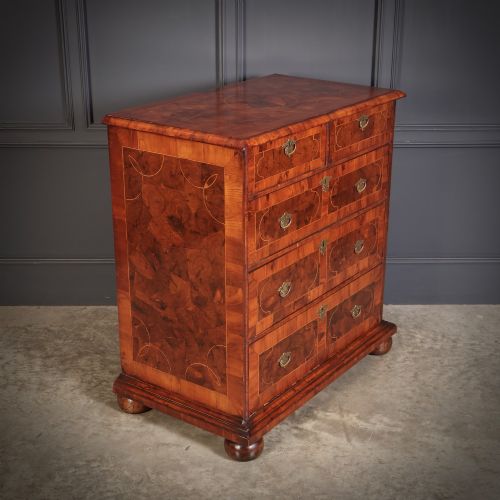
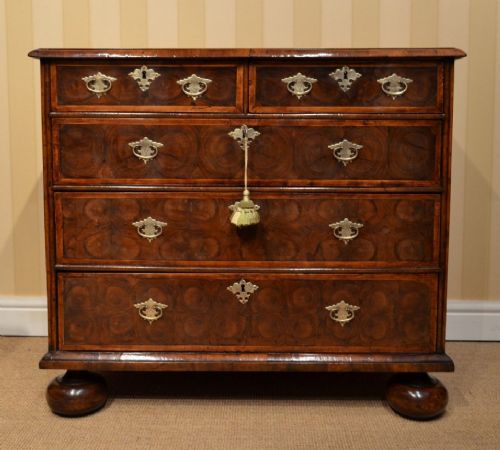
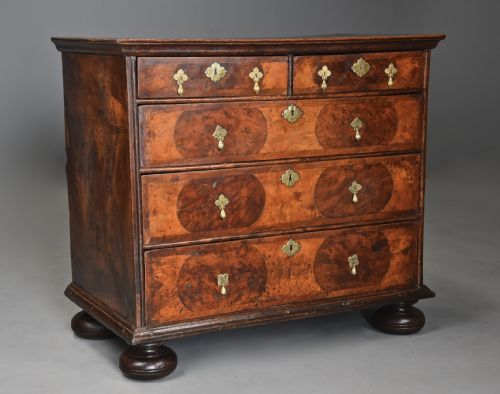
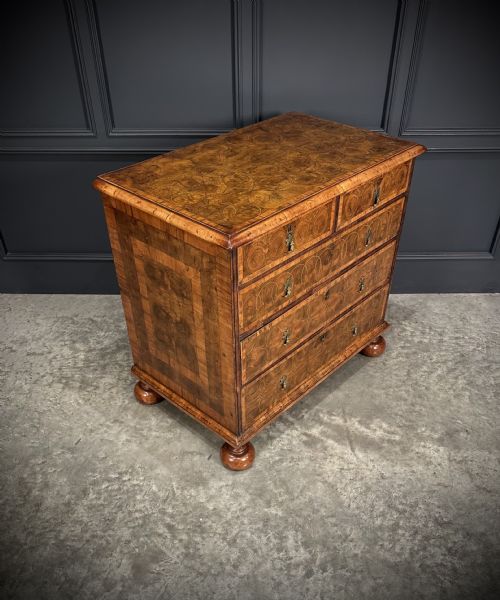
When you search for walnut oyster veneered furniture, you encounter sophisticated historic pieces primarily originating from the seventeenth century and the William and Mary period. These items predominantly take the form of chests of drawers, chests on stand, cabinets on stand, and side tables.
The pieces on this page range from early seventeenth-century examples to a later Queen Anne revival writing side table from the nineteen-thirties. The core of what you meet here consists of substantial case furniture designed to display intricate wood grain patterns across flat surfaces.
Makers and craftsmen of the period utilised distinctive forms such as chests on stands and tall cabinets to maximise the visual impact of circular veneer sections. These foundational forms define the category and remain the most sought-after variations for collectors today.
How they were made
Cabinetmakers created oyster veneer by cross-cutting small branches of walnut, olivewood, laburnum, and yew at an angle to produce distinct circular and oval discs. These thin slices were then arranged closely together across secondary timbers such as oak to form dense, patterned wooden mosaics.
Master craftsmen enhanced these complex wood surfaces by incorporating boxwood stringing and intricate marquetry details into the primary walnut structure. Brass hardware, including drop handles and escutcheons, was then applied to complete the functional design of the drawers and stands.
Branch timber that might have been discarded as firewood was sliced thin to trick the eye into seeing precious landscapes.
What varies in quality
The overall standard of walnut oyster veneered furniture depends heavily on the precision of the cutting and the uniformity of the timber selection across the primary surfaces. Finer examples display tightly fitted oyster discs with minimal filler between the joints, creating a harmonious and continuous visual flow.
The choice of contrasting woods, such as olivewood or laburnum combined with walnut, distinguishes higher-grade pieces from simpler domestic items. Furthermore, the retention of original brass mounts and the depth of the surface patina contribute significantly to the standing of an individual piece.
The Walnut Oyster Veneered Furniture Glossary
- Oyster veneer
- A method of cutting small branches or roots diagonally to produce small, oval veneer pieces resembling oyster shells. This technique creates distinctive circular patterns across furniture surfaces.
- Marquetry
- The art of forming decorative patterns by fitting together small pieces of various coloured woods and other materials. It frequently accompanies oyster veneer on high-status seventeenth-century pieces.
- Chest on stand
- A tall storage form consisting of a main drawer section elevated upon a separate table-like stand with legs. This form lifts the patterned veneer closer to eye level.
- Stringing
- A narrow strip of contrasting wood inlaid into a channel in the surface of a piece. Boxwood is commonly used for this linear detail around drawer edges.
- William and Mary
- The design period spanning the late seventeenth century, characterised by Dutch influences, turned legs, and elaborate veneering techniques. Much of the furniture in this category dates from this era.
Walnut Oyster Veneered Furniture: Frequently Asked Questions
What is oyster veneer furniture?
Oyster veneer furniture is made by cutting small branches across the grain to produce circular discs of wood, which are laid side by side to form patterned surfaces. This technique was particularly popular during the late seventeenth century.
Craftmen applied these wooden mosaics to the drawer fronts and tops of chests and cabinets, creating rich decorative effects using walnut, olive, and laburnum.
How do I date a walnut chest?
Dating a walnut chest involves examining the construction methods, secondary woods like oak, and the specific style of the hardware and stands. Seventeenth-century pieces often feature distinct dovetailing and candle-box interiors.
Comparing the primary timber and veneer patterns against known historical periods helps narrow down the decade of manufacture, distinguishing early pieces from later revivals.
Where should I place these pieces?
These items suit placement in principal reception rooms or hallways where their detailed wooden surfaces can be appreciated at close quarters. Stable humidity and temperature protect the delicate historic veneers from drying out.
Keeping them away from direct sunlight preserves the natural colour tones of the walnut and contrasting inlay woods over time.
What is a chest on stand?
A chest on stand is a two-part furniture form where a set of drawers sits securely upon an open frame with four legs connected by stretchers. This elevation lightens the visual weight of the case.
Introduced during the late seventeenth century, this form allowed makers to showcase continuous oyster veneering across a taller vertical surface.
How do I care for antique veneer?
Caring for antique veneer requires maintaining consistent indoor humidity and applying appropriate wax finishes periodically to nourish the historic timber. Avoid excessive moisture and modern chemical cleaning agents.
Gentle dusting with a soft cloth prevents particle buildup in the fine joints between the individual oyster discs.