
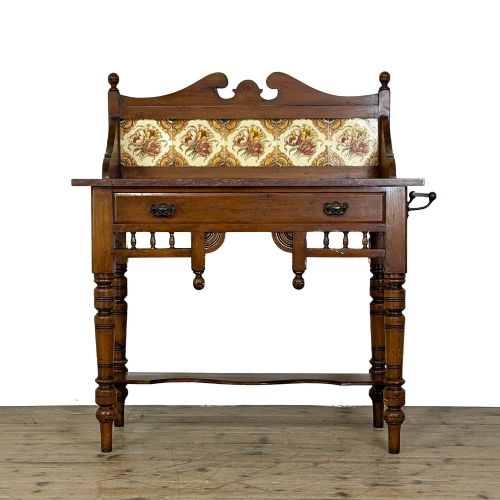
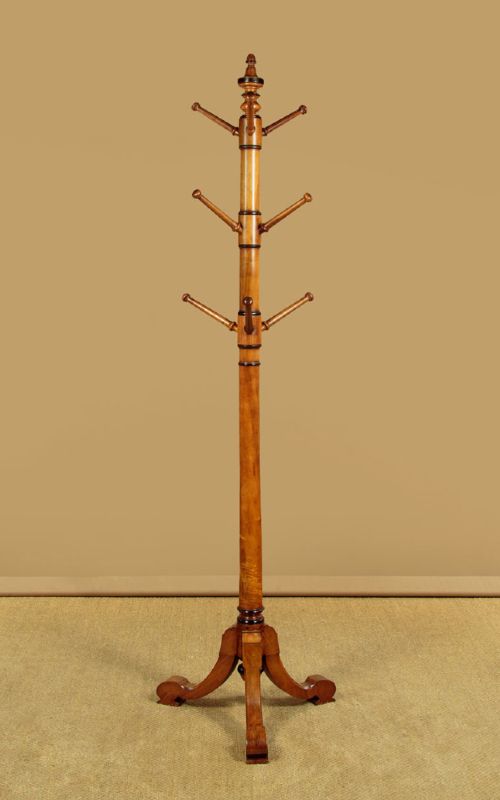
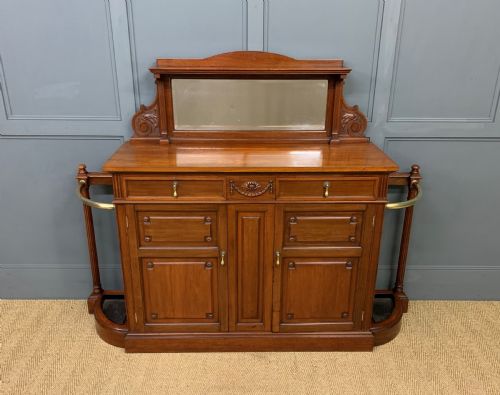


Walnut Hall Stand
A walnut hall stand brings presence to an entranceway, offering practical storage for coats, hats and umbrellas through the rich grain of its timber.
Walnut Hall Stand
A walnut hall stand is a functional piece of entrance furniture designed to hold garments, walking sticks and umbrellas, frequently incorporating a central mirror and a small bench or glove box. The versions seen most often date from the Victorian and Edwardian eras, spanning the late nineteenth century to the early twentieth century.
Makers utilised the rich dark tones and decorative figures of walnut to create imposing architectural forms for large entrance halls as well as more modest designs for town houses. Examples range from simple hat and coat racks with umbrella pans to substantial carved compositions featuring brass hooks and integrated seating.
How they were made
Craftsmen shaped these items from solid walnut and applied burr walnut or figured veneers to larger flat surfaces to highlight the natural grain patterns. Structural stability depended on internal framing of secondary timbers, while decorative detailing relied on hand carving, inlaid satinwood marquetry, and turned spindles.
Functional hardware formed an integral part of the construction, utilising brass or cast iron for coat hooks, hinges, and drip trays to catch moisture from wet umbrellas and walking sticks. Mirrors with bevelled edges were fitted securely into carved wooden frames as central focal points.
Listings feature walnut hall stands from the Victorian and Edwardian eras, alongside Arts & Crafts interpretations.
What varies in quality
The distinction between ordinary production and superior work lies in the selection of the timber veneers and the depth of the carving. Finely figured burr walnut and crisp, deep relief carving separate standard utility pieces from exhibition standard examples.
Construction methods also define the tier of the piece, with high quality items showing meticulous joinery in the framework, substantial cast brass fittings rather than plated base metals, and well-balanced proportions that integrate the mirror, hooks and umbrella wells harmoniously.
Shoolbred & Co.·Jas. Shoolbred·Shapland & Petter·William Birch
The Walnut Hall Stand Glossary
- Burr walnut
- A decorative timber cut from the abnormal growth growths of a walnut tree, yielding complex, swirling grain patterns. It was frequently used for veneering prominent surfaces on fine furniture.
- Marquetry
- The art of forming decorative patterns by fitting together thin pieces of wood veneer and contrasting materials like satinwood. This technique adorned panels and drawer fronts.
- Drip tray
- A metal container, usually cast iron or brass, placed at the base of a hall stand to catch water from umbrellas and walking sticks.
- Bevelled mirror
- A looking glass with an angled edge cut around its perimeter, characteristic of better quality Victorian and Edwardian joinery.
- Settle
- A wooden bench with high back and solid arms, occasionally incorporated into the base of larger hall stands for seating while removing boots.
Walnut Hall Stand: Frequently Asked Questions
What is a walnut hall stand?
A walnut hall stand is an entrance piece designed to organise outerwear and walking gear, combining coat hooks, umbrella holders and usually a mirror into one unit.
Most surviving examples date from the Victorian and Edwardian periods, reflecting the domestic habits of homes where visitors removed hats and coats upon entry.
How do I date a hall stand?
Dating relies on the stylistic clues of the carving and the construction methods, moving from heavy Victorian architectural forms to lighter Arts and Crafts or Edwardian designs.
Earlier pieces from the mid-nineteenth century often feature dark walnut and elaborate foliate carving, while later examples incorporate simpler lines or marquetry inlay.
Where should I place one?
These pieces suit entrance halls and large corridors where their height and mirrored panels can reflect light and anchor the room.
They require sufficient wall space and floor clearance to function safely as coat and umbrella storage without crowding the entranceway.
Are the hooks original?
Brass and cast iron hooks are frequently original to the piece, though heavy use sometimes necessitated replacements over the decades.
Examining the screw types and the indentation marks in the wood helps determine if the hardware has remained undisturbed since manufacture.