




Vintage Wooden Stackable Tables
These vintage wooden stackable tables offer clever tiered convenience for compact spaces, pairing period craftsmanship with everyday utility.
Vintage Wooden Stackable Tables
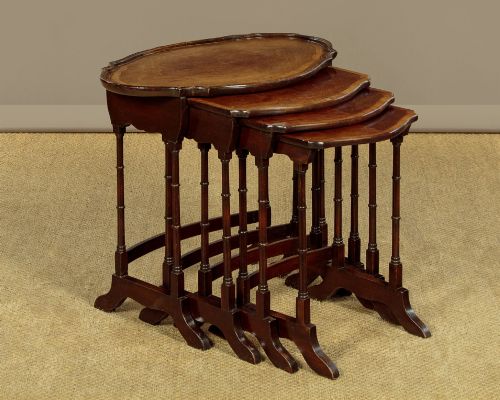
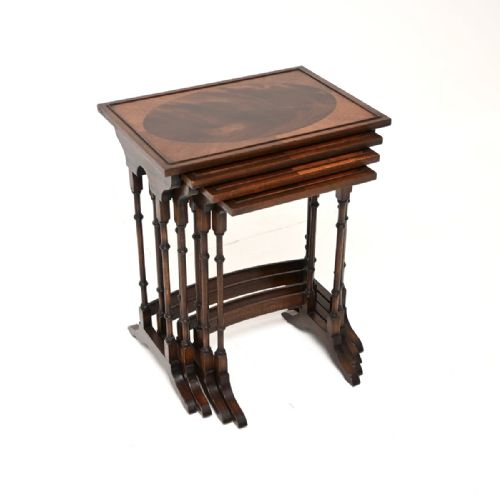
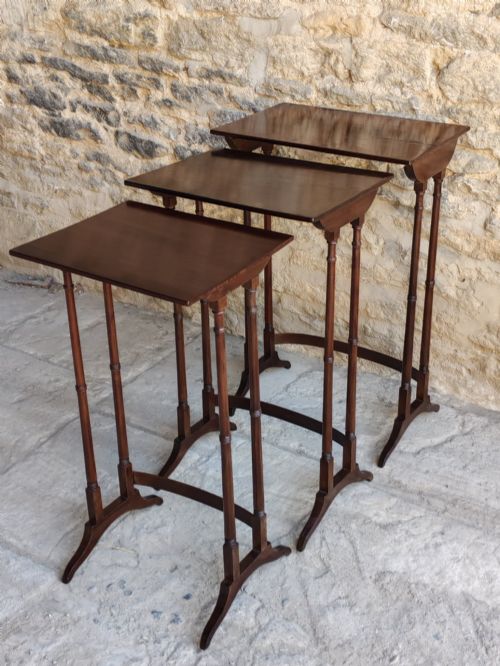
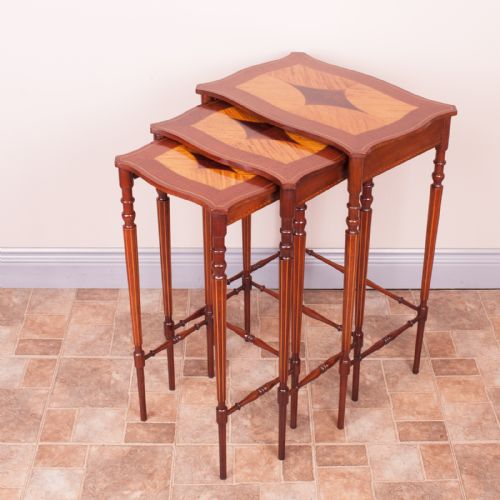
Vintage wooden stackable tables appear here primarily as nests of tables, designed to slide neatly beneath one another when floor space matters. The listings show groups of three or four graduated tables, often referred to as quartetto sets.
Most examples you encounter date from the Edwardian period or the nineteen-thirties, though older Georgian style revivals and nineteenth-century pieces also feature. Makers utilise rich timbers like mahogany and rosewood to form these practical tiered groupings.
Form follows function closely in these designs, allowing individual side tables or coffee tables to serve tea, hold books, or display ornaments before returning to a compact single stack. The shapes range from traditional rectangular forms to oval surfaces and carved side tables.
How they were made
Cabinetmakers constructed these nesting sets predominantly from solid timber and selected veneers, with mahogany and rosewood forming the primary surfaces. Workshops frequently applied boxwood stringing and fine inlay to accentuate the edges of the top panels.
Graduation is the defining mechanical feature, ensuring each smaller table slides smoothly into the frame of the one above it without binding. Joinery techniques varied from simple corner joints to more elaborate carved details on rosewood frames and Edwardian quartetto sets.
Even the smallest table in a quartetto set still needs to be sturdy enough to hold your afternoon tea without wobbling.
What varies in quality
Quality in these nested sets rests on the crispness of the graduation and how smoothly the tables slide together without scraping their legs or tops. Superior sets maintain structural rigidity even in the smallest, lowest table, avoiding the wobble common in lighter constructions.
The selection of timber grain and the precision of inlaid boxwood lines also separate standard production from finer workshop output. Maker attribution, such as pieces produced by Heal's, elevates the standing of a set through documented design pedigree.
Heal's
The Vintage Wooden Stackable Tables Glossary
- Quartetto
- A matched set of four stackable tables designed to nest together. This term appears frequently in Edwardian descriptions.
- Veneer
- A thin layer of finer wood applied over a stable secondary timber base. This technique allowed makers to display figured mahogany and burr walnut.
- Inlay
- Contrasting wood or material fitted into depressions in the primary surface to create decorative patterns. Boxwood often provides this contrast against darker rosewood or mahogany.
- Graduated
- Describing a set where each table decreases in height and width to fit inside the preceding one. This scaling is essential for proper storage.
Vintage Wooden Stackable Tables: Frequently Asked Questions
What are stackable tables called?
They are most commonly known as nests of tables or quartetto tables when four pieces are included. These names describe the way the smaller surfaces slide neatly beneath the largest table.
Historically, makers designed them to save space in drawing rooms and parlours, pulling them out only when guests required extra surface area.
How do I use a nest of tables?
You can keep the entire set stacked together as a single side table to hold a lamp or a stack of books. When visitors arrive, simply unstack the individual tables to place around the room for drinks and small items.
Because they occupy the footprint of just one small table when stored, they suit compact seating arrangements.
How can I tell Edwardian tables apart?
Edwardian stackable tables often feature light mahogany frames, sometimes with delicate boxwood stringing or inlaid details. They frequently carry the quartetto designation in their descriptions and date from around nineteen hundred to nineteen ten.
Nineteen-thirties examples, by contrast, lean towards Art Deco styles and feature exotic timbers like Indian rosewood or clean geometric lines.
Are these tables sturdy enough for daily use?
Solid timber construction and traditional joinery give these vintage tables reliable strength for everyday placement of cups and decorative objects. The smallest table in the set is naturally the lightest, but well-made examples remain stable on a flat floor.
Treating them with care prevents scuffing the inner legs during stacking.