


Georgian Style Nest Tables
Georgian style nest tables are sets of graduated stacking tables that slide neatly inside one another, offering practical surface space without crowding a room.
Georgian Style Nest Tables
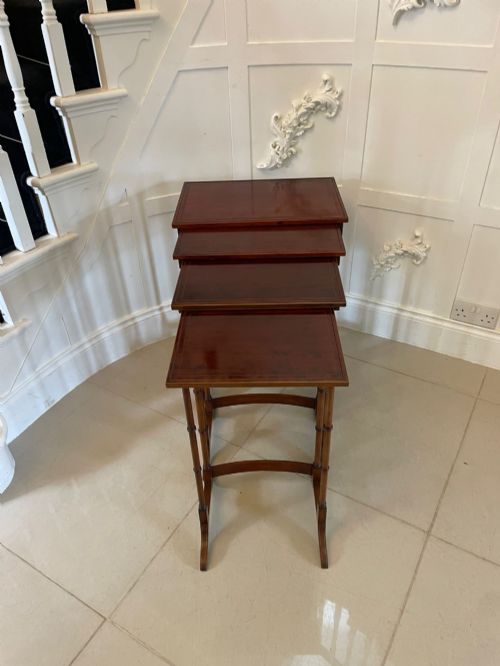
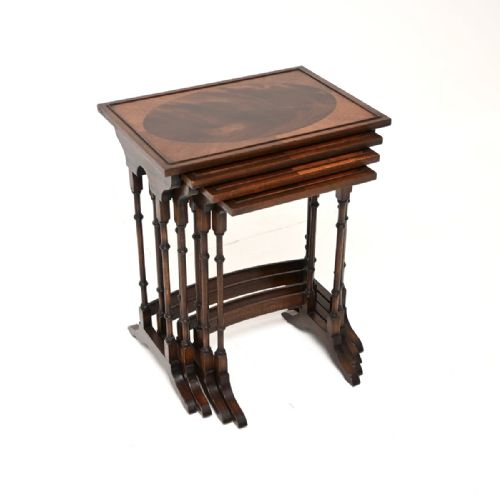
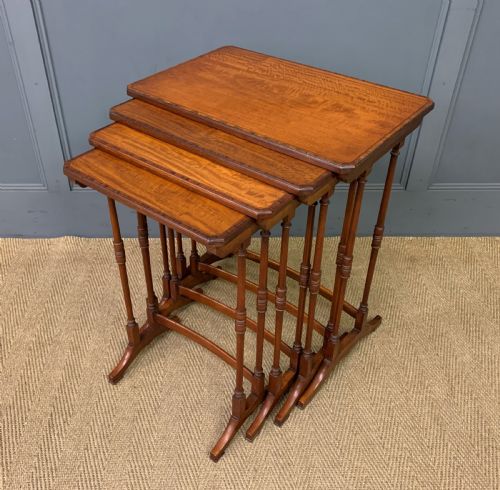
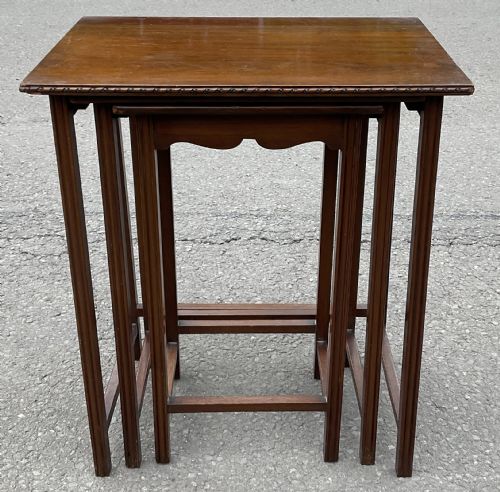
Georgian style nest tables are sets of graduating occasional tables designed to stack together when floor space is at a premium. These pieces typically comprise sets of three, four, or five tables that share matching timber frames and stylistic details.
Most examples encountered here originate from the Edwardian period or the early twentieth century, alongside nineteenth century pieces built in revival aesthetics. They draw heavily on classic Georgian and Sheraton design principles while serving modern living arrangements.
Makers utilised forms ranging from rectangular quartetto sets to oval coffee tables and occasional tables. The smaller tables slide sequentially beneath the largest top surface, maintaining a cohesive look whether stacked or deployed around a room.
What Varies in Quality
Quality rests in the precision of the timber selection and the crispness of the boxwood inlay work. Superior sets feature finely figured mahogany or satinwood grain that matches harmoniously across all graduating tiers.
The engineering of the frame determines longevity, distinguishing robust joints from loose construction that suffers from repeated stacking and removal. Attention to detail in the edgebanding and leg proportions separates standard utility pieces from finer cabinet work.
Listings feature nests built across the Edwardian era, the nineteenth century, and the 1920s using mahogany, satinwood, yew veneer, and boxwood inlay.
Waring & Gillow
The Georgian Style Nest Tables Glossary
- Quartetto
- A matched set of four stacking tables designed to nest inside one another. This term appears frequently in Edwardian cataloguing for nests of four.
- Veneer
- A thin layer of decorative wood applied over a secondary timber base. Yew and satinwood veneers added visual contrast to mahogany table tops.
- Boxwood Inlay
- Contrasting light wood strips inserted into recesses in the primary timber surface. This technique created geometric borders and delicate decorative lines.
- Sheraton Style
- A neoclassical furniture design idiom characterised by straight tapered legs and symmetrical classical motifs. Many Edwardian nests incorporate these specific stylistic elements.
Georgian Style Nest Tables: Frequently Asked Questions
How do I care for these tables?
Dust regularly with a soft dry cloth and avoid placing wooden surfaces near direct heat sources or strong sunlight. Wax polishes help maintain the sheen on mahogany and satinwood veneers.
Lift each table individually rather than sliding them across rough flooring to protect the joints and the underside runners. Proper handling preserves the tight tolerances required for smooth stacking.
Were these tables made in the Georgian period?
Most stacking nests found today date from the Edwardian era or the early twentieth century, echoing earlier eighteenth century aesthetics. Authentic eighteenth century nests are exceptionally uncommon because multi-tier stacking tables became popular later.
Cabinet makers in the nineteenth and twentieth centuries adopted Georgian and Sheraton design vocabulary to create these functional items. The construction methods, secondary timbers, and hardware usually point to these later revival periods.
How many tables come in a set?
Sets typically consist of three, four, or five graduating tables that slide together. Quartetto sets specifically designate groups of four tables designed to nest within the main frame.
Each table diminishes incrementally in height and width to fit precisely under the one preceding it. Checking the count ensures all original tiers remain together as a complete unit.
What woods were used to build them?
Mahogany served as the primary structural timber for the frames and legs across the majority of pieces. Cabinet makers frequently enhanced the top surfaces with satinwood or yew veneer.
Boxwood provided the pale material for contrasting inlay lines and decorative banding. These combined timbers created durable furniture with varied grain patterns and warm colour tones.