


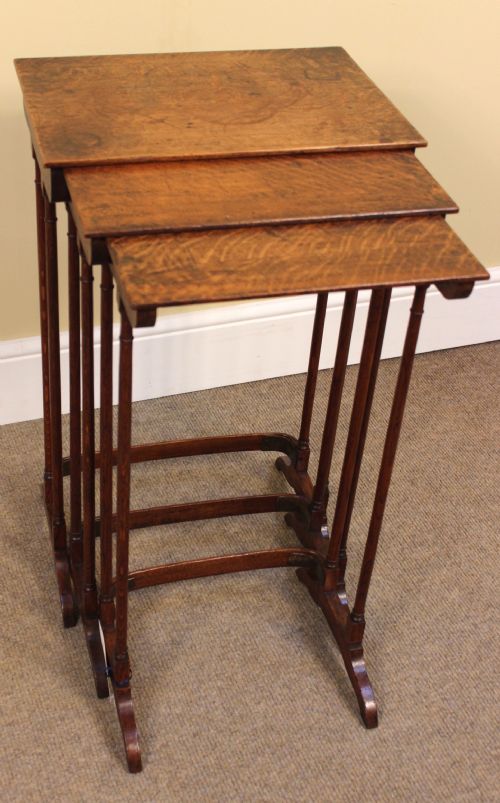


Wooden Accent Tables Set
These wooden accent tables set pieces provide modular surfaces for daily use, combining historical cabinet-making with practical home arrangement.
Wooden Accent Tables Set
A wooden accent tables set comprises nested groups of multiple tables that slide neatly beneath one another to save floor space when not in use. Buyers browsing this selection encounter multi-tiered sets typically ranging from three to five pieces, designed for flexible placement around a room.
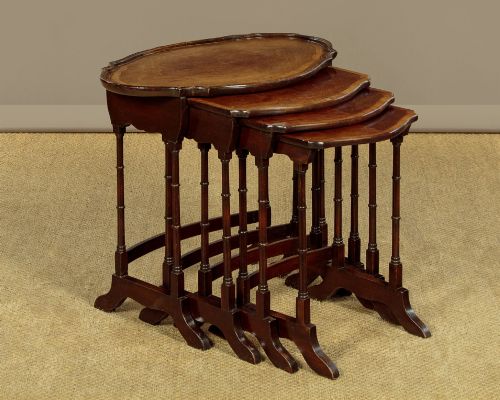
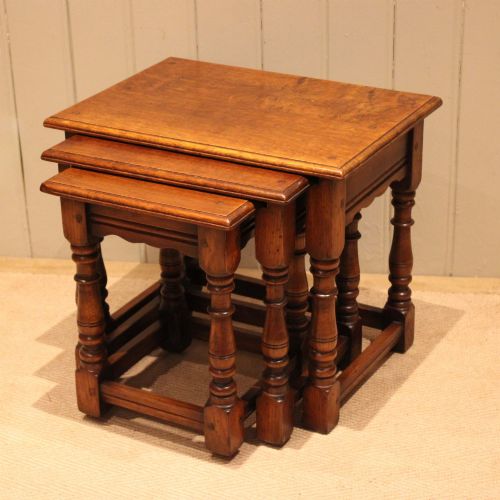
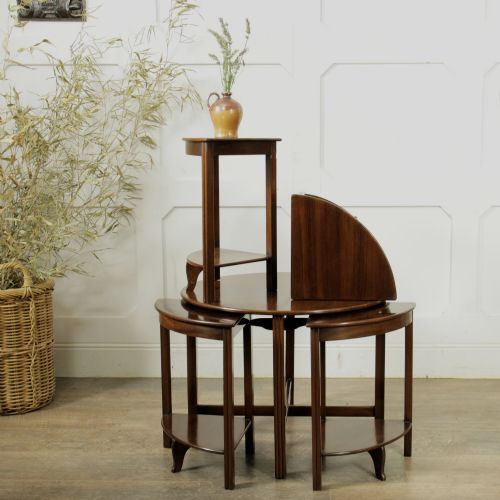
The configurations span several distinct historical eras, with Edwardian and Victorian pieces appearing frequently alongside items from the 1920s. Common formats include rectangular quartetto sets, circular tops, and serpentine designs reflecting English Country, Jacobean Revival, and Art Deco influences.
Origins vary from domestic British workshops to Asian export production, yielding diverse structural proportions. Most examples function as coffee tables or occasional surfaces, deploying clever graduated sizing to stack into the footprint of a single table.
Materials and construction methods
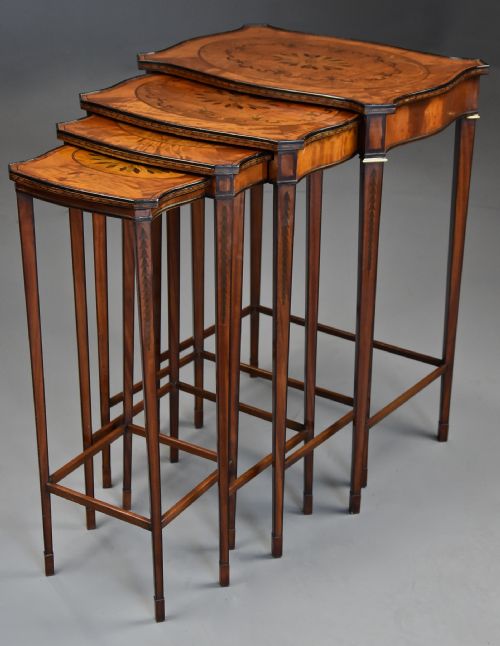
Cabinet-makers relied on sturdy timbers such as oak, mahogany, walnut, and teak to build durable frames capable of withstanding regular withdrawal and stacking. Workshops often selected figured grains like burr walnut or incorporated contrasting satinwood and rosewood inlay to create decorative borders along the table edges.
Construction techniques balanced lightness with structural integrity so each smaller table retained stability despite its slender proportions. Artisans shaped serpentine forms, turned legs, and carved hardwood details by hand, applying traditional joinery to secure the tops to the supporting frames.
Some Edwardian makers built five tables into a single nest, challenging anyone to remember the exact order of descent.
Assessing craftsmanship and finish
Quality in a wooden accent tables set is determined by the precision of the nesting mechanism and the crispness of the timber selection. Finer examples display seamless alignment when stacked, ensuring each smaller table slides smoothly into its designated slot without binding.
The sophistication of the ornamentation further distinguishes standard production from superior craftsmanship. Master workshops invested greater labour in complex satinwood inlay, delicate serpentine shaping, and well-figured mahogany or walnut surfaces that catch the light evenly.
The Wooden Accent Tables Set Glossary
- Quartetto
- A set of four nesting tables designed to fit together progressively. This term frequently appears in Edwardian and Victorian catalogue descriptions.
- Nest of tables
- A graduated group of occasional tables sized so each smaller piece slides under the next larger one. They maximise floor space in smaller rooms.
- Satinwood inlay
- A decorative technique where contrasting light satinwood is set into the primary timber surface to form borders or motifs. It adds visual brightness to dark woods like mahogany.
- Serpentine form
- A gently undulating curved edge resembling a snake's movement. Makers applied this profile to table tops to soften rigid rectangular lines.
Wooden Accent Tables Set: Frequently Asked Questions
How were nesting tables used historically?
Historically, these sets served as versatile furniture for entertaining guests in parlours and drawing rooms. Servants or hosts could quickly pull out the smaller tables to distribute tea cups, books, or writing materials around the seating area.
Once the gathering concluded, the tables stacked back into a single compact unit against a wall or beside a chair. This space-saving utility made them particularly popular in Edwardian and Victorian households where room optimisation mattered.
How do I tell Edwardian pieces apart from Victorian ones?
Edwardian tables generally display lighter, airier proportions with slender turned legs and refined satinwood or rosewood inlay work. Makers of this era favoured Sheraton revivals and delicate serpentine shapes that reflected a shift away from heavier Victorian aesthetics.
Victorian examples tend to use denser timbers like solid mahogany or oak with more substantial framing and conservative profiles. Examining the internal joinery and secondary woods often clarifies the specific period of manufacture.
Can these tables be used as daily coffee tables?
Many of these sets function effectively as flexible coffee tables in modern living spaces. The larger primary table anchors the arrangement while the smaller tiers distribute across the room as needed for drinks or decorative objects.
Care should be taken with historical finishes when placing hot cups or moisture directly onto the wood surface. Using coasters preserves the polished timber and maintains the integrity of the original polish.
What does quartetto mean in table sets?
Quartetto specifically designates a set consisting of four graduated tables designed to nest together. Originating in the nineteenth century, the term highlights the interconnected nature of the four pieces.
When fully assembled, they occupy the floor space of only the largest table. Each descending size fits precisely beneath the preceding frame.