


Vintage Water Landscape
These vintage water landscape pieces bring rivers, canals and coastal scenes into rooms through oil and watercolour.
Vintage Water Landscape
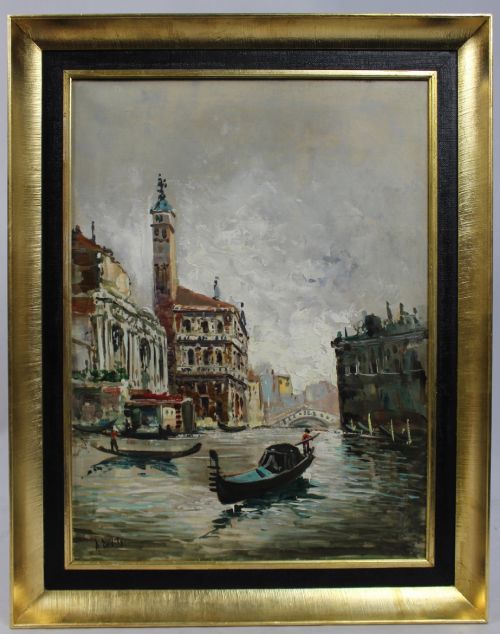
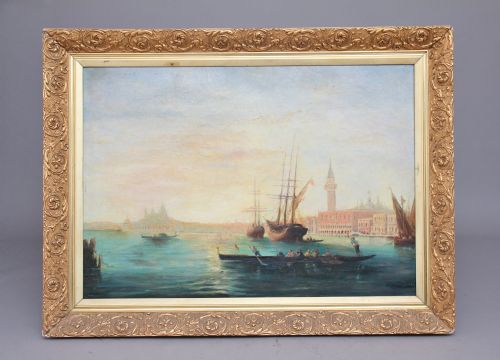
A vintage water landscape captures rivers, lakes, canals and coastal views through the lens of nineteenth and twentieth-century painters. These works span Edwardian river scenes, Venetian waterways, and French impressionist interpretations of lakes and ponds.
Most pieces encountered on this page belong to the twentieth century, particularly the decades between nineteen-ten and nineteen-fifty. Watercolours on paper and oil paintings on canvas or panel dominate the selection.
The subjects range from quiet rural streams and cattle watering holes to bustling maritime harbours and Italian canals. Artists from British, French and Italian traditions record these watery settings with varied atmospheric effects.
Materials and Techniques
The physical works rely principally on watercolour on paper or oil paint applied to canvas, board and panel. Painters use brushwork ranging from tight, detailed maritime rigging to loose, impressionistic dabs representing water lilies and reflections.
Gilt framing and glass protection often accompany these works, preserving delicate paper surfaces and enhancing oil paintings. Supports include wood panels, canvas stretched over wooden frames, and heavy artist papers bearing watermarks.
Subjects include Venetian canals, French riverbanks, Scottish highlands, and Yorkshire village waterways.
Evaluating Quality in Water Landscapes
Quality rests upon the artist's handling of light, atmosphere and the fluid properties of water. Superior examples demonstrate confident brushwork and precise tonal control, capturing the transient reflections of sky and foliage without stiffness.
The strength of the composition and the preservation of the medium dictate distinction. Works retaining vibrant pigments on stable canvas or clean paper outrank dull or heavily restored equivalents.
Antonio DeVity·Mario Pinetti·Armand Guillaumin·Yves Brayer·Adolphe Gumery·Charles Rene His
The Vintage Water Landscape Glossary
- Watercolour
- A paint consisting of pigment suspended in a water-soluble binder, traditionally applied to paper. It creates luminous, transparent washes of colour.
- Impressionism
- A nineteenth-century painting style focusing on accurate depiction of light and its shifting qualities. Artists utilise visible brush strokes and open composition.
- Gilt
- Covered thinly with gold leaf or gold paint. Frames often feature this finish to complement the artwork within.
- Panel
- A flat piece of wood or other rigid material used as a support for oil paintings. Painters used panels frequently before canvas became standard.
Vintage Water Landscape: Frequently Asked Questions
What is a vintage water landscape?
A vintage water landscape is a painting or watercolour depicting rivers, lakes, canals or the sea, produced during the nineteenth or twentieth century.
These artworks record natural bodies of water alongside human interaction such as shipping, bridges and watering livestock.
How do I care for watercolour paintings?
Watercolour paintings require protection from direct sunlight to prevent the pigments and paper from fading over time.
Keeping them behind glass with acid-free mounts safeguards the delicate paper surface from atmospheric moisture and dust.
How are oil paintings on canvas structured?
Oil paintings utilise slow-drying paint applied to woven canvas stretched across a wooden framework known as a stretcher.
This method allows artists to build rich textures and layers of colour that remain durable over centuries.
How do I date an antique painting?
Dating relies upon stylistic clues, artist signatures, framing methods and the physical composition of the canvas or paper support.
Exhibiting labels, stamps on the reverse, and historical records help confirm the precise period of creation.