
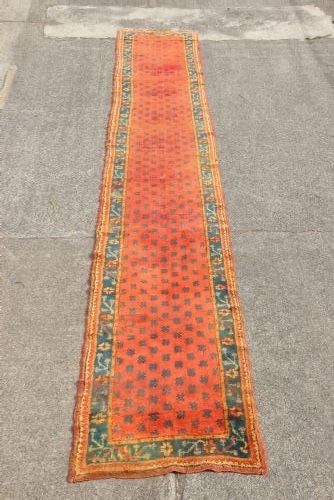



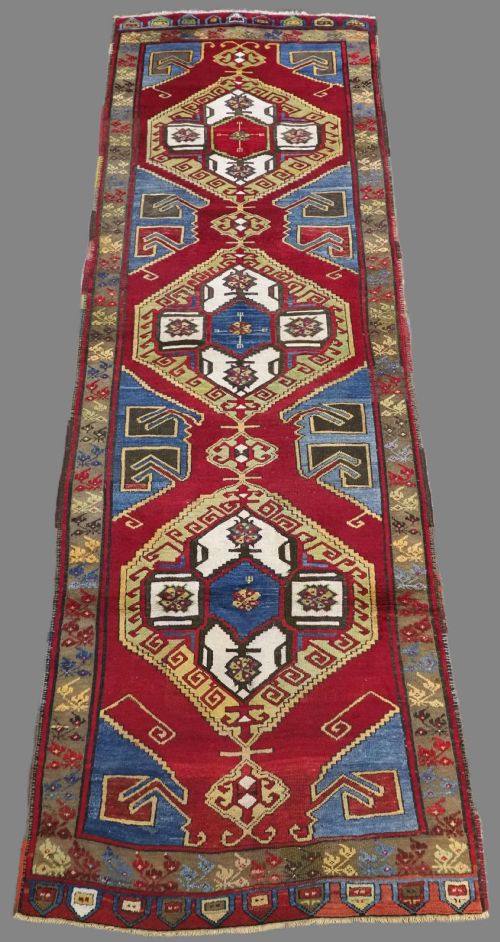


Vintage Turkish Hallway Rug
A vintage turkish hallway rug brings instant warmth and texture to narrow spaces through generations of woven skill.
Vintage Turkish Hallway Rug
A vintage turkish hallway rug provides a practical yet decorative floor covering tailored for long, narrow passages. Buyers searching for a vintage turkish hallway rug typically encounter runner formats produced across various Anatolian regions during the late nineteenth and early twentieth centuries.
These floor coverings appear in styles described as Anatolian tribal, Ottoman, and traditional Anatolian. The forms span narrow runners, long rugs, and half kilim varieties suited to corridor placement.
Materials and construction
Makers construct these floor coverings utilising natural fibres such as wool and cotton. Wool forms the pile and foundation weaves, providing resilience for high-traffic corridors.
Techniques combine traditional knotting methods with flatweave kilim construction, particularly in hybrid pieces like half kilim kelim runners. These methods produce durable textiles designed to withstand daily wear.
Listings span production dates from eighteen eighty through to nineteen thirty, utilising wool and cotton across diverse Anatolian styles.
Assessing quality
Quality differentiates through the fineness of the weave and the complexity of the traditional design. Tighter knot counts and precise geometric or floral patterns separate superior examples from simpler tribal work.
Condition also dictates standing, where evenly distressed piles from age hold greater appeal than irregular wear. The harmony of natural dyes and the integrity of the original wool foundations further define the tier of each piece.
The Vintage Turkish Hallway Rug Glossary
- Runner
- A long, narrow carpet format specifically designed for hallways, corridors, and stairs. These pieces measure significantly longer than they are wide.
- Kilim
- A flatweave textile produced without a pile by tightly interweaving warp and weft threads. Half kilim runners combine flatweave sections with knotted pile areas.
- Oushak
- A traditional style originating from the town of Usak in western Turkey, known for large-scale floral motifs and soft colour palettes. These are frequently found in runner dimensions.
- Anatolian
- Pertaining to Anatolia, the historical region encompassing the Asian portion of Turkey. This term covers regional tribal weaving traditions.
- Warp
- The stationary vertical threads stretched on a loom that form the structural foundation of the rug. The pile knots are tied around these foundational cords.
Vintage Turkish Hallway Rug: Frequently Asked Questions
Where do these runners work best?
These narrow floor coverings fit naturally into corridors, hallways, and entryways where length matters more than width.
They also serve well in narrow kitchens or beside beds where traditional rectangular rugs take up too much floor space.
How do I clean an old wool runner?
Gentle surface vacuuming without a beater bar removes everyday dust and loose debris from the wool pile.
Professional specialist cleaning is recommended for deeper maintenance to protect the natural dyes and historical fibres.
Are these rugs durable for daily foot traffic?
Constructed from sturdy natural wool and cotton, these textiles endure regular walking in busy household corridors.
Using a quality underlay prevents slipping and cushions the foundation against hard subfloors.
How do I identify different regional styles?
Regional styles appear through distinct design motifs, colour choices, and weaving structures native to areas such as Ushak, Konya, or Kirsehir.
Tribal pieces often feature geometric motifs, whereas city workshops tended towards curvilinear floral compositions.