

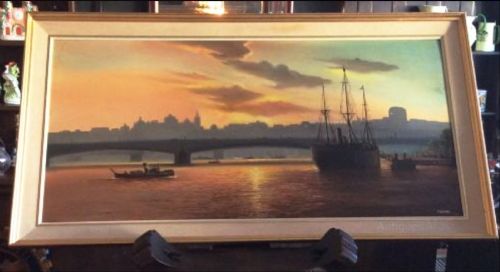
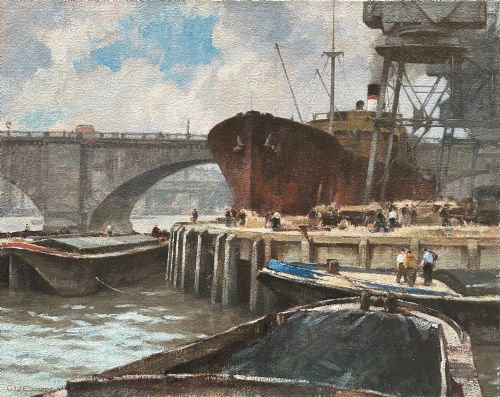


Vintage Thames River Scene
These vintage thames river scene works capture London's waterway and shipping through oils and watercolours spanning the late nineteenth to mid twentieth century.
Vintage Thames River Scene
A vintage thames river scene presents maritime views of London's waterway, featuring historic bridges, barges, and the city skyline. When exploring this selection, collectors encounter watercolours and oil paintings that document the river from the nineteenth century through the mid twentieth century.
The subjects range from busy commercial pools near London Bridge and Tower Bridge to quieter stretches at Richmond and Windsor. Works assignable to the Edwardian period and British Impressionism frequently appear among these topographical and marine paintings.
Makers represented in these listings include named artists such as Edward Henry Eugene Fletcher, Frank William Scarbrough, and Walter Duncan. These creators record the changing maritime traffic and architectural landmarks along the Thames during their respective eras.
Materials and methods
Artists rendering a vintage thames river scene utilised oil on canvas or watercolour pigment on paper. Oils provide heavy texture and depth for shipping and moody atmospheric skies, while watercolours rely on fluid washes to capture river light and mist.
Many works incorporate glass and gilt framing to protect and display the paper or canvas surfaces. The application of paint ranges from the tight topographical detail of the Victorian era to the looser brushwork associated with British Impressionism.
Several artists captured the exact moment steam tugs and wooden barges crowded beneath Waterloo Bridge.
Judging quality in river scenes
Quality in a vintage thames river scene rests on the artist's ability to render atmospheric light and movement in water and shipping. Stronger examples display confident brushwork and precise topographical rendering of London landmarks such as St Paul's Cathedral or the Pool of London.
The preservation of the pigment and the condition of the canvas or paper surface influence the visual impact. Works by established practitioners command attention through their handling of scale, perspective, and the bustling maritime activity of the Thames.
Alfred Young Nutt·Cyril Walduck Edwards·Edward Henry Eugene Fletcher·Walter Duncan·Frank W. Scarborough·Lieutenant Harold E Frecker·EW Haslehurst·Carleton Grant·Herbert John Finn·Edward Seago·R. Allan
The Vintage Thames River Scene Glossary
- Topographical watercolour
- A detailed painting on paper that records specific geographical locations and architecture with accuracy. These works often serve as historical documents of London's changing riverfront.
- Marine painting
- Artwork depicting ships, shipping, and maritime scenes on rivers, seas, or harbours. This genre forms a significant portion of the river views.
- Impressionism
- An art style focused on capturing light and fleeting moments rather than meticulous detail. British practitioners applied these principles to local landscapes and riverways.
- Gilt frame
- A wooden picture frame coated with gold leaf or metallic paint. Such framing is typical for protecting and enhancing nineteenth and twentieth century oils.
Vintage Thames River Scene: Frequently Asked Questions
What periods do these paintings cover?
The works span from the late nineteenth century through the Edwardian era up to the mid twentieth century, reflecting shifting artistic styles.
Artists during these decades recorded the transformation of London's commerce, bridges, and maritime traffic along the Thames.
How do I choose between oil and watercolour?
Oil paintings on canvas offer heavy texture and rich colour suited to dramatic skies and busy commercial pools of water.
Watercolours on paper provide delicate luminosity and fine detail, capturing the softer atmospheric mists peculiar to the river.
Which London landmarks appear most often?
Common landmarks include Tower Bridge, London Bridge, Waterloo Bridge, and Richmond Bridge alongside St Paul's Cathedral.
Views also encompass the Upper and Lower Pools of London filled with working Thames barges and shipping vessels.
How should I display these artworks?
Protect watercolours behind glass away from direct sunlight to prevent fading of the pigment on paper.
Oil paintings on canvas benefit from stable indoor environments that avoid excessive humidity or rapid temperature changes.