
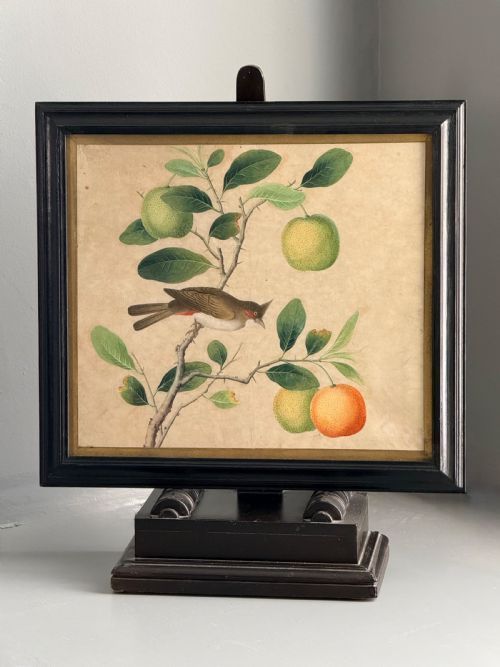
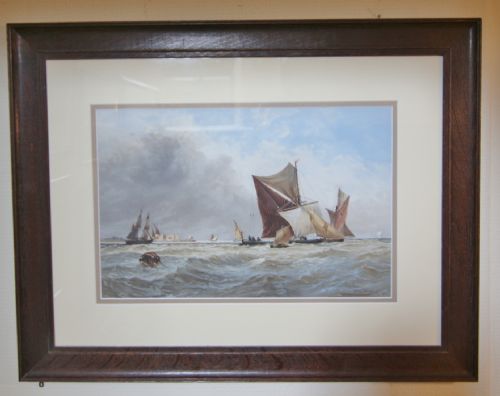

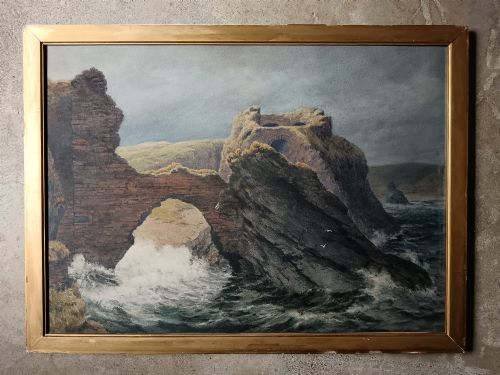


Large Watercolour Painting
A large antique watercolour painting brings scale and tonal subtlety to a room, offering genuine period atmosphere through transparent pigment and fine paper.
Large Watercolour Painting
A large antique watercolour painting serves as a substantial wall piece, typically executed on paper or pith paper and protected behind glass within a wood or gilt frame. When searching for a large antique watercolour painting, buyers encounter works ranging from expansive coastal scenes and architectural studies to detailed landscape and maritime compositions.
The selections span the eighteenth century through the early twentieth century, taking in Georgian, Victorian, and Edwardian periods alongside Chinese export and Japanese ink examples. Victorian British landscapes and Scottish coastal views appear frequently, often recording specific castles, harbours, and rural riversides.
Many works bear the signatures of known artists or studios, whilst others remain initialled or attributed to regional schools. They function primarily as framed artwork for principal rooms, combining observational detail with the fluid handling characteristic of watercolour pigment and gouache.
How they were made
Watercolour pigment was mixed with water and applied to absorbent paper or occasionally pith paper, relying on the white of the ground to provide luminosity beneath transparent washes. Artists often added touches of opaque gouache to highlight details, anchor shadows, or build texture within architectural and coastal subjects.
Completed sheets were mounted and housed behind glass to protect the fragile paper surface from atmospheric moisture and dust. Framing typically involved moulded wood, frequently finished with gilt or gilding, securing the artwork within a traditional wall display format.
What varies in quality
The strength of a large antique watercolour painting depends upon the artist's command of tone and perspective, where confident brushwork defines the architectural structure or the movement of a seascape. Skilled handling preserves the luminosity of the paper, whereas lesser examples rely on heavy, overworked washes that flatten the composition.
Condition heavily influences standing, particularly regarding the preservation of pigment against fading and the absence of damp staining across the paper. Original frames with period gilding also contribute to the integrity of the piece, anchoring the work within its historical context.
TB Hardy·James Haylla·John Moxon·Stuart Lloyd·David Cox Jnr·Martinetti·Stephen John Batchelder·Frederick Williamson·Arturo Orselli·Willie Stephenson·Frederick Tucker·Jane Utley·Harry Wanless·George Cattermole·George De Paris·Herbert John Finn·Hirst Walker·Matthew Jarvis·Olive Higginbottom·WH Romaine Walker·Stephen Frank Wasley·John Atkinson Grimshaw·Ward Heys·Paul Marny
The Large Watercolour Painting Glossary
- Gouache
- An opaque watercolour paint made from pigment mixed with a water-binding agent and a white inert material. It allows artists to apply lighter highlights over darker washes.
- Pith paper
- A delicate material formed from the cellular pith of the Tetrapanax papyrifer plant, historically used for botanical and figurative paintings in China. It possesses a unique velvety texture.
- Maritime
- Pertaining to the sea or ships, describing coastal views, harbour scenes, and shipping traffic. These subjects were especially popular among nineteenth-century British artists.
- Topographical
- A style of painting or drawing that accurately records a specific place, building, or landscape feature. These works often serve as historical records of towns and countryside.
Large Watercolour Painting: Frequently Asked Questions
How should I hang a large antique watercolour painting?
Position the artwork away from direct sunlight to prevent the watercolour pigments and paper support from fading over time. Ensure the wall is dry and stable to protect both the historic frame and the paper behind the glass.
Use heavy-duty fixings suited to the weight of the timber and glass assembly. Hang the centre of the painting at standard eye level for optimal viewing in a reception room or hallway.
Are these paintings executed on paper or canvas?
The primary support for these works is paper, occasionally including specialised surfaces such as pith paper. Watercolour pigment requires an absorbent paper base to achieve its characteristic transparent washes.
Some historical mountings involve attaching the paper sheet to a secondary canvas or backing board for added structural support. However, the medium itself remains water-based painting on paper rather than oil on canvas.
How can I tell a Victorian watercolour from an 18th-century piece?
Eighteenth-century works often employ softer, more restrained palettes with tinted monochrome underdrawings, reflecting classical landscape conventions. Paper stocks from this era frequently display visible laid chain lines when examined closely.
Victorian examples tend to exhibit brighter, more varied pigments and a freer handling of light, particularly in maritime and coastal subjects. Subject matter also shifts towards narrative scenes, specific British topography, and romanticized rural life.
What is the difference between watercolour and gouache?
Watercolour relies on transparent pigments that allow the white of the paper to shine through, creating luminous skies and water. Layers are built up from light to dark with fluid washes.
Gouache incorporates an opaque white additive, giving the pigment body and a matte, chalky finish. Artists frequently combined both mediums on the same sheet to add solid highlights to a transparent watercolour wash.