




Grey Watercolour River Landscape
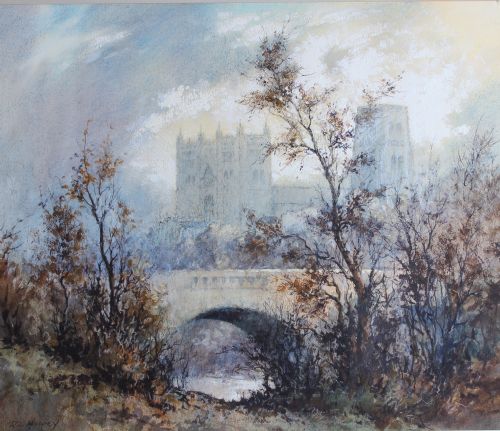
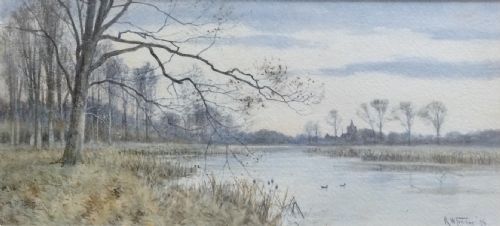
A grey watercolour river landscape captures the quiet moods of waterways across Britain through delicate monochrome washes and subtle tones.
Grey Watercolour River Landscape
A grey watercolour river landscape portrays rural streams, urban rivers like the Thames, and coastal docks rendered chiefly in muted greys, sepia, and restrained pigments. These works span from the nineteenth century through the mid-twentieth century, recording changes in British topography and pastoral life.
The versions most commonly found here belong to the Edwardian and late Victorian periods, alongside early twentieth-century British works. Artists use watercolour paint and ink on paper, often framed behind glass within wooden surrounds.
Subjects range from quiet rural tributaries in Yorkshire and Suffolk to grand metropolitan river scenes featuring London landmarks such as St Paul's Cathedral and Westminster Bridge.
Materials and technique
These works rely primarily on watercolour pigment and ink applied to paper supports, utilising the natural white or cream of the sheet to create highlights through reserve painting. Painters layer translucent washes to build atmospheric depth, capturing mist, smoke, and reflective water surfaces without heavy opaque pigments.
Most surviving examples are preserved beneath glass within timber frames that protect the fragile paper surface from atmospheric moisture and handling damage.
The listings span from the nineteenth century through the 1960s, executed in watercolour paint, ink, and paper.
Assessing quality and execution
Quality rests upon the sureness of the brushwork and the artist's ability to suggest atmosphere and movement with minimal strokes. Superior watercolours demonstrate confident control over fluid washes, where tone and line work in harmony to define architecture, water, and sky.
The preservation of the paper support and the clarity of the original pigment heavily influence the standing of an individual piece. Works that retain their subtle tonal gradations without excessive fading or discoloration display the full intended range of the painter.
Robert Leslie Howey·Arthur Reginald Smith·Alfred Grey·A. G. Hayward·Thomas James Lloyd·Walter Duncan·Fred Lawson·Amos Green·Frank W. Scarborough·Noel Harry Leaver·Robert Winchester Fraser·Henry John Sylvester Stannard·Frank Wasley·Carleton Grant·Frances E Nesbitt·William A. Macdonald·Herbert John Finn·Henry J. Kinnaird·Arthur Anderson Fraser·George Graham
The Grey Watercolour River Landscape Glossary
- Watercolour
- A painting method in which the paints are made of pigments suspended in a water-based solution. The technique relies on translucent washes on paper.
- Wash
- A thin, fluid layer of watercolour paint spread across the paper to create smooth areas of tone or colour. It forms the basis of sky and water effects in landscape painting.
- Topographical
- Representing specific real places accurately rather than inventing an imaginary scene. Many period watercolours served as detailed records of towns, rivers, and historical buildings.
- Support
- The underlying physical material upon which the artwork is painted. In these works, this is almost exclusively paper.
- Pigment
- The finely ground coloured powder that gives watercolour its tint. In monochrome or grey landscapes, artists restrict their palette to greys, blacks, and subtle earth tones.
Grey Watercolour River Landscape: Frequently Asked Questions
How should I frame and hang my watercolour?
Keep watercolours away from direct sunlight to prevent the pigments and paper from fading over time. Professional framing with acid-free mounts and protective glass safeguards the delicate paper surface.
Ensure your painting hangs on an interior wall where humidity and temperature remain stable. Good framing preserves the integrity of nineteenth and twentieth-century works for decades to come.
What subjects appear in these river landscapes?
The works depict a range of British waterways, from quiet rural streams in Yorkshire and Suffolk to busy metropolitan stretches of the River Thames in London. Artists also recorded bridges, cathedrals, and pastoral riverbanks.
Some pieces capture industrial wharves and foggy urban mornings, while others focus on quiet countryside floods and mountain streams.
How do I identify the period of a watercolour?
Dating relies on stylistic clues, framing materials, and artist signatures recorded alongside the work. Edwardian and Victorian paintings often bear specific signatures and exhibition titles that help trace their exact era.
Paper types and framing styles can also offer clues, though contemporary framing sometimes replaces the original period surround.
What is the difference between a sketch and a finished painting?
A finished watercolour displays deliberate composition, careful tonal layering, and refined details intended for exhibition. Sketches often feature rapid pencil lines and experimental brushstrokes used to capture a fleeting scene.
Both forms appear in historical collections, with finished works usually bearing a signature and title.