

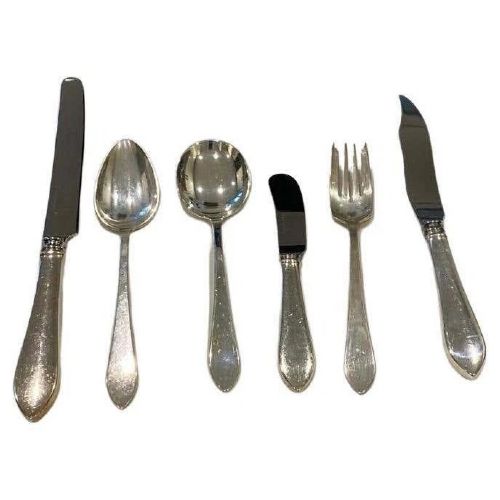


Vintage Silver Dessert Knives
These vintage silver dessert knives bring a particular tactile weight to the table, combining polished metal handles and blades with natural materials like mother-of-pearl.
Vintage Silver Dessert Knives
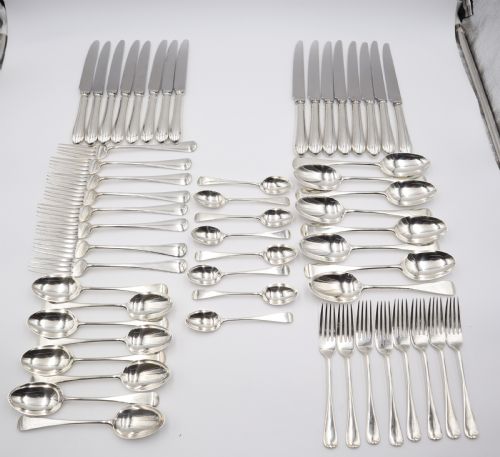
Vintage silver dessert knives comprise individual fruit knives, cased sets, and larger serving cutlery originating from the Victorian, Edwardian, and Art Deco periods. When you search for vintage silver dessert knives, you encounter pieces designed specifically for fruit courses and after-dinner dining rather than heavy main meals.
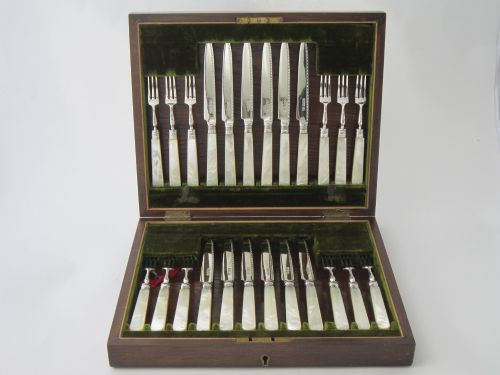
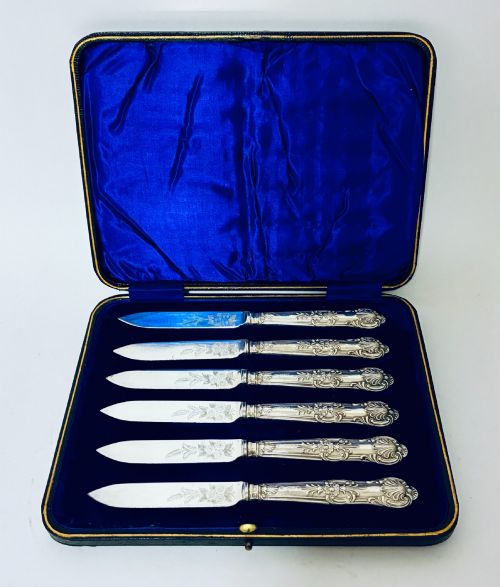
The assortment on this page ranges from mid-19th-century Victorian examples to 1930s Art Deco French servers and George V sterling silver sets. Many surviving pieces retain their original fitted boxes, often lined in velvet or housed in oak canteens.
Formations include cast silver blades, solid silver gilt designs, and steel blades paired with decorative handles. Collectors often find matching sets of six alongside individual knives meant for fruit and sweet courses.
Materials and construction
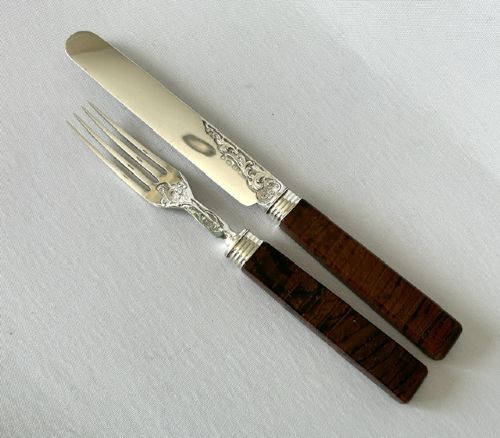
Maker workshops utilised sterling silver and silver plate for blades and mounts, frequently pairing them with organic handle materials such as mother-of-pearl and agate. Steel appears in blades particularly alongside natural handle materials.
Handles carved from mother-of-pearl or shaped from agate demonstrate detailed hand-finishing, secured to metal shafts with pins. Cast silver blades exhibit crisp detailing, while silver gilt finishes provide a rich, warm tone across nineteenth-century Dutch and British examples.
Some nineteenth-century Dutch dessert knives feature solid silver gilt blades that make slicing an apple feel like a royal decree.
Assessing quality and craftsmanship
Quality rests in the harmony between the handle material and the metalwork, where finely matched mother-of-pearl scales or richly figured agate show superior selection by the maker. The crispness of cast detail on the blade and bolster distinguishes finer workshop output from standard production.
The survival of fitted wooden presentation cases, particularly oak canteens with intact velvet linings, elevates the standing of a set. Uniformity across a multi-piece service indicates high-tier manufacture, whereas assembled sets reveal greater variation in individual execution.
Tiffany
The Vintage Silver Dessert Knives Glossary
- Sterling silver
- A silver alloy containing 92.5 percent pure silver by mass, standard for quality British cutlery.
- Silver plate
- A base metal coated with a thin layer of silver, common in twentieth-century French servers.
- Mother of pearl
- The iridescent inner layer of certain mollusc shells, utilised widely for knife handles.
- Silver gilt
- Silver objects coated with a thin layer of gold on the surface, creating a warm two-tone appearance.
- Canteen
- A fitted box or chest designed specifically to store a complete set of cutlery securely.
Vintage Silver Dessert Knives: Frequently Asked Questions
How were dessert knives used?
These knives were used during the fruit or dessert course at the end of a formal meal, designed to slice fruit without reacting to citric acid.
They sat beside the plate alongside matching forks, often presented in velvet-lined boxes when brought to the dining table.
What periods do these knives span?
The pieces span from the mid-nineteenth century through the Edwardian era up to the 1930s Art Deco period.
Victorian and Edwardian examples sit alongside later George V sets and French servers from the interwar years.
Are these knives found in sets?
Yes, many survive as cased sets of six or twelve, sometimes complete with matching forks and serving pieces.
Others appear as individual serving knives or paired sets housed in original oak canteens.
What handle materials appear most often?
Mother-of-pearl is the most frequent natural handle material seen alongside silver blades and mounts.
Agate and wood also appear on specific nineteenth-century pieces, adding colour and texture to the tableware.