

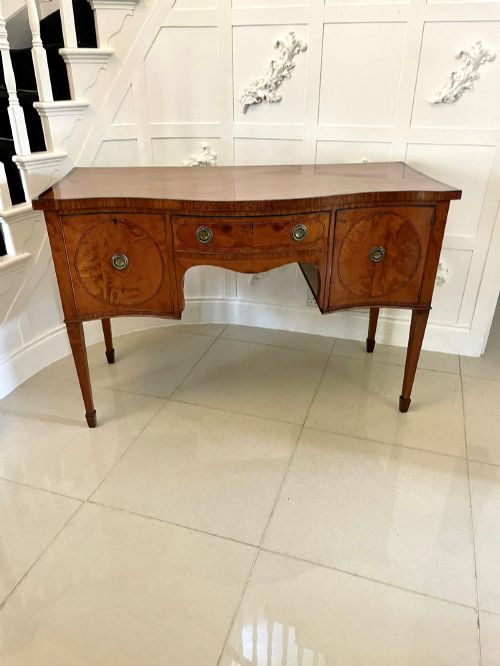
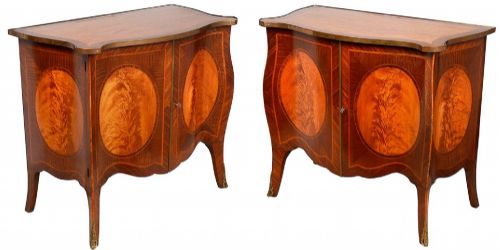


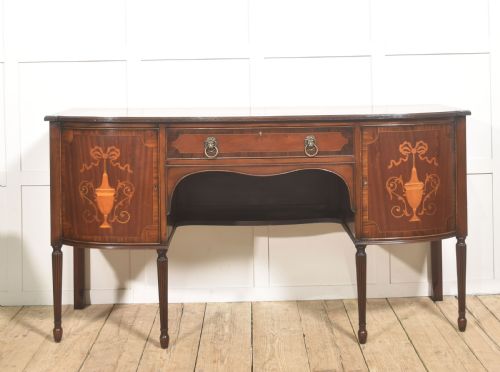

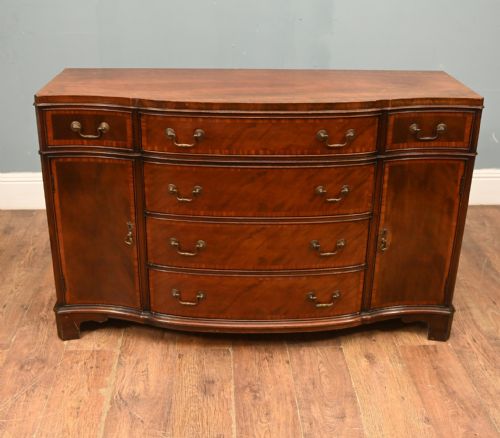

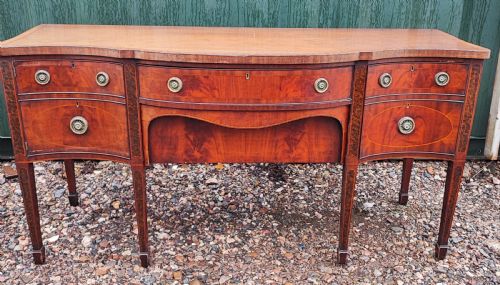


Vintage Serpentine Credenza
A vintage serpentine credenza brings sweeping lines and rich timbers into a dining room or hall.
Vintage Serpentine Credenza
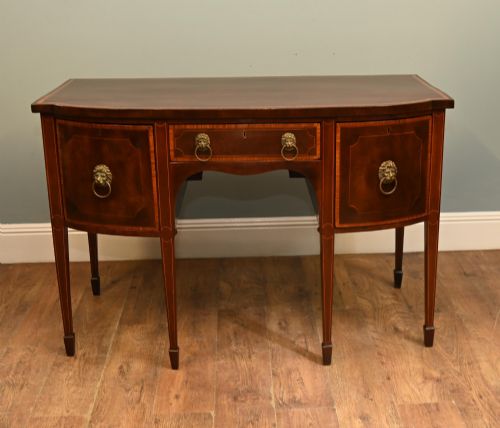
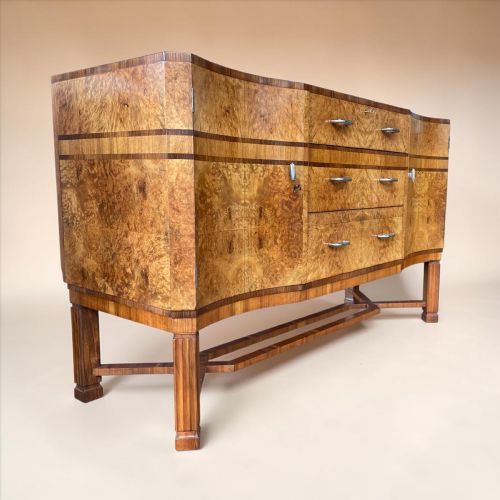
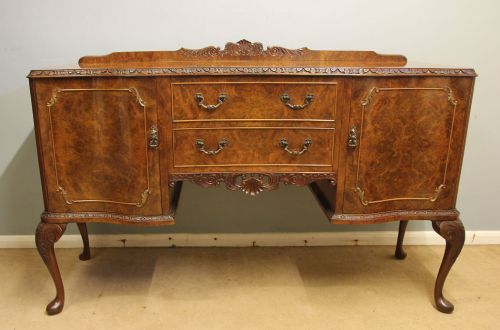
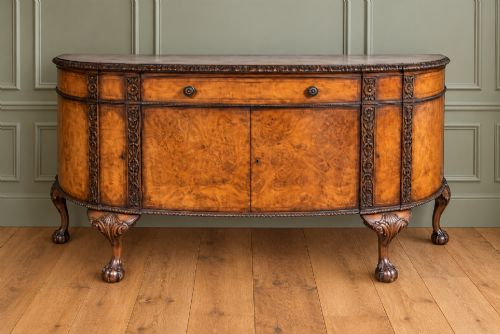
A vintage serpentine credenza is a low storage piece defined by its undulating, curved front and substantial presence. When searching for a vintage serpentine credenza, buyers encounter forms ranging from Victorian satinwood pieces to Art Deco walnut servers and Edwardian inlaid designs.
The selection on this page draws together sideboards, commodes, and side cabinets spanning the nineteenth and twentieth centuries. Mahogany and burr walnut dominate the forms, often detailed with marquetry and brass mounts.
How they were made
Cabinet makers built these pieces using solid timbers and decorative veneers such as burr walnut, satinwood, and mahogany over sturdy carcases. Complex curved drawer fronts and doors required precise shaping of the wood to achieve the signature serpentine outline.
Surface ornamentation involved intricate marquetry inlay, polished glass, and applied brass or ormolu mounts. Marble tops also appeared on specific mid-nineteenth-century iterations, adding weight and a cool tactile contrast to the timber.
Vintage Serpentine Credenza Retail Price Guide 2026
Typical asking prices for vintage serpentine credenza among the pieces listed under this phrase on Sellingantiques today, from the lower quarter to the upper quarter. They describe what is for sale here now, not the wider market.
One unexpected burr walnut server arrived equipped with its own twelve-piece cutlery set, ready for immediate deployment.
What varies in quality
Quality rests upon the choice of timber and the ambition of the joinery, particularly in how smoothly the curved drawers and doors operate within their frames. Highly figured burr walnut and delicate satinwood with balanced marquetry distinguish more ambitious commissions from simpler production.
The refinement of the carved details, the crispness of any inlay work, and the integration of brass or ormolu mounts indicate the skill of the original workshop. Pieces designated as exhibition quality display a higher level of decorative handwork across every surface.
Epstein
The Vintage Serpentine Credenza Glossary
- Serpentine
- A curved shape that bends inward at the centre and outward at the ends, creating a gentle undulating line across the front of a piece.
- Credenza
- A low cabinet or sideboard traditionally used for serving food or displaying decorative objects, often featuring doors and enclosed shelving.
- Marquetry
- Decorative veneer patterns formed by fitting together small pieces of different coloured woods, ivory, or shell to create pictorial or geometric designs.
- Ormolu
- Gilded bronze mounted onto furniture as decorative handles, feet, or edging during the eighteenth and nineteenth centuries.
- Satinwood
- A hard, durable timber with a golden sheen, frequently utilised in fine cabinet making for delicate inlay and decorative veneers.
Vintage Serpentine Credenza: Frequently Asked Questions
Where should I place a credenza?
These low cabinets suit dining rooms, hallways, or spacious living areas where their curved fronts can be viewed without obstruction. They provide useful surface space for lamps or serving items while keeping storage enclosed beneath.
Ensure there is sufficient clearance around the undulating front so the doors and drawers open fully without hitting adjacent furniture.
What is the difference between a credenza and a sideboard?
A credenza is typically a lower, more decorative cabinet often associated with Victorian and continental forms, while sideboards frequently include cutlery drawers and serving surfaces tailored for the dining room. Both categories overlap considerably in everyday usage and historical styling.
Serpentine fronts appear across both types, shaping the visual rhythm of the room regardless of the specific cabinet classification.
How do I care for the polished surface?
Dust the timber regularly with a soft, dry cloth to prevent microscopic particles from scratching the traditional wax or French polished finish. Avoid placing the cabinet in direct sunlight or near heat sources to prevent the wood veneers from drying out.
Apply a quality beeswax polish sparingly every few months to maintain the natural lustre of the mahogany or walnut.