

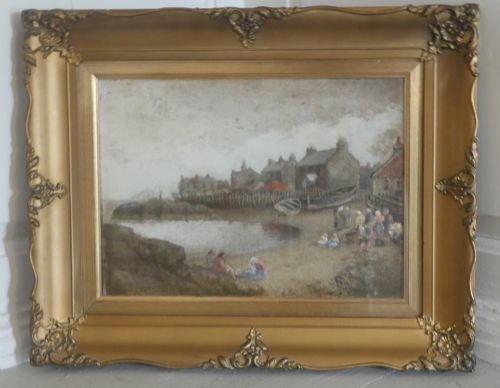


Vintage Seaside Oil Painting
A vintage seaside oil painting brings the salt air and shifting light of the coast straight into a room.
Vintage Seaside Oil Painting
A vintage seaside oil painting captures coastal life, marine landscapes, and beach scenes across diverse historical periods. Collectors seeking a vintage seaside oil painting encounter works ranging from Victorian coastal views to mid-century impressionist harbour scenes.
The selection includes depictions of British and European shores, from Yorkshire coastal villages and Cornish fishing ports to French cliffs and Italian waters. These works span the nineteenth century through to the 1960s, reflecting changing artistic interpretations of the sea.
Common formats include canvas and board supports, framed in wood or gilt wood, presenting varied interpretations of maritime light and shore activity.
Materials and technique
These works rely on oil paint applied to canvas or board, utilising the rich medium to build texture and depth. Artists handled oil paint to capture the movement of surf, the glare of sand, and the atmospheric haze of coastal weather.
Supports range from traditional stretched canvas to wooden board, framed with wood or gilt wood surrounds that complement the period of the painting.
Listings feature works spanning the nineteenth century, Victorian era, and mid-century periods, executed in oil on canvas and board.
Distinctions in quality
Quality rests in the artist's handling of light, atmosphere, and the specific character of coastal locations. Stronger works demonstrate confident brushwork and a clear command of tone, capturing the transient effects of weather and tide rather than mere topographical recording.
The sensitivity of the palette and the harmony between the painted scene and its frame also distinguish finer examples within the genre.
Clifford Hanney·Edward Mills·William J B Jenkins·William Raymond Dommersen·Alfred Henry Vickers·Jack R Mould·John Sanderson Wells·Robert Macaulay Stevenson·William Greaves·James Watson·Alfred Egerton Cooper·Harry John Pearson
The Vintage Seaside Oil Painting Glossary
- Oil on canvas
- A traditional painting medium where oil paint is applied to a woven fabric support stretched over a wooden frame. This combination allows for flexible application and enduring stability.
- Board
- A rigid flat support made of wood or composite material used by artists as an alternative to stretched canvas. It provides a firm surface well suited to plein air painting.
- Impressionism
- An art movement focusing on accurate depiction of light and its changing qualities, often painted outdoors. Works in this style prioritise visible brushstrokes and luminous colour over strict realism.
- Gilt wood
- Wood carved and finished with a thin layer of gold leaf or metallic gilt paint. Such frames are frequently found on nineteenth and early twentieth-century fine art.
- Fauvism
- A style characterised by strong, non-naturalistic use of colour and bold brushwork. In coastal works, this approach results in vivid, expressive interpretations of sea and shore.
Vintage Seaside Oil Painting: Frequently Asked Questions
What periods do these paintings cover?
The works span from the Victorian era and the nineteenth century through the early twentieth century, including the 1910s, 1920s, and 1930s, up to the mid-century period of the 1950s and 1960s.
This broad timeline demonstrates how artists continuously returned to coastal subjects, adapting their styles from nineteenth-century realism to impressionism and fauve experimentation.
Are these paintings on canvas or board?
Artists used both oil on canvas and oil on board depending on preference and period convention. Board was particularly favoured for outdoor or plein air sketching.
Both supports have proven durable over the decades, preserving the varied textures of oil paint across different coastal scenes.
How do I choose the right frame?
Many pieces retain their original wood or gilt wood frames, which often reflect the aesthetic of the period in which the painting was created.
When selecting a piece, consider whether the frame enhances the artwork and fits the intended interior space.
Where do these coastal scenes originate?
The geographic scope includes diverse British coastal locations such as Yorkshire, Cornwall, Wales, and the Dorset coast, alongside continental European shores in France and Italy.
Each location offers a distinct quality of light and architecture, from bustling fishing harbours to quiet cliff paths.