

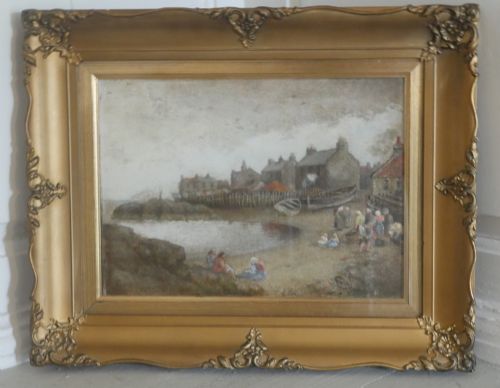


Vintage Seaside Oil Landscape
These vintage seaside oil landscape paintings capture coastal light and shorelines, offering a slice of maritime heritage for your walls.
Vintage Seaside Oil Landscape
A vintage seaside oil landscape brings coastal views and maritime atmosphere directly into a room through oil paint applied to canvas or board. These works capture specific shorelines, harbours, and cliffs, preserving historical moments by the water.
The pieces on this page span several periods, from Victorian works and the early twentieth century through to mid-century impressionism. Buyers will frequently encounter British coastal scenes alongside continental views rendered in styles ranging from realism to post-impressionism.
Subjects stretch from busy Cornish fishing ports and Yorkshire bays to French cliffs and Italian coastlines. Each painting records how artists over the past two centuries interpreted the meeting of land and sea.
Materials and technique
Artists painted these coastal views using oil paint applied predominantly to canvas or wooden board. The medium allowed for rich texture and layered colours that could capture shifting coastal light and turbulent marine weather.
Support materials varied according to the period, with traditional stretched canvas common in nineteenth-century and early twentieth-century works, while later mid-century pieces often utilise firm wooden boards. Frames frequently consist of gilt wood, which complements the warm tones of the painted surfaces.
Vintage Seaside Oil Landscape Retail Price Guide 2026
Typical asking prices for vintage seaside oil landscape among the pieces listed under this phrase on Sellingantiques today, from the lower quarter to the upper quarter. They describe what is for sale here now, not the wider market.
One particular coastal scene captures an unexpected gathering of a boxer, a photographer, and a lady in white by the seaside.
Distinguishing quality
Quality in these coastal paintings rests upon the artist's ability to handle light, atmosphere, and movement in water or sky. Superior works demonstrate a confident brushstroke and a balanced composition that draws the viewer into the maritime scene.
The distinction between standard decorative pieces and finer works often lies in the descriptive precision of the brushwork and the subtle handling of coastal hues. Stronger examples convey the specific mood of a location, whether a breezy Yorkshire bay or a sunlit Italian coast.
Clifford Hanney·Edward Mills·Norman Lloyd·William J B Jenkins·William Raymond Dommersen·Alfred Henry Vickers·Jack R Mould·John Sanderson Wells·Robert Macaulay Stevenson·William Greaves·James Watson·Alfred Egerton Cooper
The Vintage Seaside Oil Landscape Glossary
- Oil on canvas
- Pigments bound in a drying oil, usually linseed, applied to a woven fabric support stretched across a wooden frame. This traditional combination allows for subtle blending and rich surface textures.
- Oil on board
- Pigments applied directly to a rigid wooden or composition panel rather than a fabric support. This method provided artists with a firm, stable surface often favoured for plein air painting.
- Gilt wood
- Wood carved and coated with a thin layer of gold leaf or gold-coloured paint used for picture frames. It adds a traditional decorative border that enhances the tones within the painting.
- Impressionism
- An art movement characterised by relatively small, thin yet visible brush strokes and an emphasis on accurate depiction of light in its changing qualities. It appears frequently in twentieth-century coastal interpretations.
- Fauvism
- A style of early twentieth-century modern art emphasising painterly qualities and strong colour over the representational values retained by impressionists. Works in this manner use bold, non-naturalistic hues for dramatic effect.
Vintage Seaside Oil Landscape: Frequently Asked Questions
What periods do these paintings cover?
The works span from the Victorian era and the nineteenth century through the early twentieth century up to the mid-century period. Each era brings distinct framing and stylistic approaches to coastal subjects.
Earlier pieces often lean towards realism, while later decades embrace impressionist and modernist interpretations of the shore.
Where were these coastal scenes painted?
Artists painted locations around the British coastline, including Yorkshire, Cornwall, Wales, and the south coast of England. Continental scenes from France and Italy also feature among the works.
Many paintings record specific topographical viewpoints, such as Whitby, Polperro, or Sidmouth.
How should I display an oil painting?
Hang the artwork away from direct sunlight and sources of extreme heat to protect both the oil paint and the canvas or board. Stable indoor humidity helps preserve the structural integrity of the wooden frames and supports.
Ensure the wall fixings are secure and appropriate for the weight of the framed piece.
How do I identify a board painting from a canvas?
Canvas yields slightly to a gentle press and shows a woven textile texture behind the paint layer. Board provides a completely rigid, unyielding surface.
Boards were frequently utilised for quick outdoor studies or by artists working on smaller scales during the mid-twentieth century.