


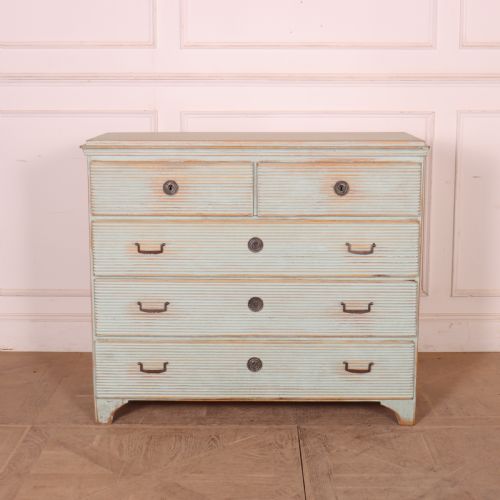


Vintage Scandinavian Commode
A vintage Scandinavian commode brings architectural restraint and luminous native timbers to a room, offering practical storage with distinct Nordic character.
Vintage Scandinavian Commode
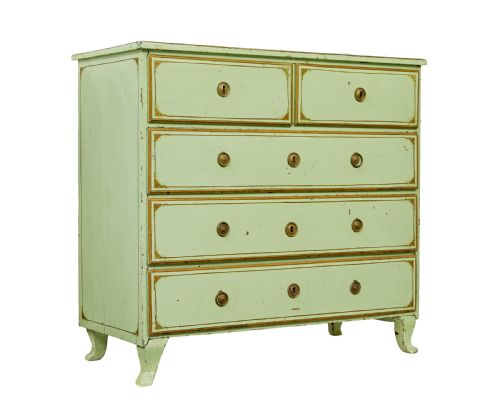
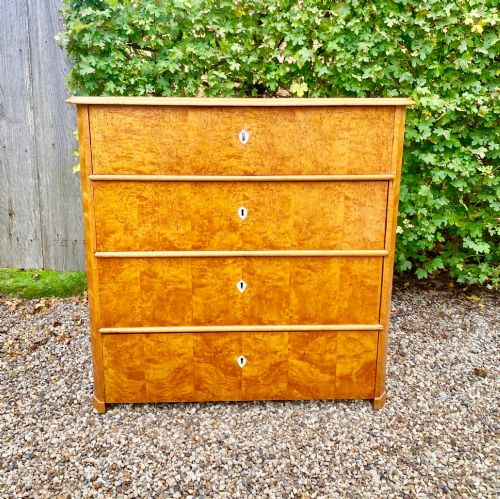
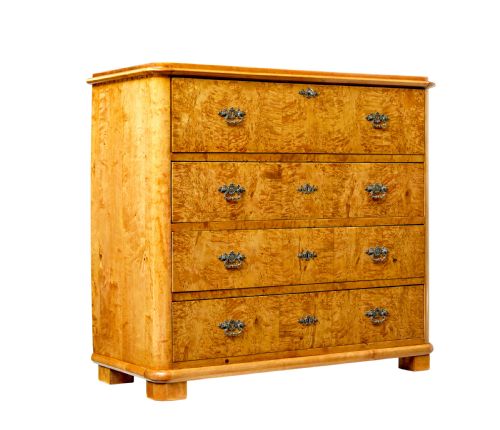
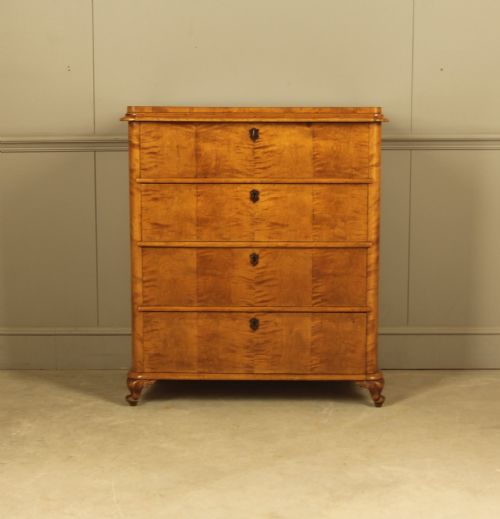
When you search for a vintage Scandinavian commode, you enter a domain defined by nineteenth-century craftsmanship, where storage forms take the shape of serpentine chests, straight-front drawer units, and secretaire desks. The most common form you will meet on this page is the Swedish chest of drawers, frequently constructed with figured birch or finished in historic paint.
The regional styles stretch from Gustavian restraint and Biedermeier warmth to Scandinavian country and continental folk art. Pieces span the nineteenth century alongside select works from the early decades of the twentieth century, reflecting both urban cabinet-making and rural traditions.
Beyond standard chests, the selection accommodates allied forms such as painted cupboards and specialised seating, yet the core remains the drawer unit. These pieces served domestic life in northern Europe, balancing utilitarian storage with sophisticated surface treatment.
Materials and construction
Cabinet-makers relied heavily on native softwoods and hardwoods, constructing carcasses from pine and surfacing them with veneers of flame birch, burr birch, satin birch, or burr walnut. Timber selection prioritized striking grain patterns, particularly on drawer fronts where book-matched flame veneers create symmetrical visual movement.
Surface finishes alternate between clear polished veneers that highlight natural wood figures and applied historic paint schemes, sometimes simulating finer timbers like birch. Iron and brass hardware, including decorative keyplates and drawer pulls, complete the structural assembly.
Evaluating quality and execution
Quality reveals itself in the handling of timber veneers and the precision of drawer construction, where superior examples exhibit seamless matching across multiple drawer fronts. The crispness of carved details, such as fluted drawer fronts or serpentine curves, distinguishes workshop pieces from simpler provincial output.
Surface preservation dictates overall character, whether through the undisturbed patina of original paint or the deep, warm lustre of polished birch. The integration of functional elements like secretaire compartments demonstrates the maker's architectural ambition and joinery skill.
Gemla Fabrikers
The Vintage Scandinavian Commode Glossary
- Serpentine front
- A furniture front characterised by a undulating curve, convex in the centre and concave at the sides. This shape requires advanced woodworking skill to execute cleanly.
- Flame birch
- A distinctive timber figuring where the grain resembles flickering flames, highly prized by Scandinavian cabinet-makers. It is sliced to create decorative veneer patterns.
- Gustavian
- The Swedish neoclassical style spanning the late eighteenth and early nineteenth centuries, known for pale painted finishes and restrained classical motifs. It emphasises symmetry and proportion.
- Secretaire chest
- A chest of drawers featuring a pull-out writing drawer that conceals smaller compartments and pigeonholes. It combines storage with a compact writing surface.
- Caddy top
- A raised, stepped tabletop profile with moulded edges, commonly found on nineteenth-century case pieces. This detail adds architectural definition to the upper surface.
Vintage Scandinavian Commode: Frequently Asked Questions
How do I identify a Gustavian commode?
Gustavian pieces typically display lighter painted surfaces, often in grey, white, or pale blue, paired with subtle neoclassical carvings like fluting or rosettes. The lines remain straight and architectural rather than heavily curved.
Look for proportioned carcases raised on tapered legs, reflecting the influence of French taste filtered through Swedish restraint during the nineteenth century.
What is flame birch?
Flame birch is a specialised cut of timber featuring a wavy, rippled grain pattern that catches the light like flickering fire. Cabinet-makers used these veneers on prominent surfaces like drawer fronts.
Because the grain is naturally occurring and difficult to match, pieces utilising extensive flame birch veneers indicate higher workshop status.
How were these chests used historically?
These chests served primarily for domestic linen and clothing storage in northern European homes, placed in bedrooms, hallways, or reception rooms. Secretaire variants offered dual utility, doubling as compact desks for household correspondence.
Their robust construction in pine and birch ensured they withstood daily household use across generations in Scandinavian interiors.
Should I choose painted or wood finish?
Choosing between painted and wood finishes depends on the interior atmosphere you wish to create and the historic character you prefer. Painted pieces, including simulated birch or folk art finishes, bring light and rustic charm to a space.
Natural wood pieces highlight the rich grain of birch, burr walnut, or satin birch, offering warmth and traditional cabinet-making texture.