
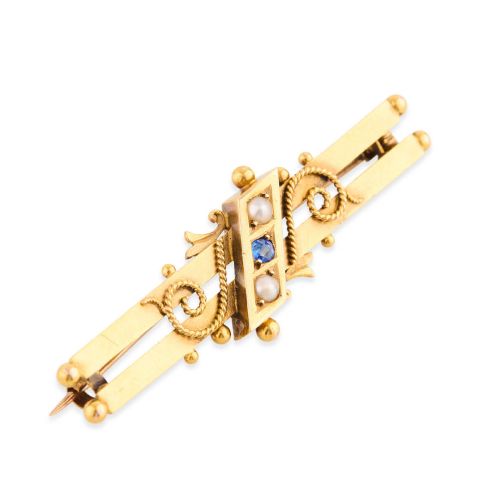


Vintage Sapphire Pin
A vintage sapphire pin brings the rich colour of the stone to a lapel, spanning styles from Victorian bar brooches to Art Deco platinum work.
Vintage Sapphire Pin
A vintage sapphire pin encompasses brooches and dress clips created across multiple eras, including Victorian, Edwardian, Art Deco, Retro and Mid-Century designs. Buyers seek these pieces for their combination of deep blue or yellow sapphire stones set alongside diamonds, pearls, or turquoise.
The pieces appearing here range from simple double bar brooches and circle forms to elaborate figural designs shaped like butterflies, owls, and bows. Early examples often pair the stones with yellow gold or silver-topped gold, while later twentieth-century pieces utilise platinum and white gold.
Victorian and Edwardian versions lean towards floral, crescent, and bar motifs, whereas Art Deco and Retro examples favour geometric symmetry and naturalistic animal forms. Each object serves as a wearable piece of period metalwork holding faceted or unheated sapphires.
Materials and Construction
Goldsmiths constructed these pins using precious metals such as platinum, silver, 15ct gold, 18ct yellow gold, and white gold to secure the central gems. Platinum emerged strongly in the twentieth century for intricate, lightweight settings that could hold numerous small diamonds alongside the main sapphire.
Makers integrated natural sapphires, including basaltic and yellow varieties, accompanied by old-cut diamonds, pearls, and occasionally emeralds or rubies. Settings relied on hand-fabrication, bezel mounts, and delicate claw work to anchor multi-carat stones into bar, bow, and cluster configurations.
Vintage Sapphire Pin Retail Price Guide 2026
Typical asking prices for vintage sapphire pin among the pieces listed under this phrase on Sellingantiques today, from the lower quarter to the upper quarter. They describe what is for sale here now, not the wider market.
Object forms span standard bar brooches, circle pins, and dimensional figures such as owls, butterflies, and bows.
Defining Quality
Quality rests upon the natural origin, clarity, and depth of colour within the sapphire itself, alongside the precision of the surrounding metalwork. Stones described as unheated or possessing strong natural saturation hold greater distinction among collectors.
The artistry of the mounting elevates a piece, particularly when platinum is hand-pierced to form complex geometric patterns or realistic animal plumage set with matching diamonds. Signed workshops and identifiable makers add historical weight to the overall construction.
Rhoda Wager·Gubelin
The Vintage Sapphire Pin Glossary
- Bar brooch
- A narrow horizontal pin format popular during the Victorian and Edwardian periods. These often feature a central sapphire flanked by pearls or diamonds.
- Basaltic sapphire
- A sapphire originating from alkali basalt terrains, known for deep, saturated hues. These stones frequently appear in late nineteenth-century cluster and figural brooches.
- Old-cut diamond
- A hand-faceted diamond shape common in antique jewellery before modern brilliant-cut standards took over. They display smaller tables and higher crowns.
- Platinum
- A dense, durable white metal utilised extensively in twentieth-century jewellery fabrication. It allowed makers to create fine, secure settings without excess weight.
- Unheated sapphire
- A gemstone that has undergone no thermal enhancement to improve its natural colour or clarity. Such stones are prized for their untouched geological state.
Vintage Sapphire Pin: Frequently Asked Questions
How do I wear a vintage sapphire pin?
These pieces suit heavy winter coats, linen jackets, or structured knitwear where the weight of gold or platinum can be supported securely.
Traditional bar brooches sit well on lapels, while larger figural pins work effectively on scarves or dress shoulders.
What periods do these pins come from?
The selections span the late Victorian era through Edwardian, Arts and Crafts, Art Deco, Retro, and Mid-Century modern designs.
Earlier pieces often use yellow gold and pearls, whereas later twentieth-century examples favour platinum and geometric diamond surrounds.
Are the sapphires natural?
Many listings specify natural or unheated sapphires originating from various global deposits, including basaltic sources.
Each period used genuine mined gemstones rather than synthetic substitutes, paired alongside diamonds and precious metals.
How are gold and platinum used together?
Victorian and Edwardian items frequently combine yellow gold bands with silver-topped sections to mount stones effectively.
Later Art Deco and Mid-Century creations transition fully to platinum and white gold for a uniform silvery finish.