

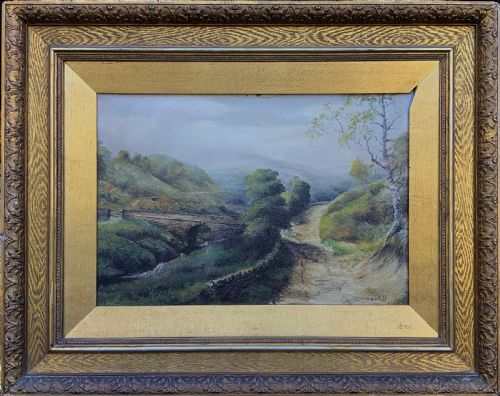
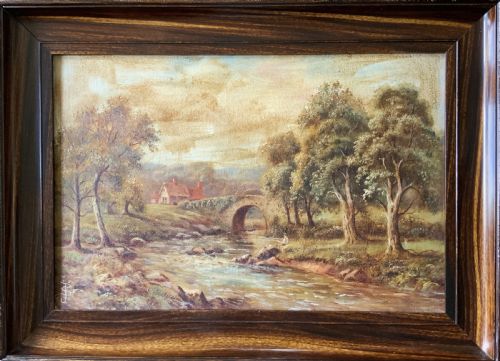

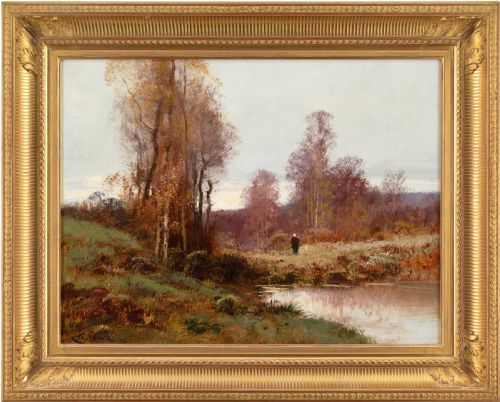


Vintage Rural River Painting
A vintage rural river painting brings the quiet stillness of pastoral waterways and riverbanks straight into a room.
Vintage Rural River Painting
A vintage rural river painting captures pastoral streams, cottages, and figures beside the water across British and European landscapes. These works span the nineteenth century through the mid-twentieth century, encompassing Victorian, Edwardian, and British Impressionist traditions.
Buyers will encounter oil paintings on canvas alongside delicate watercolours on paper. Many pieces depict everyday scenes such as children fishing, cattle watering, or figures crossing a ford.
The selection ranges from anonymous regional studies to signed works by listed artists working within established landscape schools.
Materials and technique
Artists relied primarily on oil paint applied to canvas or wood panels, building rich textures and atmospheric depths. Watercolours on paper offer a lighter, more translucent rendering of English and Scottish countryside views.
Many surviving examples retain their original gilt wood frames, which complement the tones of the pigments used in the compositions.
Several canvases quietly preserve the lingering scent of old linseed oil and decades of country air.
Assessing quality
Quality rests on the sureness of the brushwork and the artist's handling of natural light upon the water and foliage. Stronger compositions demonstrate careful observation of perspective and atmospheric conditions rather than formulaic repetition.
The integration of human figures or animals into the natural setting distinguishes finer works from routine topographical records. Preserved canvas integrity and original framing further elevate an individual piece.
George Graham·Sydney Yates Johnson·Charles Clair·William Joseph Boyes·Gudrun Sibbons·Abraham Hulk Junior·William Hoggatt·William Sidney Cooper·Alois Arnegger·George Turner·Henry John Sylvester Stannard·Henry John Kinnaird·Antoine Bouvard·Robert John Hammond·John B. MacDonald·Yeend King·Wilson·Charles McAuley·Maud Raphael Jones
The Vintage Rural River Painting Glossary
- Oil on Canvas
- Pigment mixed with drying oil applied to a stretched woven fabric support. This medium allowed artists to build rich impasto and deep tonal variations.
- Watercolour
- A painting method where fine pigment is suspended in a water-soluble binder on paper. It creates transparent washes suited to capturing shifting weather and light.
- Gilt Wood
- Timber that has been coated with a thin layer of gold leaf or metallic gilt finish. These frames protect the edges of the canvas and complement the artwork.
- British Impressionism
- A late nineteenth and early twentieth century movement focused on en plein air painting and visible brushstrokes. Artists sought to capture the immediate visual impression of a scene.
- Provincial Landscape
- A regional view depicting local countryside, riversides, and rural architecture without grand historical narrative. These works value topographical accuracy and local character.
Vintage Rural River Painting: Frequently Asked Questions
How do I date a river painting?
Dating relies on stylistic clues, framing methods, and the costumes of any figures depicted within the landscape. Victorian and Edwardian works often display specific palette choices and signature styles characteristic of their decade.
Examining the canvas backing, stretchers, and any inscriptions on the reverse can provide further evidence of the creation period.
Where should I hang my painting?
These landscapes suit spaces with stable humidity away from direct sunlight, which can fade watercolours and oils over time. Placing them on neutral walls allows the natural tones of the river and foliage to stand out.
Pairing a landscape with traditional wooden furniture enhances the historic character of the room.
Are watercolours more fragile than oils?
Watercolours painted on paper are sensitive to light and moisture, requiring glass protection and acid-free mounting to ensure longevity. Oils on canvas offer a more robust surface that withstands normal indoor environments better.
Both mediums benefit from being kept away from direct heat sources and damp walls.
What is the difference between an oil and a watercolour?
Oils use pigment suspended in oil, allowing for thick applications, texture, and deep, saturated colours. Watercolours use a water-based binder on paper, resulting in transparent, luminous effects.
Oils are traditionally stretched on canvas or painted on panels, whereas watercolours are framed behind glass.