
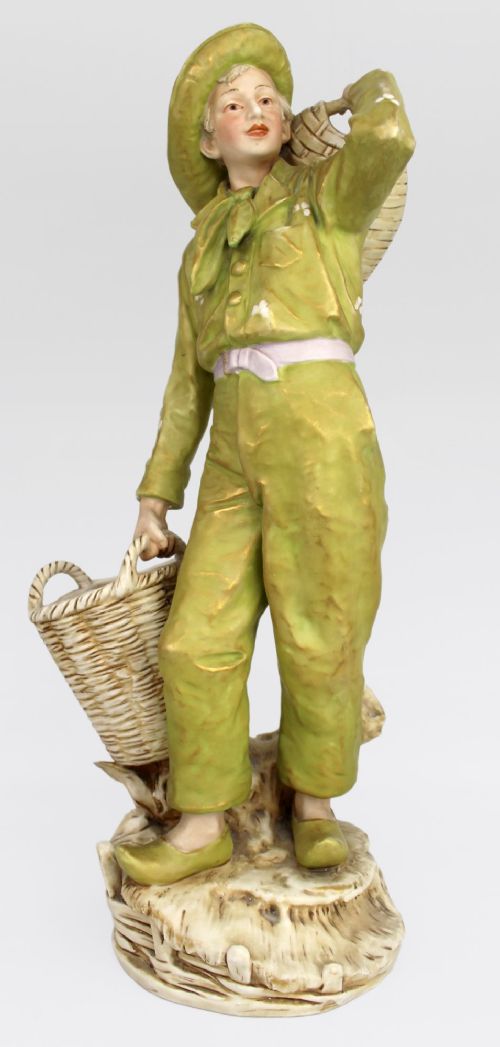


Vintage Royal Dux Statue
These vintage royal dux statue pieces bring sculptural Bohemian ceramic artistry into your home, offering expressive historical figures and animals.
Vintage Royal Dux Statue
When you search for a vintage royal dux statue, you encounter sculptural porcelain figures spanning from the late nineteenth century through the Art Deco era of the nineteen-thirties. These pieces take the form of graceful maidens, fishermen, shepherdesses, and domestic or hunting animals.
The selections you meet most frequently on this page originate from the Edwardian period and nineteen-ten, capturing flowing organic lines or realistic animal studies. They range from intimate cabinet statuettes to monumental figures and substantial pairs designed for prominent display.
How they were made
These items are constructed from porcelain, ceramic, biscuit porcelain, and bisque, utilising fired clay shaped into intricate moulds. Artisans applied glaze, enamel, and occasionally gold leaf to accentuate specific details of clothing or ornamentation.
Modelters such as H. Schubert and Alois Hampel shaped these compositions, combining matte biscuit surfaces with gloss highlights or coloured enamels to create contrast across the porcelain.
Listings feature porcelain, biscuit porcelain, ceramic, glaze, enamel, and gold leaf across pieces dated from the nineteenth century to nineteen thirty.
What varies in quality
Quality in a vintage royal dux statue rests in the crispness of the modelling and the sensitivity of the hand-painted enamel work. Earlier pieces often display sharper definition in facial expressions and drapery folds compared to later mass-produced variants.
H. Schubert·Alois Hampel·Eichwald
The Vintage Royal Dux Statue Glossary
- Biscuit Porcelain
- Unglazed porcelain fired once to vitrification, yielding a matte, tactile surface similar to marble. This material is frequently utilised for the flesh tones and delicate garments of figures.
- Art Nouveau
- A decorative style prevalent around nineteen hundred characterised by undulating organic lines and natural motifs. Figures from this period often depict maidens with flowing hair and sinuous drapery.
- Art Deco
- A design movement prominent by nineteen thirty favouring geometric symmetry and stylised modern forms. Flapper girls and streamlined nudes typify this phase of production.
- Enamel
- Vitreous coloured glass fused to the porcelain surface through firing to add pigment and pattern. It provides vibrant hues on garments and decorative accessories.
- Bisque
- Another term for biscuit porcelain, denoting unglazed ceramic ware. It allows for subtle modelling details without the softening effect of a thick glaze layer.
Vintage Royal Dux Statue: Frequently Asked Questions
What periods do these porcelain figures come from?
The listings span from the nineteenth century through the Edwardian era, nineteen-ten, and into the nineteen-twenties and nineteen-thirties.
Most examples date to the early decades of the twentieth century, encompassing both Art Nouveau and Art Deco aesthetic movements.
How do I identify a genuine piece?
Genuine items typically display the characteristic pink triangle earthenware mark associated with Bohemia, along with impressed model numbers.
Many also retain painted signatures or early numbering systems corresponding to specific sculptural designs.
What subjects are most common?
Human figures include maidens, water carriers, wool spinners, fishermen, shepherds, and flapper girls.
Animal subjects feature hunting dogs, setters, puppies, and kittens, often modelled alone or alongside human companions.
How should I display a large figure?
Monumental figures and large figure groups require a sturdy surface with adequate load-bearing capacity and spatial clearance.
Placing them away from high-traffic walkways protects vulnerable protruding elements like baskets, limbs, or animal tails from accidental knocks.