





Vintage Rosewood Nest
These vintage rosewood nest sets are clever graduating occasional tables that tuck away neatly, offering versatile surfaces for modern living.
Vintage Rosewood Nest
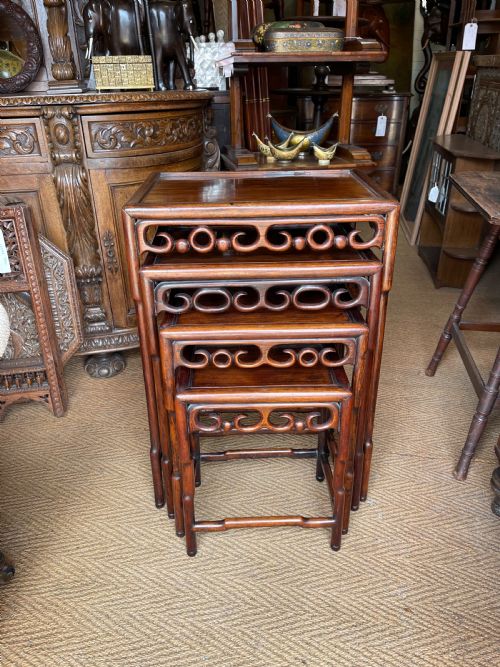
When you search for a vintage rosewood nest, you encounter sets of graduating occasional tables designed to slide one beneath the other to save floor space. The forms span the nineteenth century, nineteen-ten, nineteen-twenty, nineteen-thirty, and the Regency period, alongside Chinese Oriental, Chinese Export, Art Nouveau, Sheraton Revival, Art Deco, and Chinese Qing styles.
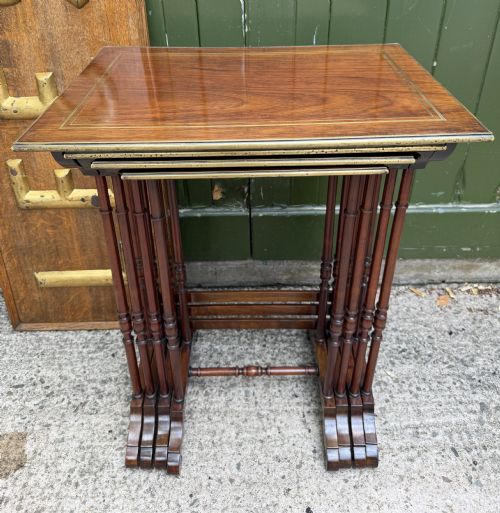
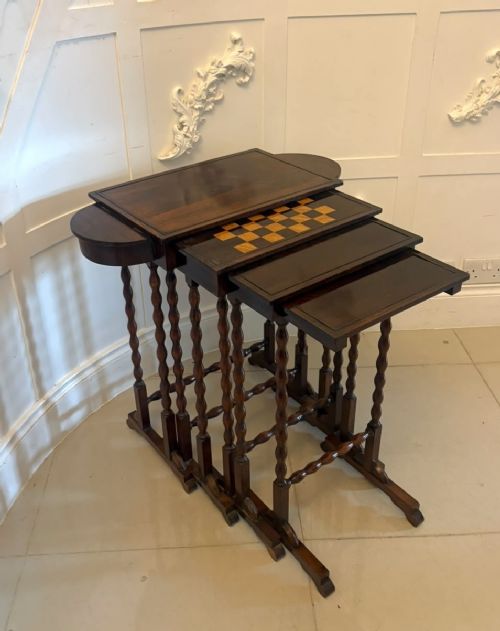
The objects on this page include nests of three tables, nests of four tables, and quartetto sets. You will find pieces shaped as side tables, coffee tables, and occasional tables, sometimes featuring integrated chess boards or brass inlay.
The versions you are most likely to meet combine rosewood, hardwood, satinwood, wood veneer, brass, boxwood, and mahogany. Their origins stretch from French ateliers to Chinese workshops and English cabinet makers.
How they were made
Cabinet makers constructed these nests using solid rosewood, Indian rosewood, carved rosewood, and hardwood, frequently employing wood veneer over secondary timbers. Surfaces were often enhanced with contrasting inlays of satinwood and boxwood.
Structural embellishments include brass inlay work and intricate carving. Individual tables in a set were carefully scaled in graduating dimensions so that each smaller frame fits precisely under the one preceding it.
One exceptional nineteenth-century set doubles as a miniature battleground with an integrated chess table built right into the top.
What varies in quality
The distinction between standard examples and superior pieces rests upon the selection of timber and the precision of the graduating dimensions. Finer sets display carefully matched wood veneers and harmonious grain patterns across all surfaces.
Execution of decorative details such as brass inlay, boxwood stringing, and hand carving marks the difference in craftsmanship. The structural integrity of the joints where the smaller tables slide beneath the larger frames also dictates the overall standard.
Émile Gallé
The Vintage Rosewood Nest Glossary
- Quartetto
- A set of four graduating tables designed to nest together. This term appears frequently in Regency period descriptions.
- Veneer
- A thin layer of superior wood applied over a base timber to create decorative surfaces. Rosewood and satinwood veneers are common in these sets.
- Inlay
- Material embedded into the wood surface to form decorative patterns. Brass, boxwood, and satinwood are typical inlay materials found on these tables.
- Graduated
- Describing a set of tables where each piece decreases in height and width to fit inside the previous one. This sizing ensures the tables stack into a compact single unit.
Vintage Rosewood Nest: Frequently Asked Questions
What is a vintage rosewood nest?
A vintage rosewood nest is a group of graduating tables designed to slide neatly underneath one another. They provide multiple surfaces while occupying the floor space of a single table.
These sets appear in configurations of three or four tables, utilising materials such as rosewood, Indian rosewood, and hardwood.
How were nesting tables used?
Nesting tables were utilised as flexible occasional furniture in drawing rooms and parlours. Individual tables could be pulled out to serve tea, hold books, or play games.
Some specialised examples incorporated integrated chess boards directly into the top surface for entertainment.
How do I identify a Regency nest?
Regency period nests often use the term quartetto and frequently feature brass inlay or contrasting wood stringing. Their forms reflect classical furniture designs of the early nineteenth century.
Cabinet makers of this era focused on clean geometric lines and rich rosewood timbers.
What styles are available?
The available styles range from Regency and Sheraton Revival to Art Nouveau, Art Deco, and Chinese Oriental or Qing designs. Each style brings distinct decorative characteristics to the tables.
French ateliers and Chinese export workshops both contributed unique aesthetic traditions to these graduating sets.