

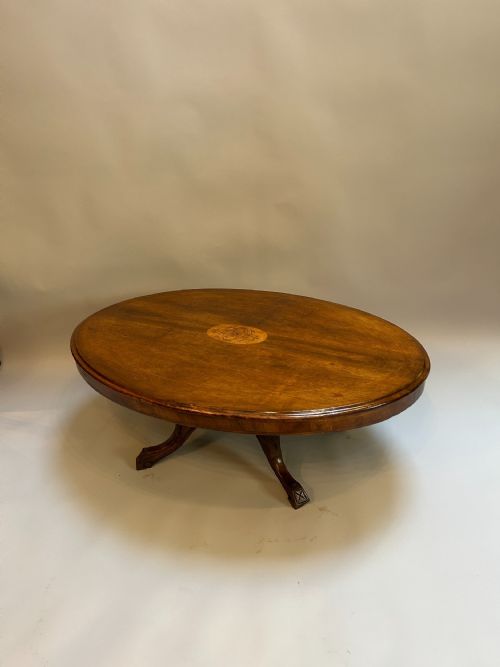


Vintage Oval Centre Table
A vintage oval centre table brings warmth and proportion to a room, offering a welcoming surface that breaks up straight lines.
Vintage Oval Centre Table
A vintage oval centre table serves as a functional and decorative focal point within a room, designed to sit freely in an interior space rather than against a wall. When searching for a vintage oval centre table, buyers encounter a variety of forms ranging from compact coffee tables to larger library and occasional pieces.
The selection on this page spans several distinct periods, with Victorian examples appearing frequently alongside Edwardian and early twentieth-century interpretations. These pieces often adopt revival styles such as Sheraton, French Rococo, and Queen Anne, reflecting the eclectic tastes of their respective eras.
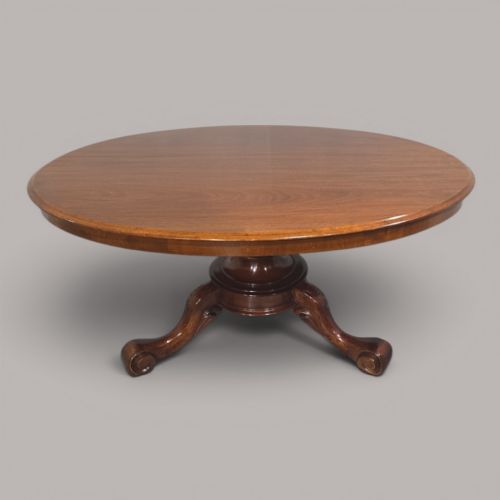
Forms vary significantly, including tilt-top tables, pedestal bases, and two-tier occasional designs. Buyers will find both traditional timber finishes and adapted pieces, such as antique tops paired with modern cast iron bases.
Materials and construction methods
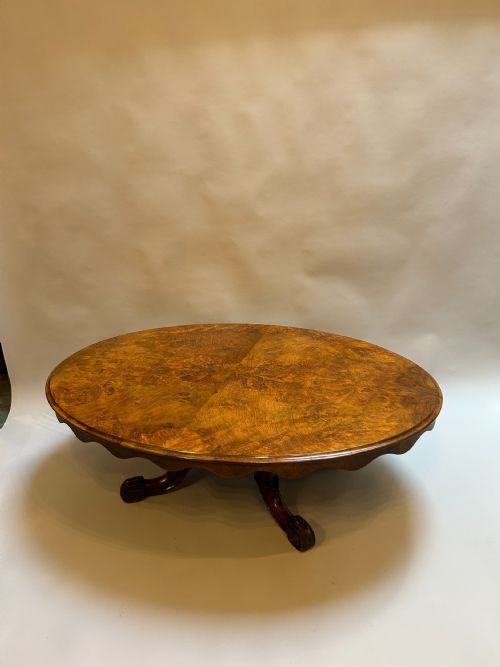
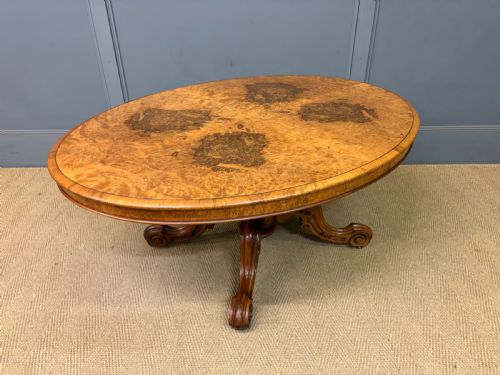
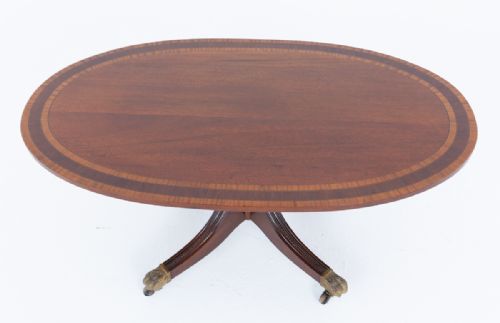
Makers utilised rich hardwoods such as walnut, mahogany, and burr walnut to construct these tables, often selecting figured veneers to create striking surface patterns. Inlay work incorporating boxwood and satinwood adds delicate linear detail to the borders and tops of Edwardian and Sheraton Revival pieces.
Structural elements rely on traditional joinery, with pedestal bases, tripod supports, and hand-carved details appearing across the selection. Selected pieces incorporate additional materials like marble tops and brass mounts, enhancing the decorative weight of the furniture.
The selection includes specialised forms such as library tables, occasional tables, and snap-top designs alongside standard coffee and centre tables.
Distinctions in quality
Quality in these tables is determined by the selection and matching of timber veneers, particularly figured burr walnut and flame mahogany. Superior examples display thoughtful grain alignment across the oval top and refined hand-carved detailing on the pedestals and legs.
Construction integrity also separates standard production items from exhibition-grade pieces. The precision of the inlay work, the stability of the central pivot or pedestal, and the crispness of any carved ornament indicate the standard of craftsmanship invested in the table.
The Vintage Oval Centre Table Glossary
- Burr walnut
- A prized timber harvested from the wart-like growths on walnut trees, yielding highly figured and swirling grain patterns. It was frequently utilised for the top surfaces of Victorian tables to create visual impact.
- Tilt-top table
- A table designed with a mechanism that allows the top to hinge into a vertical position when not in use. This clever engineering saved valuable floor space in nineteenth-century homes.
- Inlay
- A decorative technique where pieces of contrasting wood, such as boxwood or satinwood, are inserted into recessed portions of the primary timber base. It defines the borders and centre motifs of Sheraton Revival and Edwardian pieces.
- Pedestal table
- A table supported by a single central column rising from a weighted base or feet, rather than four traditional corner legs. This design allows for easier seating arrangement around the perimeter.
- Satinwood
- A dense, durable timber with a characteristic golden-yellow sheen and a fine grain. It became popular during the Edwardian period for light, elegant occasional furniture.
Vintage Oval Centre Table: Frequently Asked Questions
What is a centre table?
A centre table is designed to stand free in the middle of a room rather than being pushed against a wall. These pieces were historically used for displaying books, lamps, or decorative objects.
Today, they function brilliantly in open-plan living spaces or large hallways as a striking focal point.
How do I style an oval table?
An oval table softens the geometry of a room filled with rectangular furniture. Its curved edges allow for easier movement around the piece.
Keep the styling balanced by placing a single low centrepiece, such as a ceramic bowl or a stack of art books, in the middle.
What is a tilt-top table used for?
Tilt-top tables, common in the Victorian era, were built with hinges that let the top flip vertically. This allowed owners to tuck the furniture against the wall when they needed extra floor space.
In modern homes, they make fascinating decorative conversation pieces even when kept flat.
How do I identify a Victorian table?
Victorian tables often feature rich dark timbers like walnut and mahogany, accompanied by heavy pedestal bases or carved tripod legs. Many pieces from this period incorporate burr walnut veneers with deep figuring.
Checking the construction underneath often reveals hand-cut joinery typical of nineteenth-century workshops.