



Vintage Oval Back Chair
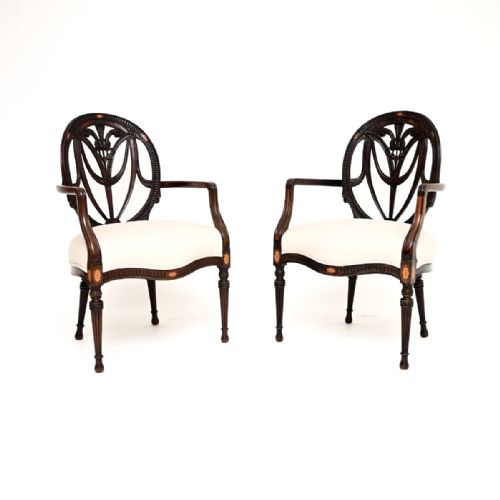
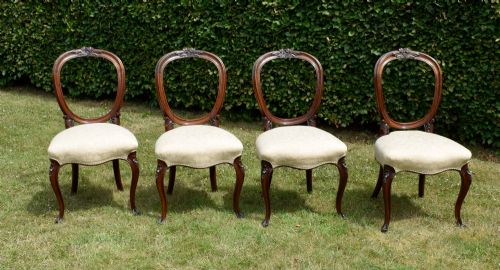
These vintage oval back chairs bring classical Louis XVI and Sheraton Revival grace to a room, offering upright support with distinctive rounded frames.
Vintage Oval Back Chair
A vintage oval back chair combines the formal geometry of eighteenth-century seating with later nineteenth- and twentieth-century revivals. Buyers searching for a vintage oval back chair will encounter pieces spanning the Victorian and Edwardian eras alongside distinct French styles.
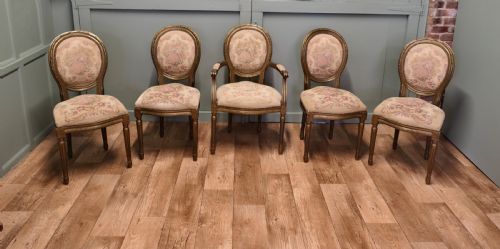
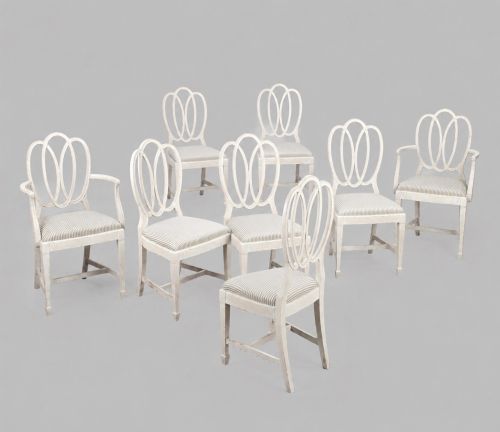
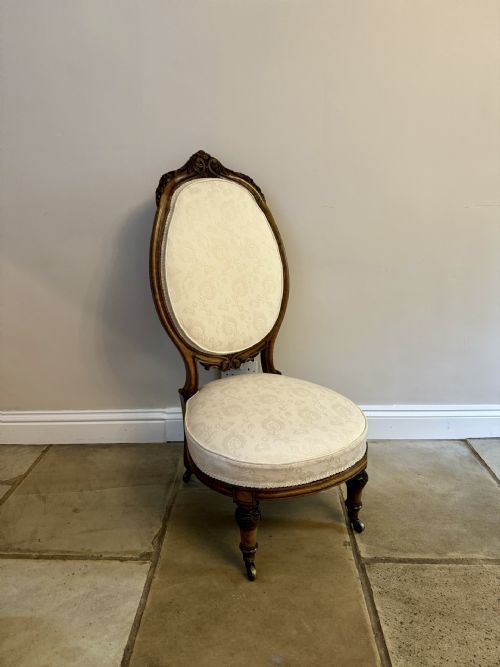
The selection ranges from single salon chairs and bedroom chairs to pairs of armchairs and larger sets of dining chairs. Most examples adopt Louis XVI revival aesthetics or English Sheraton and Hepplewhite influences.
Frames appear in woods such as mahogany and walnut, occasionally finished with paint or giltwood. Upholstery choices vary widely from original needlepoint tapestry panels to modern fabrics.
Materials and construction methods
Cabinetmakers constructed these frames using solid hardwoods like mahogany and walnut, employing traditional joinery to shape the characteristic curved backrests. Carved details and inlaid woodwork frequently accent the structural timber.
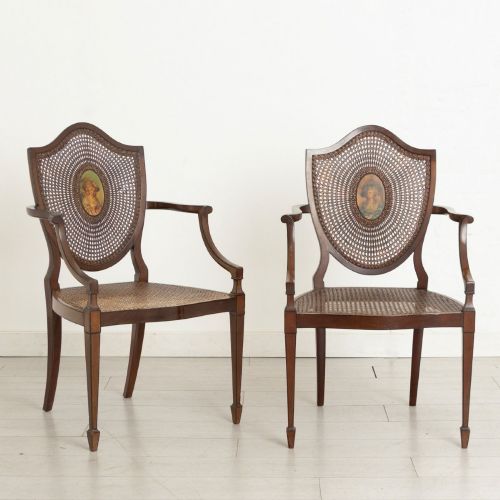
Surface finishes include natural wood polish, delicate paintwork, and gilded details seen on French giltwood salon chairs. Caning appears on specific bergere models, providing a woven lattice for seats and backs.
Upholstered versions rely on supportive interior webbing and padding beneath outer layers of velvet, fabric, or tapestry panels. Brass hardware or decorative studs occasionally secure the textile edges to the wooden frame.
Materials represented across the selection include mahogany, walnut, giltwood, paint, cane, and various upholstered fabrics.
Distinguishing quality across the range
Quality reveals itself in the crispness of the wood carving around the medallion frame and the integrity of the joinery where the back meets the seat. Superior pieces display harmonious proportions and hand-carved ornamentation rather than shallow mechanical stamping.
The choice of primary timber and the precision of any decorative inlay separate standard production from finer craftsmanship. Solid walnut and finely grained mahogany provide greater durability and visual depth than softer or heavily painted substitute woods.
Upholstery execution also defines standard, with hand-stitched details and quality textiles indicating superior workshop origins. Matching sets and pairs demonstrate higher initial investment than single assembled chairs.
The Vintage Oval Back Chair Glossary
- Fauteuil
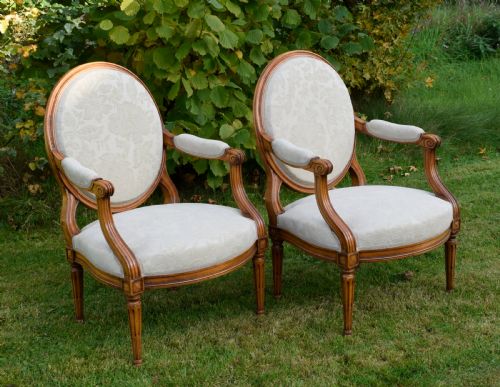
- An open-armed upholstered armchair originating in France. These chairs typically feature exposed wooden frames and padded armrests.
- Bergere
- An enclosed upholstered armchair with a wooden frame and cane or upholstered back and sides. They often include a loose squab cushion for the seat.
- Medallion chair
- A chair featuring an oval or circular backrest framed in carved wood. This form is central to Louis XVI revival seating.
- Giltwood
- Wood that has been treated with gold leaf or a gold-coloured finish. This technique highlights carved details on formal salon chairs.
- Sheraton Revival
- A late nineteenth-century design movement inspired by the furniture of George Sheraton. It often incorporates satinwood inlay and graceful tapering legs.
Vintage Oval Back Chair: Frequently Asked Questions
How do I use these chairs in a modern room?
These chairs work effectively as accent pieces in a living room, dressing table seats in a bedroom, or occasional seating in a hallway. Their open frames maintain visual space while introducing classical form.
Pairing a single armchair with modern minimalist furniture creates a striking contrast of periods. Alternatively, a matching pair provides symmetry when placed beside a fireplace or console table.
What is the difference between Louis XVI and Sheraton styles?
Louis XVI style seating generally emphasises neoclassical symmetry, featuring exposed carved wooden frames, fluted legs, and oval medallion backs. French examples often incorporate giltwood or painted finishes.
Sheraton Revival pieces reflect English interpretations of the same classical vocabulary, favouring mahogany construction, delicate stringing, and straight tapered legs. Both traditions value refined elegance over heavy ornamentation.
Can I use dining chairs everyday?
Dining chairs constructed from solid mahogany or walnut remain structurally robust for daily use. Traditional joinery ensures the frames withstand regular sitting.
Upholstered seats and delicate painted finishes benefit from gentle care. Checking the stability of the joints periodically helps maintain their longevity.
How do I identify the period of a chair?
Dating relies on examining the timber, secondary woods, and construction marks. Victorian and Edwardian makers frequently reinterpreted eighteenth-century French and English designs.
Stylistic cues, such as the specific curve of an oval back or the presence of factory rather than hand-cut joints, assist in distinguishing original nineteenth-century work from later twentieth-century revivals.