
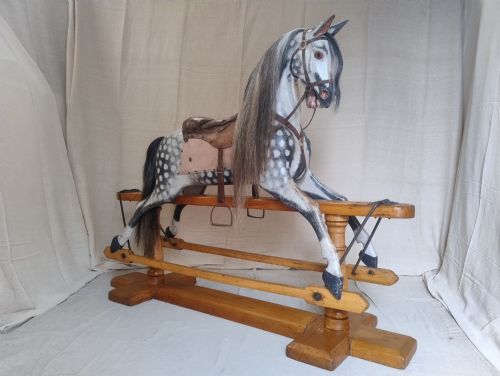


Vintage Nursery Horse
A vintage nursery horse brings the tactile history of the playroom into a modern interior.
Vintage Nursery Horse
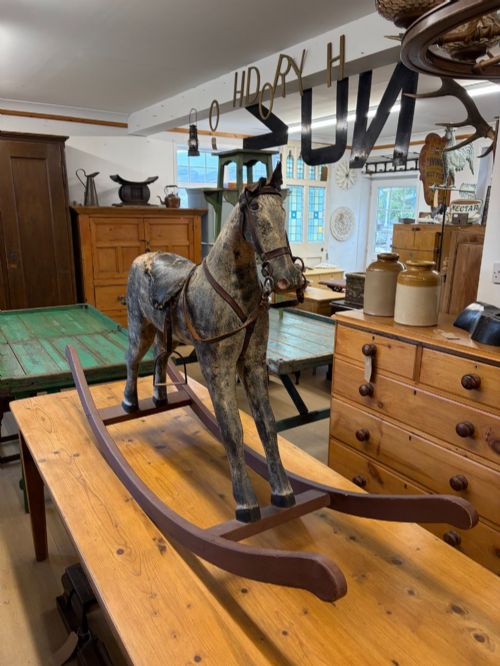
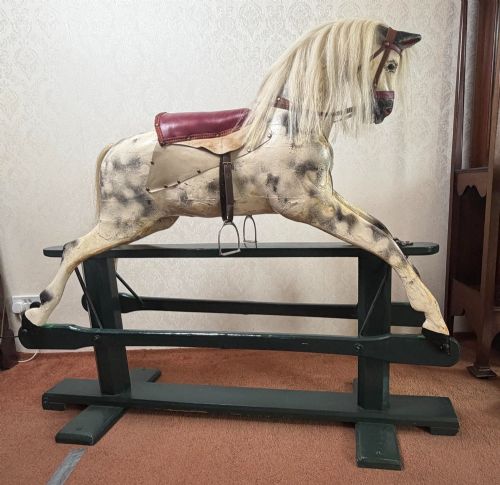
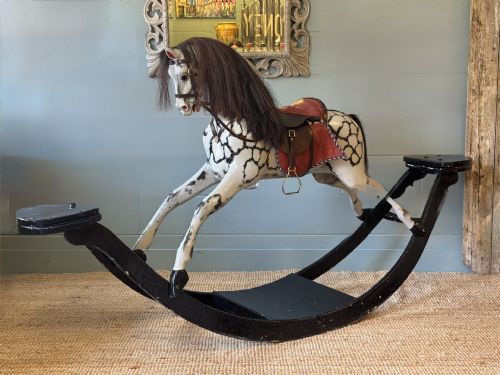
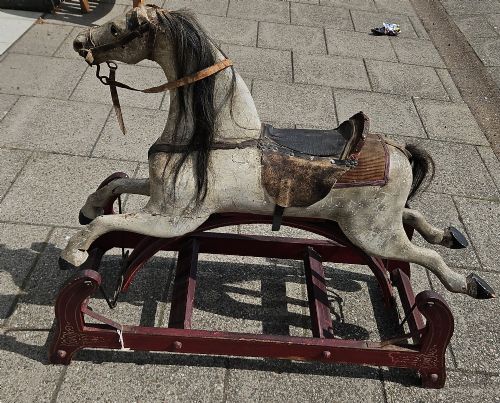
A vintage nursery horse encompasses traditional rocking horses, pull-along toys, and smaller decorative charms from the nineteenth and twentieth centuries. Buyers searching for a vintage nursery horse generally encounter substantial carved wooden rocking horses mounted on original rockers, alongside smaller pull-along toys.
The selections span Victorian folk art, Edwardian pieces, and mid-century examples originating from British makers and international workshops. These objects function equally as decorative focal points in domestic spaces and as survivors of historical children's play.
How they were made
Makers constructed these figures primarily from carved wood such as pine, shaping the bodies by hand before applying layers of paint to create dappled or solid finishes. Structural integrity often relied on internal iron or steel hardware to support the weight of the wooden body.
Detailing relied on organic materials including genuine horsehair for manes and tails, complemented by leather tack and harnesses. Surface decoration combined pigment with primitive carving techniques, particularly visible in nineteenth-century folk art examples.
Listings feature periods from the Georgian era through to the mid-twentieth century, utilising pine, leather, horsehair, and iron.
What varies in quality
Quality rests on the integrity of the original carved wooden structure and whether the piece retains its factory or workshop mounted rockers. Surviving original paintwork or untouched surface finishes elevate an example above those stripped or heavily repainted during later decades.
The reputation of documented makers and the sophistication of the anatomical carving separate standard workshop production from superior examples. Inclusion of original horsehair manes, leather components, and functional iron fittings further distinguishes the better specimens.
G & J Lines of London·F.H. Ayres·Collinson·Lines Bros Sportiboy
The Vintage Nursery Horse Glossary
- Folk art
- Objects created by self-taught or traditional craftsmen outside academic artistic traditions. These pieces often display naive proportions and charming regional characteristics.
- Rockers
- The curved wooden members attached to the base of a rocking horse that allow forward and backward motion. Original rockers are integral to the historical value of the piece.
- Pull-along
- A child's toy mounted on a small wooden platform with wheels or castors, designed to be towed with a string. These date frequently to the late nineteenth century.
- Dappled
- A painted finish imitating the mottled coat pattern of a grey horse. Traditional dapples were built up in layers by hand.
Vintage Nursery Horse: Frequently Asked Questions
How do I date a vintage rocking horse?
Dating relies on examining the construction methods, nail types, and the style of the wooden carving. Earlier nineteenth-century examples often display simpler primitive forms, while twentieth-century pieces incorporate maker stamps and more refined mechanics.
Paint layers and materials like horsehair or leather also provide clues to the era of production. Comparing the piece to documented examples from known makers helps narrow down the decade.
Are these horses safe for children to ride?
Most antique nursery horses are valued as decorative objects or historical artefacts rather than modern toys. Their antique wooden frames and iron components may not meet contemporary safety standards.
Collectors generally preserve them in domestic interiors or display spaces. Gentle handling is recommended to protect original paint and historical materials.
What is a pull-along horse?
A pull-along horse is a smaller child's toy mounted on a wooden base with wheels rather than curved rockers. Children pulled these toys across the floor using a cord during the late nineteenth and early twentieth centuries.
These pieces share the same carved wooden construction and painted finishes as larger rocking horses. They offer a compact alternative for collectors with limited display space.
How should I care for original paint?
Original painted surfaces require gentle dusting with a dry, soft cloth to prevent the accumulation of dirt. Avoid chemical cleaners, harsh solvents, or excessive moisture that might lift or dissolve historic pigment.
Keeping the piece away from direct sunlight and stable humidity levels protects the wood and paint from cracking. Preserving the untouched surface maintains the historical integrity of the object.