





Vintage Mina Khani Rug
These vintage mina khani rug examples bring structured floral lattices and rich wool foundations into a room.
Vintage Mina Khani Rug
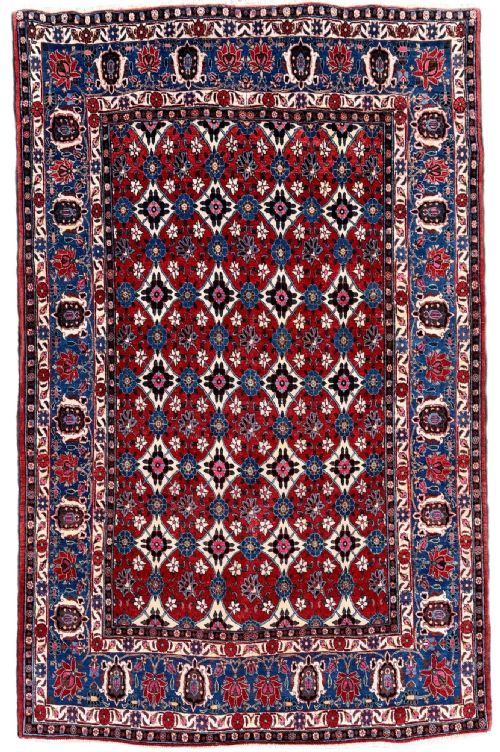
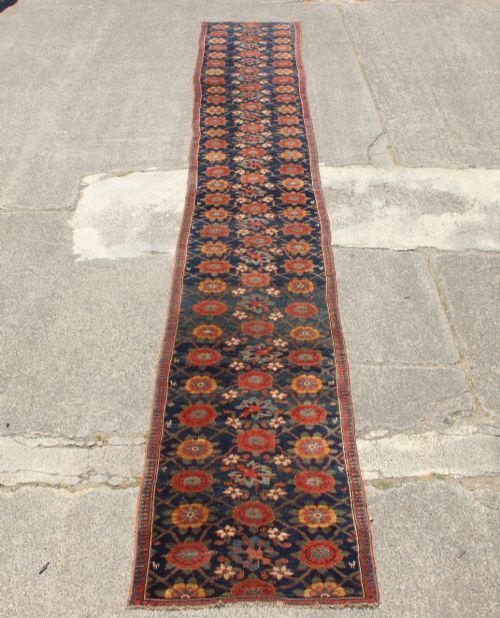
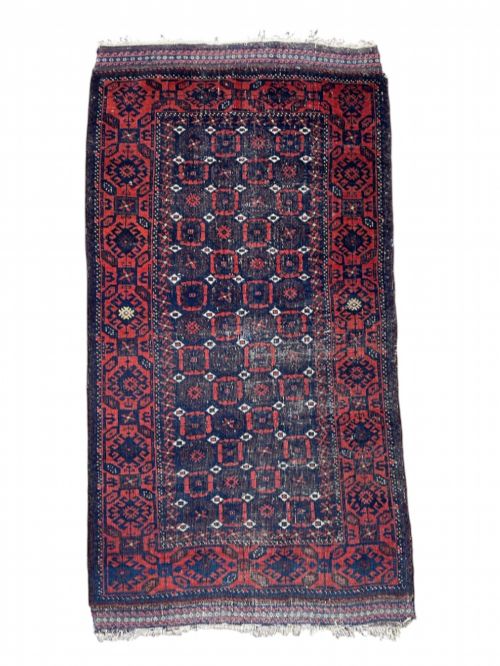
A vintage mina khani rug displays a repeating geometric lattice of flowers and rosettes across the field, forming a continuous pattern. These pieces originate from Persian weaving traditions, including Veramin, Bijar, Khorasan, and Kurdish centres. Buyers encounter formats ranging from square area carpets to long runner rugs.
The aesthetic relies on botanical motifs linked by delicate trellis lines, often set against deep blue or neutral grounds. Dating spans the nineteenth century through to the early decades of the twentieth century. Each rug demonstrates traditional village or tribal craftsmanship rather than mass production.
How they were made
Weavers constructed these carpets using hand-spun wool for the pile and cotton for the foundation warps and wefts. The natural wool fibres take dye deeply, yielding rich variations in tone across the surface.
Tightly knotted pile structures provide durability for floor use while maintaining flexibility. The lattice geometry requires precise calculation by the weaver to keep the repeating floral motifs aligned across the field.
Vintage Mina Khani Rug Retail Price Guide 2026
Typical asking prices for vintage mina khani rug among the pieces listed under this phrase on Sellingantiques today, from the lower quarter to the upper quarter. They describe what is for sale here now, not the wider market.
Materials recorded across these listings consist entirely of wool and cotton, utilised in Persian rugs dating from the nineteenth and early twentieth centuries.
What varies in quality
Quality depends on the crispness of the lattice design and the density of the knots within the wool pile. Finer knot counts allow for sharper botanical details and more intricate secondary ornaments.
The choice of dye palette and the condition of the wool pile also influence the overall standard. Examples with balanced proportions and well-preserved borders command stronger attention.
The Vintage Mina Khani Rug Glossary
- Mina Khani
- A traditional Persian repeating pattern of daisy-like flowers connected by a continuous lattice network. This motif appears frequently in carpets from Veramin and surrounding regions.
- Veramin
- A Persian town known for producing distinctive carpets with structured floral designs and robust wool construction. Pieces from this origin often feature deep blue grounds.
- Bijar
- A Persian weaving centre associated with heavy, dense carpets built to withstand enduring use. The knotting technique creates a rigid and resilient fabric.
- Kurdish Tribal
- An attribution to village and nomadic weavers who produced rugs with expressive geometries and saturated wool colours. These pieces carry traditional tribal motifs.
- Runner
- A long, narrow carpet format designed for hallways or corridors. Runners display compressed field patterns to fit restricted dimensions.
Vintage Mina Khani Rug: Frequently Asked Questions
Where were these rugs made?
These carpets originate from Persian weaving regions, with many examples attributed to Veramin, Bijar, and Khorasan. Tribal groups such as Kurdish and Baluch weavers also produced pieces featuring this lattice design.
Production spans from the nineteenth century into the early twentieth century, reflecting distinct regional dyeing and knotting traditions.
How do I care for wool pile?
Vacuum the rug gently without using a rotating brush roll to protect the wool pile and cotton foundations. Rotate the piece periodically to ensure even exposure to foot traffic and light.
Professional cleaning suited to antique textiles helps maintain the integrity of the natural dyes and fibres.
What is the mina khani design?
The pattern consists of repeating floral heads linked by a continuous geometric lattice across the central field. It is a classic Persian motif associated with village and town weaving.
Variations in the arrangement and secondary ornaments help distinguish between different regional workshops.
How do I identify a runner?
Runners are narrow, elongated carpets specifically proportioned for corridors, hallways, and staircases. Their design adapts the repeating field pattern to fit a restricted width.
Lengths vary considerably, accommodating different architectural spaces while retaining the characteristic lattice motifs.