



Vintage Mercury Stick Barometer
These vintage mercury stick barometer examples measure atmospheric pressure with precision and bring classic domestic science into a room.
Vintage Mercury Stick Barometer
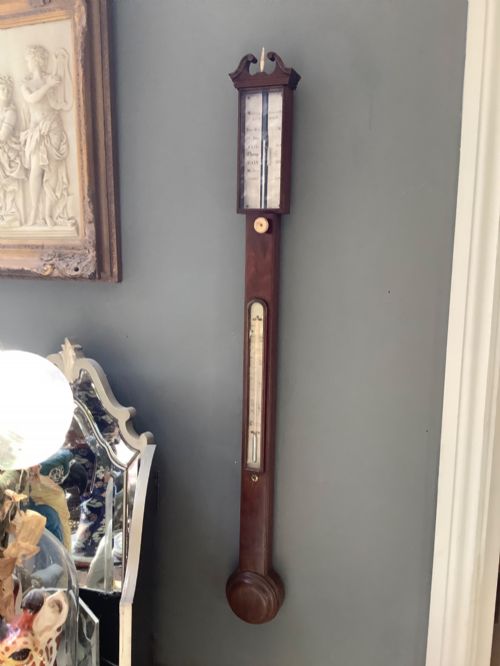
A vintage mercury stick barometer provides a direct physical reading of barometric pressure through a column of liquid metal encased in a tall wooden body. When you search for a vintage mercury stick barometer, you encounter vertical instruments designed to hang on a wall or stand upright in domestic and maritime settings.
The pieces appearing here span Georgian, Regency, and Victorian periods, alongside later examples from around nineteen hundred. Mahogany and oak form the primary housings, while rosewood, walnut, and boxwood also appear.
Most examples take the traditional stick form, though marine versions and occasional banjo variants surface. Makers signed their work upon the brass register plates, leaving names that trace provincial workshops and London makers alike.
Materials and construction
Cabinets rely upon dense hardwoods such as mahogany, oak, and rosewood, chosen for stability against warping. Craftsmen shaped these timbers into straight shafts, sometimes incorporating bow fronts or boxwood and ebony inlay.
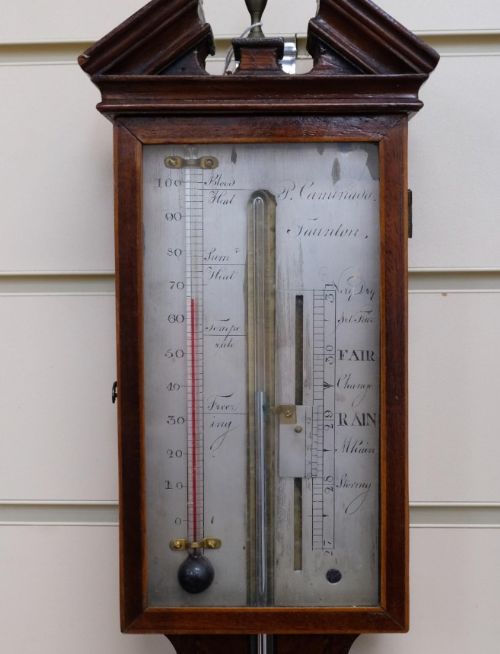
The working heart consists of a glass tube filled with mercury, mounted alongside a silvered brass scaleplate that bears the engraved weather descriptions and calibrations. Bone or ivory indicators often accompany the vernier scale for tracking pressure changes.
Cisterns at the base use wood, metal, or leather containment to hold the liquid column securely while exposing the mercury to atmospheric shifts.
Vintage Mercury Stick Barometer Retail Price Guide 2026
Typical asking prices for vintage mercury stick barometer among the pieces listed under this phrase on Sellingantiques today, from the lower quarter to the upper quarter. They describe what is for sale here now, not the wider market.
Makers represented include firms from London, Dublin, Liverpool, Exeter, Milan, and Taunton.
Distinctions in quality
The integrity of the cabinetry and the crispness of the brass engraving determine the standing of an instrument. Superior pieces display finely figured wood veneers, delicate stringing, and well-executed architectural pediments.
Signed register plates by established makers elevate an instrument, especially when the signature links to recorded optical and scientific instrument makers from London or regional centres. The legibility and depth of the division engraving on the silvered brass plate dictate how cleanly the pressure can be read.
Originality of components, including the glass tube, cistern cover, and ivory vernier knobs, separates untouched examples from those with replaced elements.
P Caminada Taunton·Negretti and Zambra·Blunt·Dollond of London·Prada of High Wycombe·Alexander Wright·Bate of London·J Hughes London·Sandrino of Liverpool·Gilbert London·S and B Solomons·Ciresa of Milan·Alexander Adie·Bassi·Gowland London·Pozzoby London·Corti of Exeter·Malacrida of Dublin
The Vintage Mercury Stick Barometer Glossary
- Vernier scale
- A small sliding auxiliary scale that allows fractional readings of the barometer dial. This device grants precise measurement down to fractions of an inch or millimetre of mercury.
- Register plate
- The engraved metal plate, usually silvered brass, that displays the weather conditions and numerical pressure scale. Makers typically signed their business names and locations directly onto this plate.
- Cistern
- The enclosed reservoir at the base of the instrument that holds the lower portion of the mercury column. Marine versions feature specially constructed cisterns to prevent spillage during ship movement.
- Sympiesometer
- A portable barometer variant that uses oil or gas instead of a heavy column of mercury alongside a thermometer. It responds rapidly to pressure changes.
- Banjo barometer
- A household weather glass housed in a broader, curved wooden case resembling a stringed instrument. These incorporate thermometer and hygrometer dials alongside the main pressure tube.
Vintage Mercury Stick Barometer: Frequently Asked Questions
How do you read a stick barometer?
Observe the top meniscus of the mercury column against the graduated scaleplate. Use the sliding vernier to align with the exact height for precise measurement.
Rising columns indicate improving weather, while falling levels suggest approaching rain or wind.
Where should a stick barometer hang?
Mount the instrument on an interior wall away from direct sunlight, radiators, and heavy draughts. Stable ambient temperatures ensure the mercury responds accurately to atmospheric pressure rather than room heat.
Ensure the wall fixing supports the full vertical weight securely.
How do I date a stick barometer?
Examine the timber species, case silhouette, and style of the pediment or cistern cover. Georgian and Regency examples often feature plain mahogany shafts, while Victorian pieces introduce carved walnut and broader bezels.
Maker signatures and engraved styles on the silvered brass register plate provide further chronological clues.
What is an Admiral Fitzroy barometer?
Designed in the nineteenth century following meteorological guidelines from Admiral Robert Fitzroy, these instruments incorporate specific storm warnings and multiple thermometer dials. They focus on practical weather forecasting for coastal and domestic use.
Oak cases and detailed explanatory remarks on the paper or brass scales distinguish this type.