

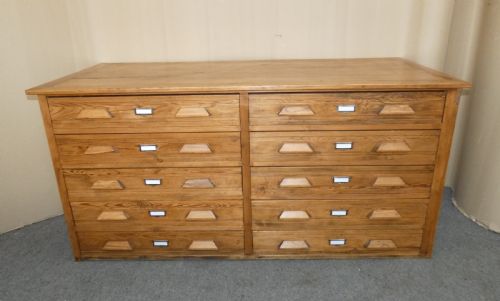


Vintage Map Chest
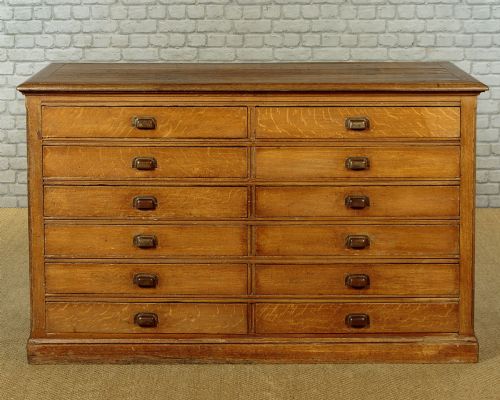
These vintage map chest pieces offer deep drawers for charts, drawings and folios, bringing sturdy utility and rich timber character to any study.
Vintage Map Chest
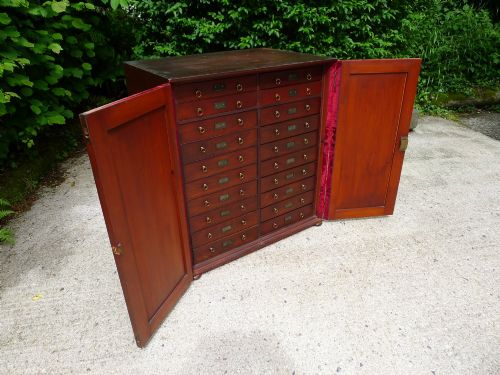
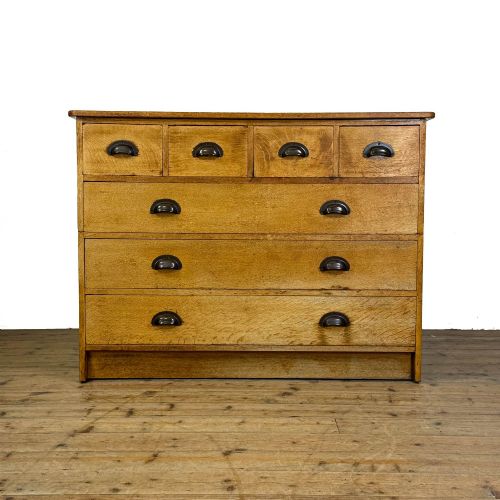
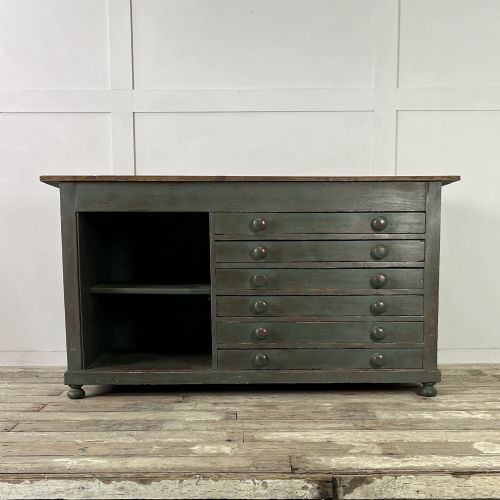
A vintage map chest serves as a robust storage solution designed originally for cartographers, artists and collectors who needed to keep large sheets flat and organised. These pieces appear in forms such as banks of drawers, plan chests, folio cabinets and collectors cabinets spanning the nineteenth and twentieth centuries. The versions most commonly met on this page range from Victorian pine and deal examples to Edwardian pitch pine and later oak plan chests.
Makers designed these heavy pieces for commercial, institutional or studio use rather than domestic display, which accounts for their utilitarian build and generous proportions. Surviving examples reflect diverse stylistic influences including Victorian, Edwardian, Arts and Crafts and Mid-Century Utility. Buyers encounter variations in drawer counts, from compact tabletop specimen chests up to massive thirty-two or forty drawer banks.
How they were made
Cabinet makers utilised dense native timbers such as pine, deal, oak, mahogany and fruitwood to construct the carcase and shallow drawer banks that could withstand heavy daily loading. Joinery relies on solid timber framing, frequently paired with brass drawer pulls, handles and card holders that assist with organisation.
Surface finishes vary from polished mahogany and stained deal to painted pine and pale oak, depending on whether the piece served a fine collector or a trade workshop.
Listings feature pieces spanning from the early nineteenth century through to the nineteen fifties, encompassing pine, oak, mahogany and brass elements.
What varies in quality
The distinction between ordinary utility storage and a finer piece rests in the selection of timbers, such as solid mahogany versus plain deal, and the refinement of the drawer construction. Superior examples display tight dovetail joints, smooth running drawers within the carcase, and original hardware like brass label holders.
The ambition of the design separates standard workshop output from stylistic pieces influenced by Edwardian or Arts and Crafts ideals, where proportions and secondary woods receive greater attention.
Brady of Edmonton
The Vintage Map Chest Glossary
- Plan chest
- A wide, shallow chest of drawers specifically built for storing architectural plans, maps and large paper sheets flat. They usually feature numerous low drawers to prevent curling.
- Collectors cabinet
- A specialised cabinet containing many small drawers designed for storing specimens, coins, or natural history items. These often feature glass doors or secure locking mechanisms.
- Folio cabinet
- A piece of furniture made to hold large folios, prints or artwork. They provide large vertical or horizontal storage compartments.
- Deal
- A softwood timber, typically fir or pine, widely used in British cabinet making for secondary framing and functional carcases during the nineteenth century.
- Dovetail
- A joint formed by interlocking wedge-shaped fingers, prized by woodworkers for its tensile strength in drawer construction.
Vintage Map Chest: Frequently Asked Questions
How do I clean the wood?
Dust the timber regularly with a soft, dry cloth to prevent the accumulation of dirt in the grain and around drawer pulls.
Apply a microcrystalline wax sparingly once or twice a year to nourish dry wood without building up a sticky residue.
Are the drawers interchangeable?
Many older map chests have drawers fitted by hand to specific openings due to historical timber movement and seasonal expansion.
Keep each drawer in its original position to ensure smooth operation and prevent jamming within the carcase.
How do I date a chest?
Examine the secondary timbers, construction joints like dovetails, and the style of the brass hardware to establish the period.
Pine and deal carcases often point to Victorian or Edwardian utility work, while mahogany and fruitwood can indicate earlier nineteenth century craftsmanship.
Can I use one in a modern home?
These chests offer exceptional surface space and shallow storage that suits modern living areas for paperwork, linens or flat screen televisions.
Measure the room clearances carefully before purchase, as these pieces possess significant depth and weight.