

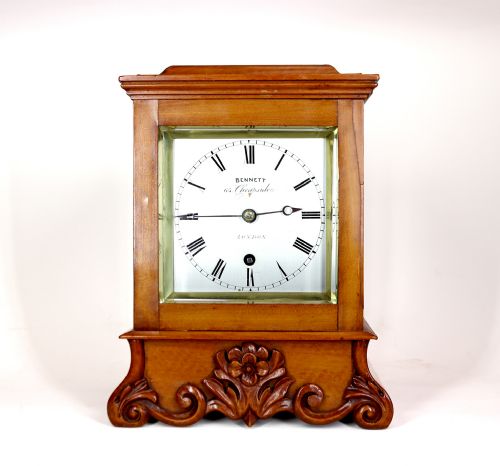


Vintage Library Table Clock
These vintage library table clock pieces are dependable timepieces designed for desks and surfaces, bringing period character and mechanical interest to any room.
Vintage Library Table Clock
A vintage library table clock sits on a desk, shelf, or table, serving as a functional timepiece and an architectural object. The pieces seen here span periods such as Georgian, Victorian, and mid-twentieth century, showing how designs evolved from formal chambers into offices and studies.
The forms encompass traditional mantel clocks, compact desk clocks, and mechanical compendiums. Makers housed these movements in portable wooden cases or architectural bronze frames designed to be viewed up close.
You are most likely to meet mahogany or satinwood cases fitted with white dials and brass bezels. Many examples utilise fusee movements, reflecting the high standards of nineteenth-century British horology.
How they were made
Cabinetmakers shaped dense timbers like mahogany, rosewood, and satinwood into polished cases, often incorporating glass panels to reveal the escapement. Brass and silvered metal provided contrasting bezels, dials, and handle fittings.
Clockmakers fitted mechanical fusee movements to ensure steady tension across the running cycle. Bronze and marble construction also appears, lending substantial weight and industrial character to novelty and desk formats.
One exceptional desk compendium borrows the industrial aesthetic of Andre Guilmet to tell time amidst miniature tools.
What varies in quality
The refinement of the movement dictates the standing of the piece. Fusee gear trains and specialised year-going mechanisms demand superior engineering compared to standard spring-driven alternatives.
Cabinet work distinguishes finer examples. Matched veneers, careful timber selection, and precise brass fittings demonstrate the workshop standards behind the clock.
Bush of London·Sir John Bennett·Walker·Andre Guilmet·Leith of London
The Vintage Library Table Clock Glossary
- Fusee
- A conical pulley used in a clock movement to equalize the torque of the mainspring as it unwinds. This mechanism improves timekeeping consistency across the running duration.
- Timepiece
- A clock that indicates the time without striking the hours or quarters. These movements focus purely on visual rotation and escapement precision.
- Satinwood
- A light-yellow timber valued for its lustrous grain and smooth finish. Cabinetmakers utilised it for refined nineteenth-century desk accessories.
- Gothic Revival
- An architectural and decorative style drawing inspiration from medieval forms. Pieces in this aesthetic feature pointed arches and heavy casting details.
Vintage Library Table Clock: Frequently Asked Questions
Where should I place a library clock?
These clocks suit stable surfaces like writing desks, bookcases, or mantelpieces where they remain undisturbed. Their compact dimensions allow them to sit comfortably among books and study items.
Keep them away from direct sunlight, radiators, and damp areas to protect the polished wood cases and delicate internal metalwork.
How do fusee movements work?
A fusee movement uses a conical drum linked to the mainspring by a fine chain or cord. As the spring loses tension, the chain pulls on a wider part of the cone to maintain steady power.
This clever mechanical design ensures the clock maintains consistent force and better accuracy as it runs down between windings.
What timber types are common?
Mahogany and satinwood dominate the wooden cased examples from the Georgian and Victorian eras. Rosewood also appears in select formal designs.
These hardwoods were chosen for their durability and attractive grain patterns, which took a high polish suited to gentleman's libraries.