
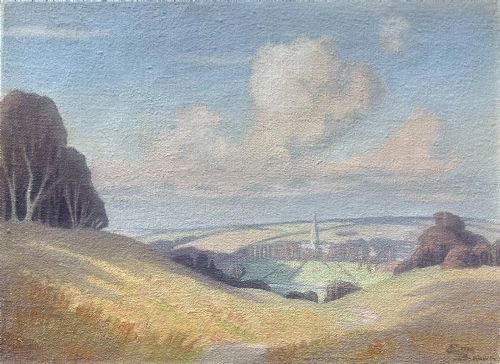
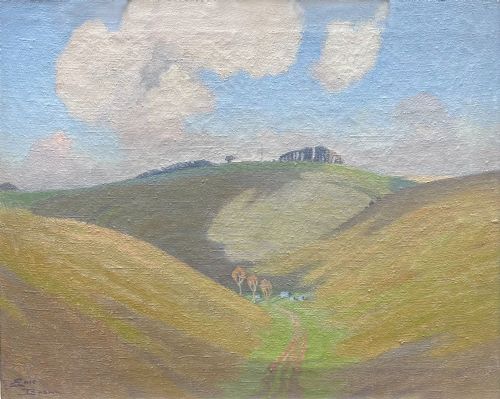
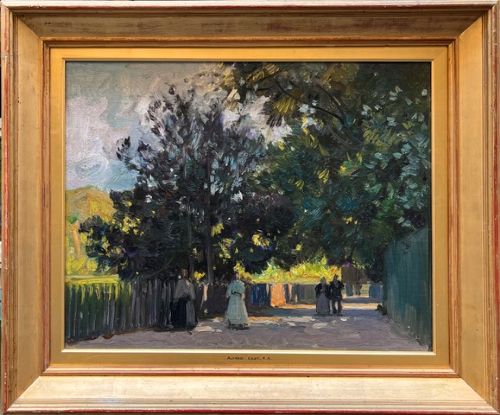
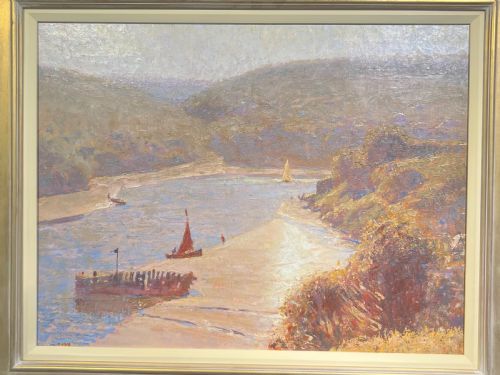


Vintage Hill Landscape Artwork
These vintage hill landscape artwork selections capture elevated terrain across British and European views.
Vintage Hill Landscape Artwork
A buyer seeking vintage hill landscape artwork looks at topographical watercolours, charcoal sketches, and oil paintings depicting elevated terrain and rural vistas. These works span periods from the Victorian era through the Edwardian years and into the mid-century modern period, showing British and continental settings.
The most common examples on this page are mid-century and early twentieth-century watercolours and oil paintings on canvas or paper. Artists capture locations such as Dorset, Yorkshire, and Irish coastal hills alongside French and Mediterranean scenes.
The forms range from intimate pen-and-ink drawings to larger framed oil paintings carrying specific regional attributions. Each piece records a distinct topography through the lens of styles including British Impressionism, Post-Impressionism, and English School traditions.
Materials and methods
These works rely primarily on oil paint, watercolour, and occasionally pen-and-ink applied to canvas, paper, or board. Painters often built up pigment using impasto techniques or handled washes of transparent watercolour to capture atmospheric light over hills and coastlines.
Support materials include framed canvas, stretched linen, heavy art paper, and wooden panels, paired with protective glass where works are executed on paper. Frames in wood and gilt finish frequently accompany the paintings, reflecting the period of creation.
Materials documented across these hill landscape works include oil paint, watercolour, pen-and-ink, canvas, paper, glass, and gilt wood.
Assessing quality and execution
The strength of a piece rests in the artist's handling of light, brushwork confidence, and composition depth. Stronger examples demonstrate assured handling of pigment, whether through thick impasto strokes or fluid watercolour washes that define the contours of the terrain.
Condition of the surface and framing also distinguishes individual works, with well-preserved paper, stable canvas integrity, and original framing contributing to the overall presence of the piece.
Eric Brown·Sir Alfred East·Joseph Edward Hennah·James Fry·Sidney James Beer·Rowland Henry Hill·James L. Brooke·Alfred Graham·Martin Lamotte
The Vintage Hill Landscape Artwork Glossary
- Impasto
- Paint applied thickly to a surface, leaving brush or palette-knife marks visible in relief. This technique adds texture and tactile depth to depictions of natural terrain.
- Watercolour
- A painting method where the paints are made of pigments suspended in a water-based solution. It is typically applied to paper to create translucent layers of colour.
- Fauvism
- A style of early twentieth-century painting characterised by vibrant, unnatural colours and bold brushwork. It emphasises painterly qualities over realistic representation.
- British Impressionism
- A movement focusing on everyday subject matter and natural light captured through rapid, visible brushstrokes. Artists working in this manner prioritized outdoor observation.
- Provenance
- The chronological history of the ownership of a work of art. It helps establish authenticity and historical context.
Vintage Hill Landscape Artwork: Frequently Asked Questions
What periods do these hill artworks cover?
The selections span from the Victorian and Edwardian eras through the 1910s, 1920s, 1930s, 1940s, and 1950s up to the mid-century modern period of the 1960s.
These dates reflect the shifting artistic movements recorded across the various paintings and drawings.
Where do the landscape scenes typically depict?
The locations include British sites such as Dorset, Yorkshire, the Lake District, and County Wicklow in Ireland, alongside continental views from France and the Mediterranean.
Artists recorded specific regional topographies ranging from coastal cliffs to rolling inland hills.
How should I care for vintage paper works?
Works on paper, including watercolours and drawings, require protection from direct sunlight to prevent fading of pigments and discoloration of the paper support.
Displaying them behind glass with proper framing helps shield the delicate mediums from ambient moisture and dust.