
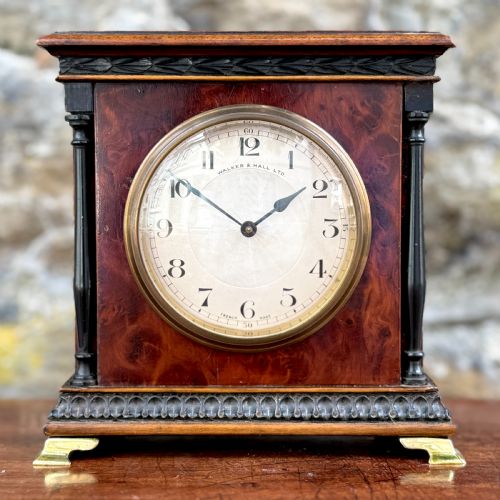


Vintage French Mantelpiece Clock
These vintage french mantelpiece clock options bring period weight and striking brass to a room.
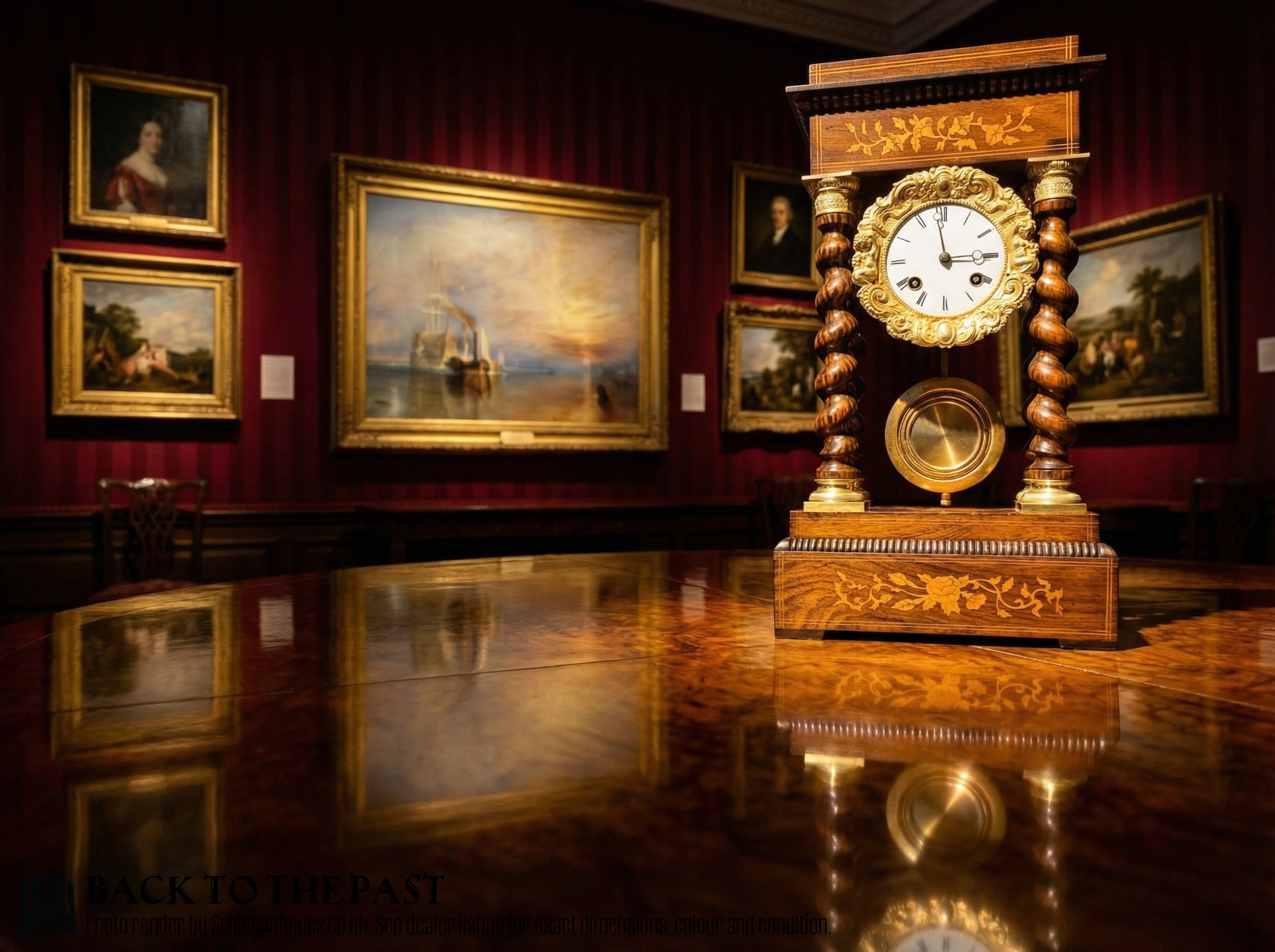
Vintage French Mantelpiece Clock
A vintage french mantelpiece clock sits firmly on a shelf or sideboard, keeping time while anchoring the room's decorative scheme. The examples gathered here span from the mid nineteenth century through to the art deco period of the nineteen twenties and thirties.
Most pieces encountered on this page take the form of substantial marble or ormolu mantel clocks, alongside occasional clock garnitures with matching side ornaments. Styles range from ornate rococo revival and louis xiv designs to geometric art deco lines.
Makers and retailers such as Walker and Hall, Henry Marc, Dent, and Jaz appear among the pieces, reflecting both English and French origins from the eighteen fifties to nineteen thirty.
How they were made
Foundations rely on dense natural materials such as red and white marble, onyx, rosewood, and mahogany, shaped to house delicate mechanical movements. Metal components utilise cast brass, gilt bronze, and ormolu, often finished with chased detailing.
Dials incorporate white enamel with painted numerals, protected behind bevelled glass, while some examples feature champleve enamel work or engine turned masks. Cases combine cabinetmaking joinery with metal casting and fire gilding techniques typical of nineteenth and early twentieth century workshops.
Listings feature periods spanning from eighteen fifty through to nineteen thirty, encompassing Victorian, Edwardian, and art deco designs.
What varies in quality
The degree of hand chasing on the ormolu and the depth of relief in figural bronze castings separate standard examples from superior works. Finer pieces display crisp engraving across all sides and substantial stone bodies with harmonious proportions.
Movement sophistication also dictates standard, seen in eight day striking mechanisms, repeating carriage clock escapements, and fusee movements that require careful calibration by horologists.
Walker and Hall·Henry Marc·JAZ·Dent·Hay London
The Vintage French Mantelpiece Clock Glossary
- Ormolu
- Gilded bronze, where a layer of gold amalgam is applied to a bronze base through heat treatment. This technique creates a rich, durable surface finish found on many nineteenth century French clock cases.
- Garniture
- A set consisting of a central clock flanked by two matching ornamental pieces, such as urns or vases. These symmetrical sets were designed to sit together on a mantelpiece.
- Champleve
- An enamelling technique where troughs or cells are hollowed out of a metal surface and filled with vitreous enamel paste before firing. The resulting design shows vibrant colour set flush with the metal partitions.
- Fusee
- A conical pulley used in clock movements to maintain even tension on the gear train as the mainspring unwinds. This mechanism improves timekeeping accuracy across the power reserve.
- Carriage clock
- A small, portable spring driven timepiece with a carrying handle, originally developed for travel. Nineteenth century versions often feature elaborate brass cases with bevelled glass panels.
Vintage French Mantelpiece Clock: Frequently Asked Questions
How do I wind a mantel clock?
Most mechanical clocks utilise a key inserted into winding holes on the enamel dial to tension the internal springs. Care must be taken not to overwind the movement, stopping as soon as resistance is felt.
Striking mechanisms should be allowed to complete their sequence without manual interference of the hands during the strike.
What is a clock garniture?
A clock garniture is a matched set comprising a central mantel clock accompanied by two side pieces, typically urns or candelabra. These sets were manufactured to create a symmetrical display on a fireplace shelf.
The materials used for the clock, such as white marble or green onyx, are mirrored precisely in the accompanying side pieces.
How do I distinguish art deco clocks?
Art deco mantel clocks feature streamlined geometric forms, stepped cases, and materials like red bakelite or contrasting marbles. Ornamentation is minimal compared to earlier Victorian or rococo revival designs.
Typography on the dials adopts bold, stylised numbers characteristic of the nineteen twenties and thirties.
Where should I place a marble clock?
Marble and onyx clocks require a sturdy, level surface capable of supporting considerable weight. Mantelpieces or heavy sideboards provide the ideal stable foundation.
Direct sunlight and damp environments should be avoided to protect both the stone surface and the brass movement inside.