


Vintage Female Figure Lamp
A vintage female figure lamp brings sculptural presence and period illumination into a room, combining figural form with functional light.
Vintage Female Figure Lamp
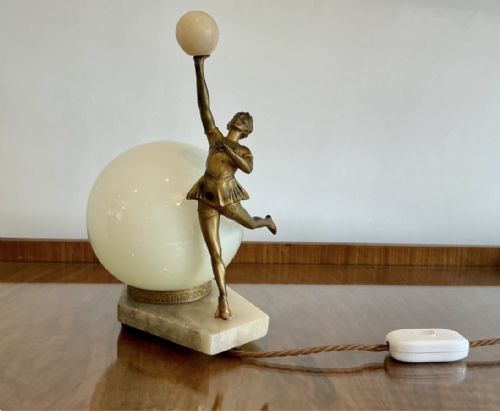
When you search for a vintage female figure lamp, you encounter sculptural lighting pieces that take the human form as their primary subject, frequently emerging from the Art Deco period. These objects function as both table lamps and wall lights, placing human figures in roles that support or incorporate the light source.
The versions you are most likely to meet on this page span the 1920s, 1930s, and 1940s, alongside older nineteenth-century wall light brackets and seventeenth-century wooden elements. Figures stand on balls, hold torchere shades, or form twin lighting arrangements on desks and tables.
Makers and manufacturers of these pieces utilise distinct styling ranging from clean Art Deco geometry to Neoclassical and Art Nouveau aesthetics. The resulting objects present female figures cast, carved, or modelled in various attitudes of standing or supporting.
Materials and construction methods
Makers of vintage female figure lamps work in metal, glass, porcelain, and stone, combining spelter, brass, silver plate, and chrome with marble and alabaster bases. Spelter appears frequently as a casting material, often painted or patinated to resemble bronze or other finishes.
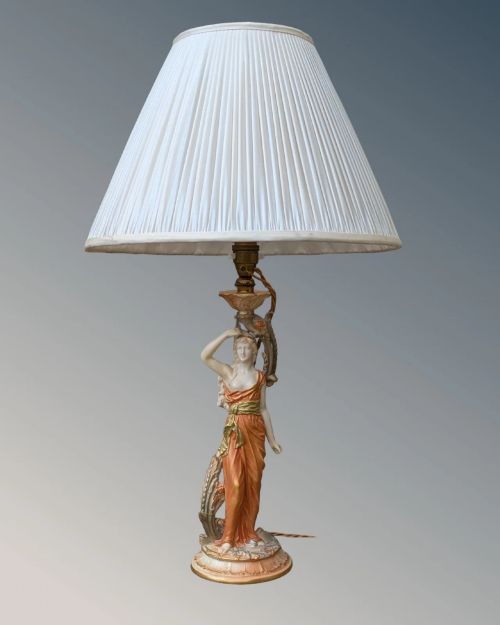
Porcelain works, such as those from Royal Worcester, involve high-heat firing and glaze application to create detailed figural bodies and blue and white decorative schemes. Glass and fabric components complete the assemblies, providing shades and diffusers that pair with metal or ceramic figures.
Listings in this category span five distinct periods, reaching from the seventeenth century through the nineteenth century and into the 1920s, 1930s, and 1940s.
Distinctions in quality and execution
The separation between standard and superior pieces rests on the crispness of the casting and the refinement of the figural modelling. Better examples display careful anatomical definition in the hands, face, and drapery, whereas lesser ones lose detail in soft or muddy metal casts.
Material selection also dictates the hierarchy, with solid brass, carved alabaster, and named porcelain manufactories occupying the upper tier compared to painted spelter or simpler plated base metals. The integration of the shade and the structural stability of the figure upon its ball or base determine the overall integrity of the design.
Royal Worcester
The Vintage Female Figure Lamp Glossary
- Spelter
- A zinc alloy commonly used as a cost-effective substitute for bronze in decorative figures and lamp bases. It takes patination and paint well but remains softer than true bronze.
- Caryatid
- A sculpted female figure serving as an architectural support taking the place of a column or pillar. These appear in earlier furniture and lighting forms.
- Torchere shade
- A lighting diffuser designed to hold or surround a bulb in an upward-pointing configuration, often paired with figural standards.
- Alabaster
- A fine-grained, translucent stone used for bases and shades to diffuse light softly. It varies in veining and colour depth.
- Art Deco
- A design style prevalent in the 1920s and 1930s characterised by streamlined geometric forms, stylised figures, and modern industrial materials.
Vintage Female Figure Lamp: Frequently Asked Questions
What periods do these lamps come from?
The pieces shown here predominantly date from the 1920s and 1930s during the height of the Art Deco movement. Earlier examples stretch back through the nineteenth-century Neoclassical revival and seventeenth-century woodcarving traditions.
While the majority capture interwar design trends, the inclusion of earlier architectural fragments demonstrates a long-standing tradition of using the female form in structural lighting and support.
How do I identify Art Deco lamps?
Art Deco female figure lamps typically feature stylised anatomical forms, sleek metallic finishes like chrome and silver plate, and geometric bases. Figures often interact with spheres, steps, or torchere shades.
Look for streamlined silhouettes and materials such as patinated metal, glass, and alabaster that define the interwar aesthetic.
Are these pieces made of bronze?
Many metal figural lamps from this era are actually cast from spelter rather than solid bronze. Spelter is a softer zinc alloy that manufacturers painted or patinated to imitate more expensive metals.
Heavier examples may incorporate brass, silver plate, or chrome, while others utilise porcelain, glass, and marble.
Where were these lamps placed originally?
These figural lamps served as table, desk, or wall-mounted lighting in domestic interiors. Twin-figure designs and larger standing pieces were intended to occupy prominent spaces such as sideboards, mantelpieces, or dedicated display surfaces.
Wall light brackets provided bracketed illumination along hallways and principal rooms.
How should I care for a vintage figure lamp?
Maintenance requires gentle dusting with a soft, dry cloth to protect patinated metal surfaces, painted spelter, and delicate porcelain glazes. Avoid abrasive cleaners that can strip original finishes or damage patination.
Wiring should be checked and updated by a qualified professional to ensure safety while preserving the original structural components.