
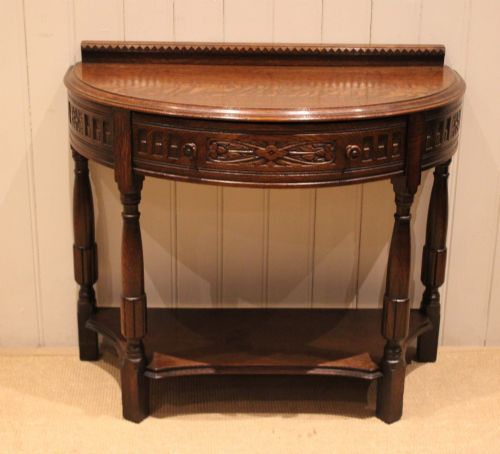


Vintage Crescent Table
A vintage crescent table brings architectural curve to a narrow hallway or drawing room.
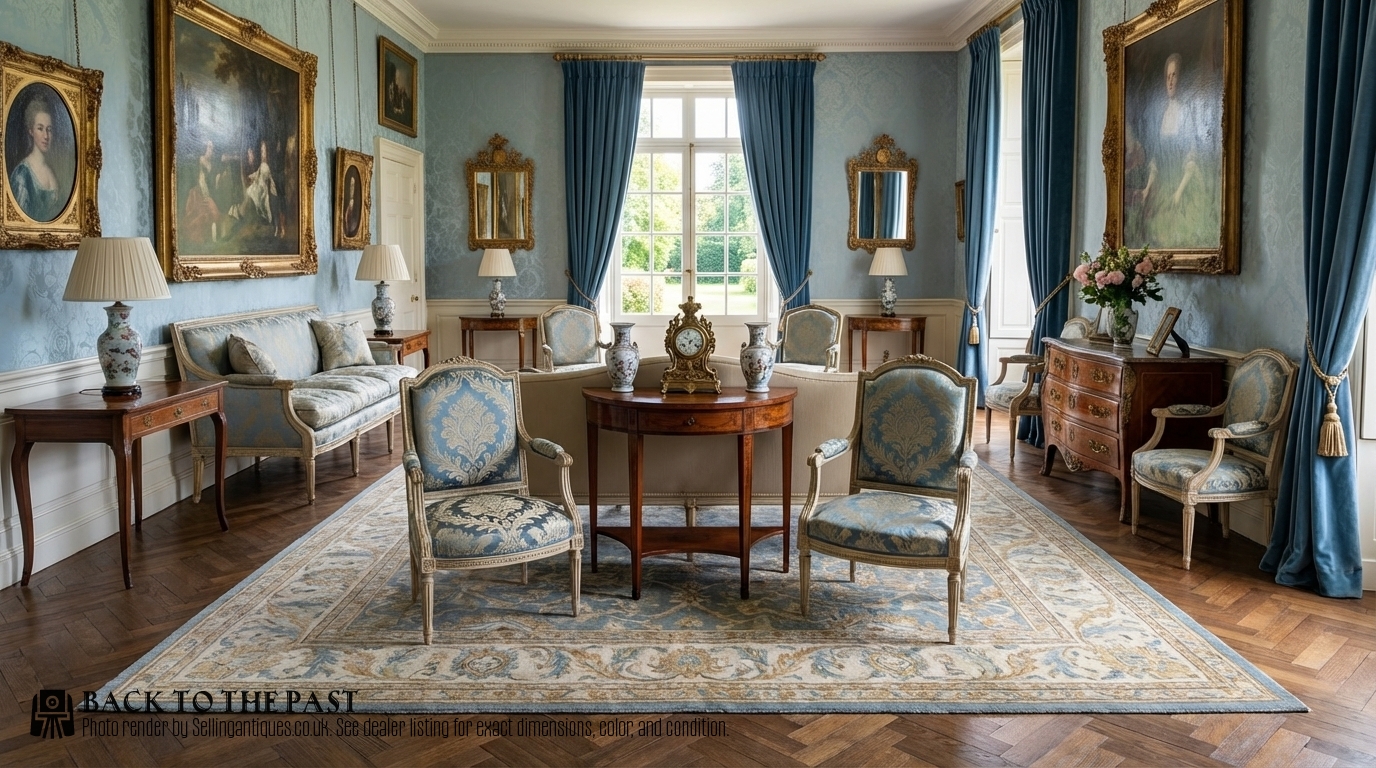
Vintage Crescent Table
When you search for a vintage crescent table, you encounter half-moon and demi-lune forms designed to sit flush against a wall while offering a useful surface. These pieces emerge across several periods, most notably the Edwardian era, the 1930s, and the nineteenth century, reflecting diverse tastes from French Country to Sheraton Revival.
The selection on this page relies heavily on console tables, side cabinets, and matching mirror sets rather than dining furniture. Such forms suit entrance halls or smaller spaces where depth is limited but decorative presence remains essential.
Origin and stylistic influence vary widely among these items, encompassing English painted pine, French carved solid oak, and inlaid mahogany. Buyers find both understated country pieces and formal Neoclassical or Art Deco interpretations.
Materials and construction
Makers utilised solid oak, mahogany, satinwood, and pine to construct the carcasses and tops of these demi-lune surfaces. Inlaid decoration often incorporates contrasting boxwood to create delicate border patterns and classical motifs.
Surface treatments range from French painted finishes to polished mahogany veneers and intricate carvings. Brass handles, hinges, and occasional mounts provide structural reinforcement and decorative contrast.
Listings feature mahogany, satinwood, oak, and painted pine alongside brass mounts and glass elements across nineteenth-century and twentieth-century periods.
Assessing quality
The distinction between standard and superior pieces rests on timber selection and the crispness of the carving or inlay. Finely figured satinwood and precise boxwood stringing indicate a higher grade of workshop production.
Structural integrity depends on the stability of the curved apron and the attachment of the legs. Original painted finishes or well-maintained polished surfaces retain greater integrity than heavily altered examples.
The Vintage Crescent Table Glossary
- Demi-lune
- A half-moon shape used to describe tables with a curved front and a flat back designed to stand against a wall.
- Console table
- A table supported by wall brackets or console legs, traditionally positioned beneath a mirror or in a hallway.
- Sheraton Revival
- A late nineteenth and early twentieth century style drawing on the neoclassical designs of eighteenth-century cabinetmaker Thomas Sheraton.
- Stringing
- A narrow inlay of contrasting wood used in cabinetmaking to outline panels, drawers, or table edges.
Vintage Crescent Table: Frequently Asked Questions
Where should I place a crescent table?
These tables fit naturally into narrow hallways, entrance spaces, or against living room walls where standard rectangular furniture protrudes too far into the room.
Because of their flat back, they anchor securely to the vertical surface while providing an ideal display area for lamps or mirrors.
What is the difference between a demi-lune and a crescent table?
The terms are generally used interchangeably in the antiques trade to describe furniture with a semicircular or half-moon top.
Both descriptions refer to the distinct curved profile that sets these tables apart from standard rectangular forms.
Can I use a console table as a desk?
Most vintage console and crescent tables lack the knee clearance and internal depth required for comfortable daily writing.
They function primarily as decorative surfaces for holding small objects, lighting, or mirrors rather than as working desks.