


Vintage Catholic Medal
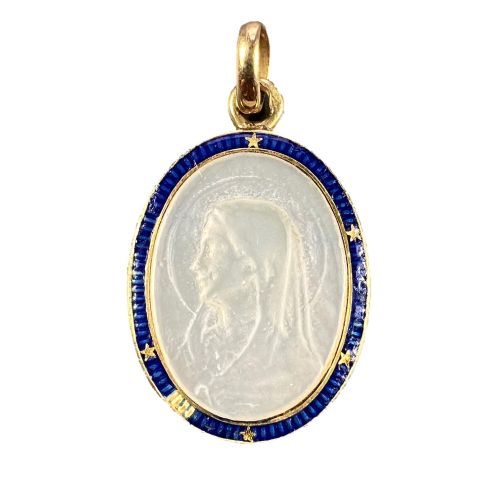
These gold and enamelled vintage catholic medal pieces are wearable devotions shaped by French makers across the late nineteenth and mid twentieth centuries.
Vintage Catholic Medal
A vintage catholic medal functions as a personal devotional pendant, taking the form of round or oval charms worn close to the heart. When exploring this selection of vintage catholic medal items, buyers encounter French religious jewellery dating primarily from the decades between eighteen ninety and nineteen fifty.
The most common version on this page is an eighteen carat yellow gold pendant portraying the Virgin Mary, the Madonna and Child, or the Sacred Heart. These objects combine religious iconography with distinct period design movements including Art Nouveau and Art Deco.
Materials and construction
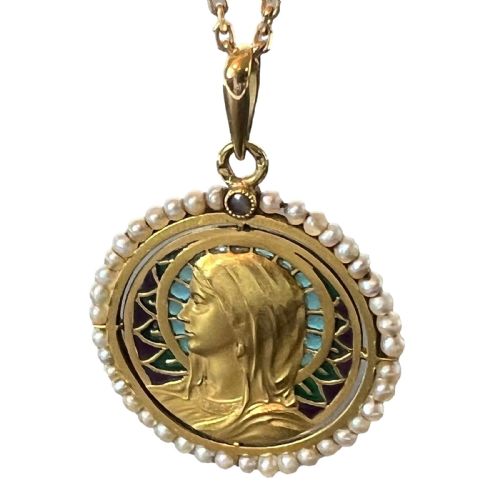
Goldsmiths shaped these pendants using eighteen carat yellow, rose, and white gold, often casting or stamping the metal to form intricate devotional imagery. Skilled artisans added depth and colour through enamel work, including translucent plique-a-jour techniques that let light pass through the design.
Many pieces incorporate mother of pearl plaques as a luminous backing for sculpted gold figures, while others feature delicate seed pearls set along the borders. Engraving tools provided fine facial expressions, lettering, and radiating sunburst halos around the central holy figures.
Vintage Catholic Medal Retail Price Guide 2026
Typical asking prices for vintage catholic medal among the pieces listed under this phrase on Sellingantiques today, from the lower quarter to the upper quarter. They describe what is for sale here now, not the wider market.
Listings span periods from eighteen ninety through nineteen fifty, featuring mother of pearl, enamel, and seed pearls set in gold.
Assessing quality in religious pendants
The preservation of fragile decorative elements such as enamel and seed pearls also defines the tier of a piece. Intact plique-a-jour cells and securely mounted pearls indicate careful handling and superior original craftsmanship.
Emile Monier·Emile Dropsy·Mazzoni·Pageli Perriat·Guilbert·Vernon·Sellier·Tairac·Pageri Perroud·Perriat·Becker·Charl
The Vintage Catholic Medal Glossary
- Plique-a-jour
- An enamelling technique where enamel is applied without a backing, resembling miniature stained glass. This method allows light to shine through the transparent coloured glass areas.
- Sacred Heart
- A devotional representation of the physical heart of Jesus Christ as a symbol of divine love. The imagery frequently includes flames, a crown of thorns, and rays of light.
- Miraculous Medal
- A particular devotional medal whose design was based on Catherine Labouré's visions of the Blessed Virgin Mary. These pieces typically feature specific inscriptions and twelve stars around the Marian image.
- Seed Pearl
- A very small natural or cultured pearl used in jewellery ornamentation. Makers set these tiny pearls in clusters or borders around the central religious motif.
Vintage Catholic Medal: Frequently Asked Questions
What metals are used in these medals?
These devotional pendants consist primarily of eighteen carat yellow gold, alongside variations in rose gold and white gold.
Additional decorative materials integrated into the metalwork include mother of pearl, enamel, and seed pearls.
How do I date a religious medal?
Dating relies on stylistic clues and hallmarks stamped onto the gold suspension rings or frames. Pieces displaying flowing organic lines typically originate from the Art Nouveau era around nineteen ten, while geometric motifs point toward the nineteen thirties and fifties.
Who are the figures shown on the pendants?
The most frequent subjects are the Virgin Mary, the Madonna and Child, and Jesus Christ depicted through the Sacred Heart.
Other representations include saints such as Saint Christopher, Saint Joseph, Saint John the Baptist, and Saint Isabelle of France.
How were these pendants worn historically?
Owners wore these religious medals suspended from fine gold chains as personal necklaces for daily spiritual protection.
They also served as travel charms or commemorative keepsakes marking significant life events and feast days.