

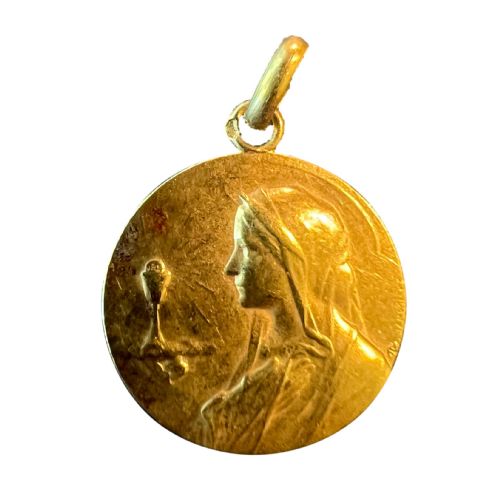


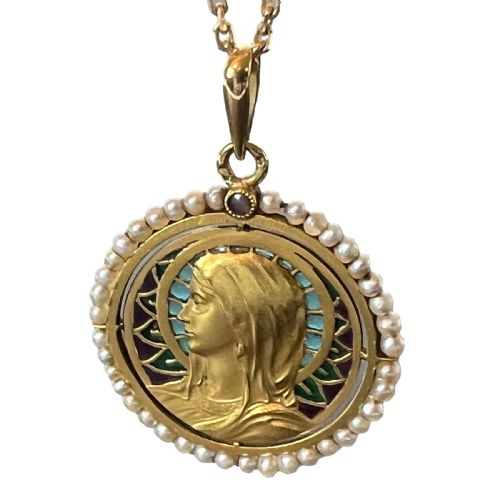


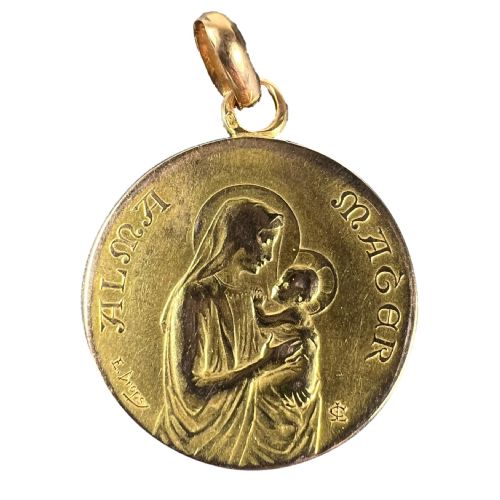


Gold Blessed Mother Pendant
A gold blessed mother pendant offers a tangible link to French devotional art, spanning the delicate curves of Art Nouveau and the clean lines of Art Deco.
Gold Blessed Mother Pendant
A gold blessed mother pendant functions primarily as a devotional jewel, taking the form of a small medallion or charm worn close to the heart. When you search for a gold blessed mother pendant, you encounter pieces originating predominantly from France, created across the early decades of the twentieth century.
The most common examples on this page date from around nineteen ten, rendered in yellow gold and often depicting the Virgin Mary, Notre Dame of Lourdes, or the Madonna and Child. These medals frequently double as charms, integrating seamlessly into historic chains or charm bracelets.
Stylistically, the pieces mirror shifts in taste from the ornate floral motifs of Victorian and Art Nouveau periods through to the geometric precision of Art Deco and mid-century modernism. They serve simultaneously as personal expressions of faith and miniature works of goldsmithing.
Materials and construction
Makers fashioned these pendants primarily from eighteen-carat yellow gold and white gold, sometimes incorporating mother of pearl as a luminous backing for the central religious figures. Details were frequently enhanced using seed pearls, diamonds, and enamel work.
Gold Blessed Mother Pendant Retail Price Guide 2026
Typical asking prices for gold blessed mother pendant among the pieces listed under this phrase on Sellingantiques today, from the lower quarter to the upper quarter. They describe what is for sale here now, not the wider market.
Materials appearing across the selection include yellow gold, white gold, mother of pearl, enamel, seed pearls, and diamonds.
Distinctions in quality
Quality in these devotional medals rests heavily on the crispness of the relief and the identity of the artisan or workshop behind the piece. Medals bearing the signatures of known French medallists display a superior depth and realism in the depiction of the Madonna and Child.
The choice of supplementary materials also elevates a piece, as seen where translucent enamel, seed pearls, or small diamonds frame the central gold imagery. Pieces that combine multiple skilled techniques, such as plique-à-jour work alongside fine metalcasting, stand apart from simpler stamped medals.
Emile Monier·Pageli Perriat·Emile Dropsy·Pageri Perroud·Serraz·Augis and Mazzoni
The Gold Blessed Mother Pendant Glossary
- Plique-a-Jour
- An enamelling technique where the enamel is applied without a backing, creating a stained-glass effect that lets light shine through the translucent colours. This method requires considerable skill to avoid cracking during the firing process.
- Medal
- A flat piece of metal stamped or cast with commemorative imagery, frequently worn as a pendant in religious contexts. These often feature devotional inscriptions such as Ave Maria.
- Seed Pearl
- A very small, naturally occurring or cultured pearl, often drilled and strung or used as delicate accent decoration. They appear frequently in border settings on turn-of-the-century devotional jewellery.
- Charm
- A small decorative pendant suspended from a bracelet or necklace, often imbued with personal or symbolic meaning. In French devotional pieces, charms double as wearable medals.
Gold Blessed Mother Pendant: Frequently Asked Questions
What do these pendants depict?
These pieces predominantly portray the Virgin Mary, often referred to as the Madonna and Child, or specific sites of devotion such as Notre Dame of Lourdes. The imagery draws directly from French religious iconography of the late nineteenth and early twentieth centuries.
Inscriptions like Ave Maria frequently accompany the central figures, serving as a direct prompt for prayer and reflection. The designs range from simple profile busts to elaborate narrative scenes.
How can I tell the period?
Dating relies heavily on stylistic shifts, moving from the organic lines of Art Nouveau and Victorian pieces towards the restrained geometry of Art Deco and mid-century French jewellery. Hallmarks stamped onto the gold also provide precise indicators of national origin and metal purity.
Materials offer further clues, with mother-of-pearl backgrounds and seed-pearl borders appearing frequently in the earliest examples from nineteen hundred to nineteen ten. Later mid-century pieces adopt cleaner metallic profiles without auxiliary gem-setting.
Were these worn daily?
Historical evidence suggests these medals served as personal devotional items intended for continuous wear on necklaces or charm bracelets. Their sturdy eighteen-carat gold construction made them durable enough for everyday use.
Over decades of handling, the softer details of the high relief might show gentle softening, bearing witness to generations of active wear and handling by previous owners.
How do I style one today?
A gold blessed mother pendant suits modern layering when suspended from a simple gold chain of matching carat weight. Mixing antique French medals with contemporary chains creates a deliberate contrast between historic artistry and modern simplicity.
They also adapt well to traditional charm bracelets, sitting comfortably alongside other gold tokens and mementos collected over time.