


Vintage Burmese Furniture
Vintage Burmese furniture brings dense carved teak, padouk and lacquer into the room with robust colonial character.
Vintage Burmese Furniture
Vintage Burmese furniture encompasses heavily carved tables, seating suites and storage pieces originating from Burma, Myanmar and colonial contexts spanning the nineteenth and early twentieth centuries. These items reflect traditional Burmese vernacular woodworking alongside Anglo-Burmese and Anglo-Indian colonial influences.
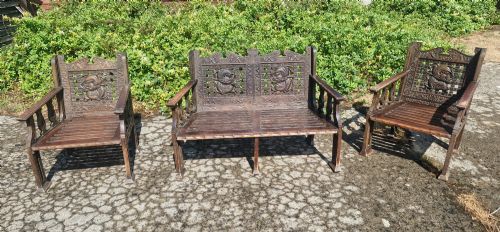
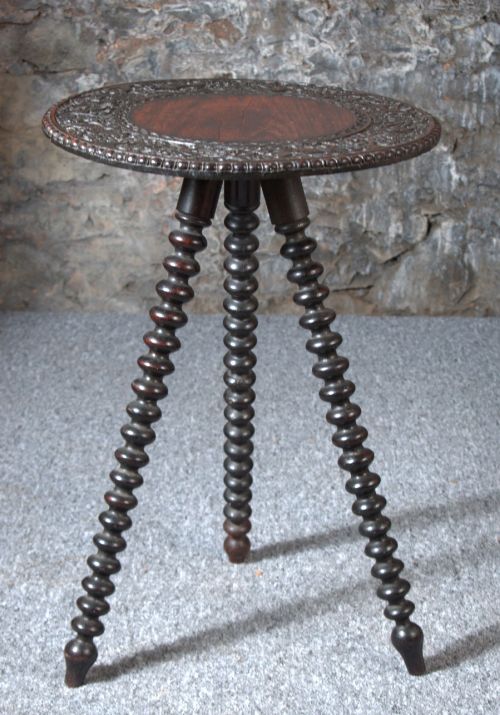
Side tables, occasional tables and console tables form the core of what you encounter, often detailed with intricate relief carving, elephant legs or tiered structures. Larger forms such as seating suites, buffets, whatnots and village tables also appear regularly.
The materials span solid hardwoods like teak, padouk and general wood alongside lacquer, brass and rattan. Dating ranges from the mid-nineteenth century through to the 1930s, capturing both vernacular village items and grander colonial pieces.
How they were made
Makers utilised dense tropical timbers, predominantly teak and padouk wood, which provided the structural stability required for deep, three-dimensional relief carving. These durable hardwoods were often paired with brass fittings and woven rattan elements.
Surface finishes included traditional dark lacquer and painted applications over natural wood grains. Joinery combined traditional vernacular techniques with colonial furniture-making standards, accommodating folding mechanisms and multi-tiered constructions like three-tier buffets and whatnots.
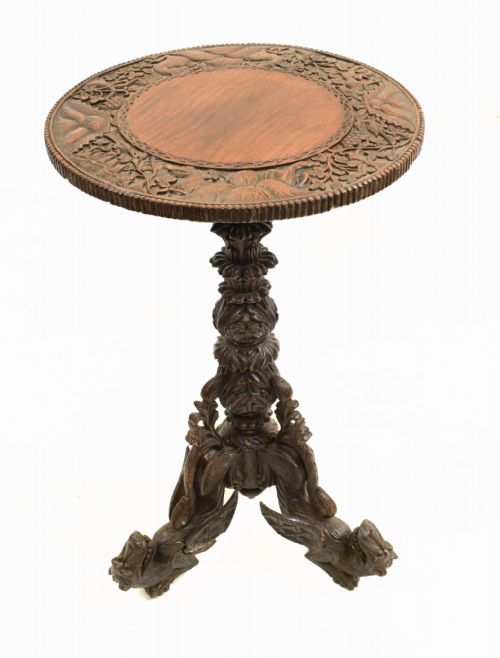
Several side tables stand firmly on carved elephant legs, bringing an unexpected stomp of wildlife into the parlour.
What varies in quality
Quality rests primarily in the crispness and depth of the carving, where sharply defined figures, foliage and zoomorphic elements such as elephant legs distinguish superior execution from softer, more generalised chisel work. The selection and grain of the teak or padouk wood also set higher tier examples apart.
Structural complexity dictates the upper range, seen in multi-tiered buffets, intact folding chair mechanisms and substantial conservatory seating suites rather than simpler occasional tables. Original surface treatments, particularly well-preserved lacquer and patinated hardwood, complete the distinction.
The Vintage Burmese Furniture Glossary
- Padouk
- A heavy, durable tropical hardwood with a rich reddish hue, frequently utilised in fine nineteenth-century Burmese carving. It takes a high polish and resists decay.
- Whatnot
- A piece of open-shelved furniture designed for displaying ornaments or books, often constructed with multiple tiers in these collections. These items utilise vertical supports to create stacked display surfaces.
- Anglo-Burmese
- A design style combining British colonial forms with traditional Burmese craftsmanship and decorative motifs. This aesthetic emerged during the nineteenth century.
- Lacquer
- A durable resin finish applied in multiple layers and cured to a hard coating, often seen on Burmese tables. It provides a smooth, protective surface that deepens in character over time.
Vintage Burmese Furniture: Frequently Asked Questions
What is vintage Burmese furniture?
These pieces comprise carved wooden tables, seating, buffets and whatnots originating from Burma and Anglo-colonial workshops between the mid-nineteenth and early twentieth centuries.
They showcase dense tropical hardwoods like teak and padouk, often ornamented with deep relief carving and traditional vernacular designs.
How was Burmese furniture used?
Pieces fulfilled domestic roles ranging from side tables and console surfaces to large conservatory seating suites and multi-tiered storage buffets.
Foldable chairs and village tables also provided practical, movable utility within colonial homes and country houses.
How do I identify the materials?
Most items are built from heavy tropical timbers such as teak and padouk wood, identifiable by their dense weight and deep grain structure.
Secondary materials include brass accents, woven rattan and dark lacquer finishes applied to tabletops and frames.
How do I date these pieces?
Dating relies on stylistic markers and recorded periods spanning from the mid-nineteenth century through the 1920s and 1930s.
Early examples often feature heavy padouk construction and deep hand-carving, while later pieces include lacquered surfaces and specific conservatory suites.