
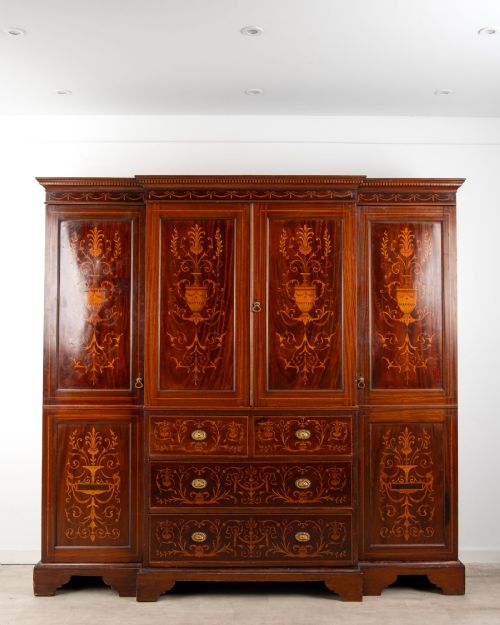
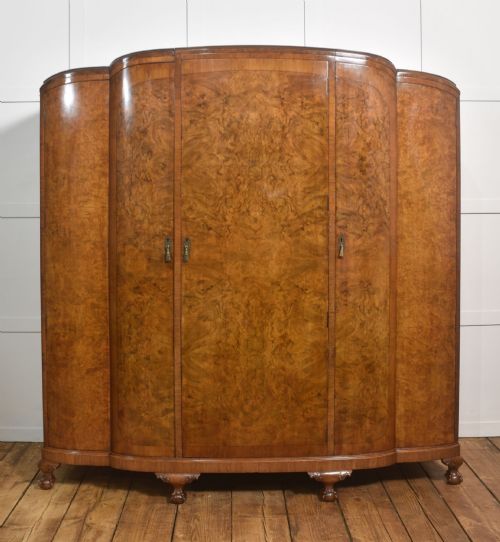


Vintage Breakfront Wardrobe
A vintage breakfront wardrobe offers commanding storage, and here you find pieces spanning Georgian grandeur to Art Deco lines.
Vintage Breakfront Wardrobe
A vintage breakfront wardrobe provides substantial bedroom storage through a tripartite configuration where the central section projects forward from the flanking wings. When searching for a vintage breakfront wardrobe, buyers encounter diverse forms ranging from Edwardian inlaid mahogany models to striking 1930s burr walnut editions.
The selections span multiple eras including Victorian, George IV, and Georgian periods, alongside specialised forms like compactum wardrobes and housekeepers cupboards. Edwardian examples frequently feature delicate inlay and satinwood accents, whilst earlier centuries bring substantial mahogany and oak constructions.
How they were made
Cabinet makers utilised dense timbers such as mahogany, walnut, oak, and satinwood, often applying flame mahogany veneer to create rich grain patterns across large door panels. Carved details and contrasting string inlay define the decorative vocabulary of Edwardian pieces, while structural integrity relies on traditional joinery.
Hardware typically incorporates brass for handles, escutcheons, and hanging fittings, complementing the warm tones of the wood. Painted finishes also appear on select country house pieces, demonstrating variety in regional workshops.
The listings here feature oak, walnut, mahogany, and satinwood across periods spanning from the eighteenth century through the nineteen-thirties.
What varies in quality
The calibre of a piece rests upon the selection of timber veneers and the precision of the cabinet work, particularly around the projecting central breakfront section. Superior examples display harmonious grain matching across multiple doors and refined hand-carved or inlaid ornamentation.
Structural heft and internal configuration also separate standard utility pieces from grander commissions by notable makers. The integration of compactum shelving alongside hanging space indicates thoughtful interior planning tailored for domestic utility.
Lamb of Manchester·Harry and Lou Epstein·Maples and Co
The Vintage Breakfront Wardrobe Glossary
- Breakfront
- A cabinet design where the central section projects forward from the two flanking wings. This architectural arrangement creates depth and visual rhythm across large furniture facades.
- Compactum
- A fitted wardrobe containing a combination of hanging space, internal drawers, and shelving units. This multifaceted interior layout maximises storage efficiency within a single footprint.
- Inlay
- A decorative technique where contrasting woods or materials are set flush into the primary surface of the timber. Edwardian cabinet makers frequently employed this method for linear borders and motifs.
- Veneer
- A thin layer of figured wood applied over a secondary timber base to display decorative grain patterns. Flame mahogany and burr walnut veneers achieve rich visual texture on large doors.
Vintage Breakfront Wardrobe: Frequently Asked Questions
How do I fit a large wardrobe in a modern bedroom?
Measure your ceiling height and floor space carefully before selecting a multi-door breakfront or compactum wardrobe, keeping in mind their substantial depth.
Ensure clearance for internal swing doors and drawers, as these large pieces cannot be easily manoeuvred once assembled in a tight room.
What is the difference between a wardrobe and a compactum?
A standard wardrobe focuses primarily on vertical hanging space for garments, often with a single long door or pair of doors.
A compactum integrates dedicated internal drawers, sliding trays, and smaller shelving compartments alongside hanging space for comprehensive garment organisation.
How do I identify Edwardian wardrobe styles?
Edwardian wardrobes frequently display lighter timbers like satinwood or mahogany enriched with contrasting string inlay and subtle carved detailing. They reflect a transition towards refined neoclassical revival forms popular around nineteen hundred.
Look for balanced proportions, often accompanied by matching dressing furniture when purchased as part of a bedroom pair or suite.
Can these wardrobes be dismantled for transport?
Many large period wardrobes were constructed in modular sections to facilitate delivery into grand country houses and town residences.
Check the specific construction of individual pieces, as breakfront designs often separate into a cornice, central section, wings, and plinth base.