

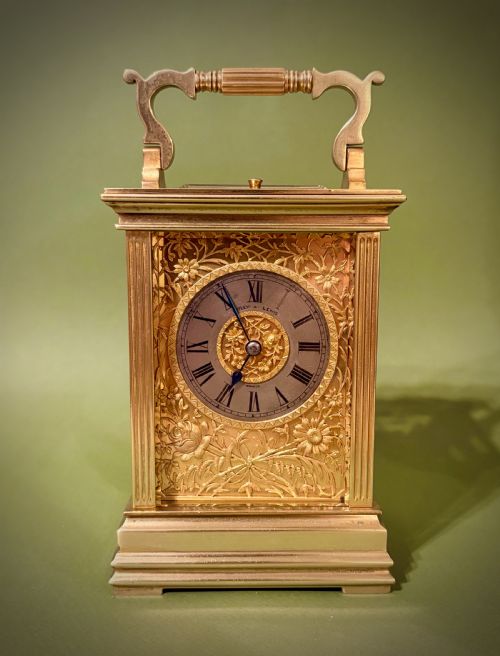
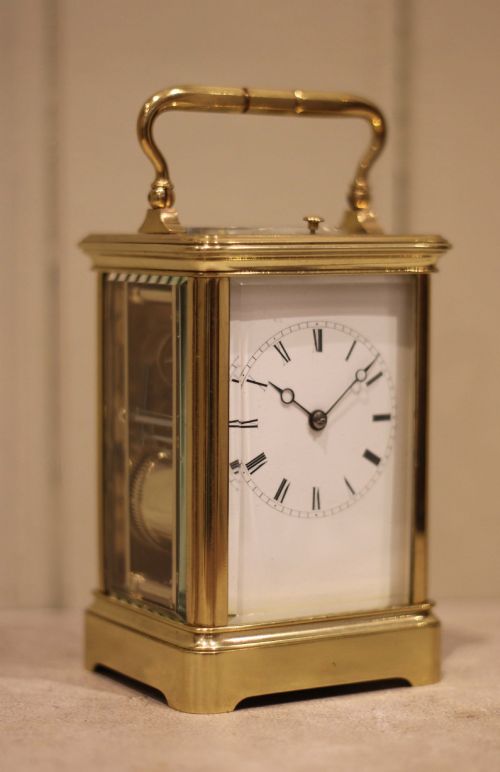


Vintage Brass Repeater Clock
These vintage brass repeater clocks are robust travel timepieces that chime the hour on demand, combining heavy metal cases with visible glass panels.
Vintage Brass Repeater Clock
A vintage brass repeater clock is primarily a French carriage clock designed to travel with its owner while keeping accurate time. These pieces span the nineteenth century and the early twentieth century, encompassing Victorian examples alongside French Second Empire styles.
Most pieces seen here belong to the carriage clock category, often featuring heavy brass frames inset with glass panels to reveal the moving escapement. Enamel dials and side panels appear frequently across the selection, occasionally detailed with hand-painted decoration.
The defining feature of a vintage brass repeater clock is the push button on top which, when pressed, sounds the last hour and quarters on demand. These mechanisms emerge from workshops dating from eighteen fifty through nineteen hundred and ten.
Materials and construction
Construction relies upon heavy brass or gilt brass frameworks housing precision steel gear trains and lever escapements. Glass panels protect the internal mechanics on four sides while allowing the escapement to remain visible from the top or front.
Dial faces are typically formed of white enamel with black Roman numerals, sometimes accompanied by subsidiary alarm dials or painted enamel scenes. Cases are shaped in standard brass frames or distinct gorge case profiles.
Vintage Brass Repeater Clock Retail Price Guide 2026
Typical asking prices for vintage brass repeater clock among the pieces listed under this phrase on Sellingantiques today, from the lower quarter to the upper quarter. They describe what is for sale here now, not the wider market.
One exceptional piece arrives with built-in race horse interest, proving that nineteenth century travellers liked to keep their sporting passions close at hand.
Variations in quality
Quality rests upon the complexity of the movement, distinguishing standard striking clocks from those featuring alarm functions, grande sonnerie striking, or ting tang quarter hours. Maker attribution also elevates certain pieces, particularly those bearing signatures from known Parisian and regional workshops.
The preservation of the original surface finish, whether fully gilded brass or polished metal, contributes significantly to the standing of an individual clock. Complete documentation, original leather travelling cases, and paperwork further set apart the finest examples.
Brunelot·L Epee·J. F. Bautte Et Cie·Bourdin·Drocourt·Henry Jacot·Richard And Co
The Vintage Brass Repeater Clock Glossary
- Repeater
- A clock mechanism that chimes the hours and quarters upon pressing a button or pendant. This complication allowed travellers to check the time in darkness without striking a match.
- Gorge case
- A stepped, architectural brass case style with characteristic fluted or moulded pillars at the corners. This heavy housing protects the delicate movement within.
- Grande sonnerie
- A complex striking train that chimes the hours and the current quarter hour automatically on every quarter. It represents the highest order of carriage clock mechanics.
- Ting tang
- A two-hammer striking system that sounds two different notes on bells or gongs to indicate the half hour. This pleasant chime provides a distinct alternative to standard hour strikes.
- Escapement
- The internal mechanism that controls the release of gear power to regulate timekeeping. In these clocks, the visible platform escapement sits atop the movement.
Vintage Brass Repeater Clock: Frequently Asked Questions
How do I operate the repeater mechanism?
Press the button mounted on the top of the case firmly downwards to trigger the striking train. The clock will sound the last elapsed hour and quarters.
Ensure the button travels its full distance before releasing to let the chime complete its sequence without interruption.
Why does the clock need winding so often?
Carriage clock mainsprings are designed to run for a specific duration, typically eight days per full wind. The additional power required to drive the repeater and alarm trains can also influence the running time.
Use the proper key on the winding arbors at the base or backplate, turning gently until firm resistance indicates a full wind.
How do I tell different periods apart?
Nineteenth century examples often display heavy gilt brass frames and simpler platform escapements with cylinder or early lever designs. Later pieces from the eighteen nineties onwards frequently incorporate more refined compensated balances and varied case silhouettes.
Examining the backplate for maker signatures, serial numbers, and retailer stamps helps narrow down the exact decade of manufacture.
Where should I place a carriage clock at home?
Position the clock on a stable, level surface away from direct sunlight, draughts, and damp environments. A mantelpiece or sturdy desk allows the ticking and chiming to be enjoyed safely.
Avoid placing it near edge surfaces where accidental knocks could send the heavy brass and glass case tumbling.