






Vintage Brass Inkstand
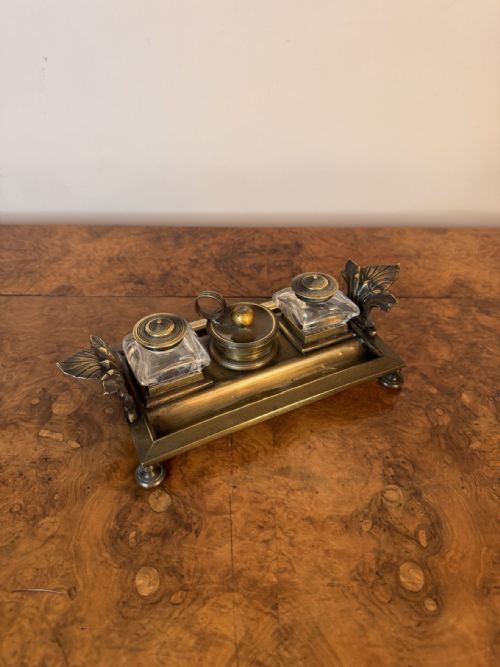
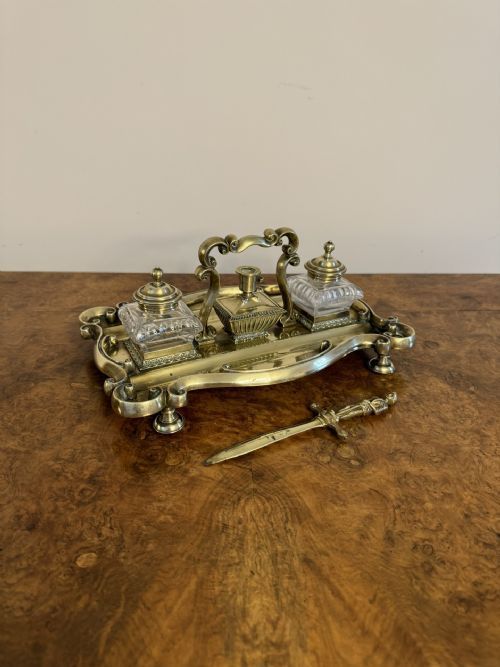
A vintage brass inkstand sits firmly on the desk, holding ink bottles and pens in solid metal frames.

Vintage Brass Inkstand
A vintage brass inkstand gathers writing tools together on a base made of metal, stone, or timber. These items stem from the nineteenth and twentieth centuries, spanning periods from early Victorian work to Art Deco and Art Nouveau designs.
Most pieces on this page combine brass work with glass ink bottles or ceramic wells. Buyers encounter single inkwells alongside elaborate double desk sets fitted with drawers, pen rests, and letter holders.
Forms vary from simple utilitarian trays to figural novelties shaped like animals, busts, or jockey caps. Continental and English workshops produced these stands for domestic writing desks and offices.
Materials and Construction
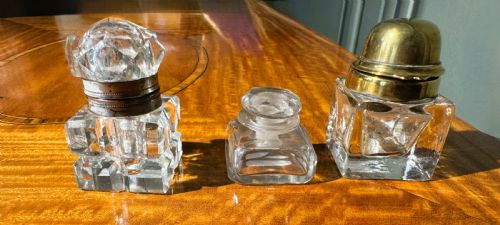
Foundries cast brass, ormolu, and bronze into structured stands, frequently mounting the metal on heavy bases of marble, onyx, oak, walnut, or mahogany. Cut glass and moulded glass form the ink pots, often paired with hinged brass lids.
Many examples incorporate decorative techniques such as champlevé enamel, gilt bronze highlights, or inlaid wood borders. Individual components screw or fit together securely to hold heavy glass ink bottles without movement.
Vintage Brass Inkstand Retail Price Guide 2026
Typical asking prices for vintage brass inkstand among the pieces listed under this phrase on Sellingantiques today, from the lower quarter to the upper quarter. They describe what is for sale here now, not the wider market.
Playful Victorian desks include inkstands modelled as playing kittens or equestrian jockey caps to amuse the writer.
Judging Quality and Execution
The weight of the metal and the crispness of the casting define the standard of a piece. Finer examples display deeply chased detail on mounts, smooth hinges, and heavy cut-glass inserts that match the scale of the stand.
Materials elevate certain pieces, particularly those combining gilt bronze, decorative marble, or signed glass components. Complete sets retaining their original matching ink pots and fitted trays carry greater integrity than assembled groupings.
James Cartland and Sons·Kralik·Loetz
The Vintage Brass Inkstand Glossary
- Inkstand
- A complete desk accessory comprising a tray or stand fitted with one or more inkwells and space for pens. These pieces formed the centrepiece of a nineteenth century writing table.
- Ormolu
- Gilded bronze mounted on decorative objects, popular in French and English manufacturing. This finish gives a bright gold appearance to brass or bronze surfaces.
- Champlevé
- An enamelling technique where troughs or cells are hollowed out of a metal surface and filled with vitreous enamel. The resulting design is then fired and polished flush with the metal.
- Desk Tidy
- A practical desk accessory that groups inkwells together with compartments for stamps, nibs, and letters. They organise loose writing equipment in a single wooden or metal frame.
- Grand Tour
- A cultural journey undertaken by nineteenth century travellers who collected souvenirs such as small bronzes and marble desk ornaments. These items reflect classical or continental styles.
Vintage Brass Inkstand: Frequently Asked Questions
How do I date a brass inkstand?
Dates rely on the stylistic markers of the metalwork and the surrounding materials. Victorian pieces often feature heavy cast brass or walnut bases, while Art Nouveau examples show flowing organic lines from around nineteen hundred.
Changes in glass manufacture and screw threads on ink bottle collars also help narrow down the decade of production. Examining the construction methods underneath the base provides further clues to the manufacturing period.
Are original ink bottles usually included?
Many surviving desk stands retain their original glass ink pots with matching brass collars or hinged lids. Finding a set with the correct matching bottles is common among late nineteenth and early twentieth century examples.
Replacements do occur when original glass bottles broke through heavy use. Checking whether the base accommodates the specific shape of the ink inserts helps determine originality.
Where were these inkstands used?
These desk stands sat upon writing tables, bureau bookcases, and library desks in homes and offices. They provided a stationary station for daily correspondence before the invention of the ballpoint pen.
Larger double inkstands belonged in formal studies, while smaller single wells served bedroom writing desks. Novelty designs often doubled as decorative ornaments when not in active use.
What is the difference between an inkstand and an inkwell?
An inkwell is simply the individual glass or ceramic vessel that holds the ink liquid. It may sit alone or drop into a fitted hole within a larger structure.
An inkstand is the entire assembly that incorporates the inkwells alongside pen trays, stamp boxes, and blotter holders. Stands offer a complete desktop solution rather than a single container.